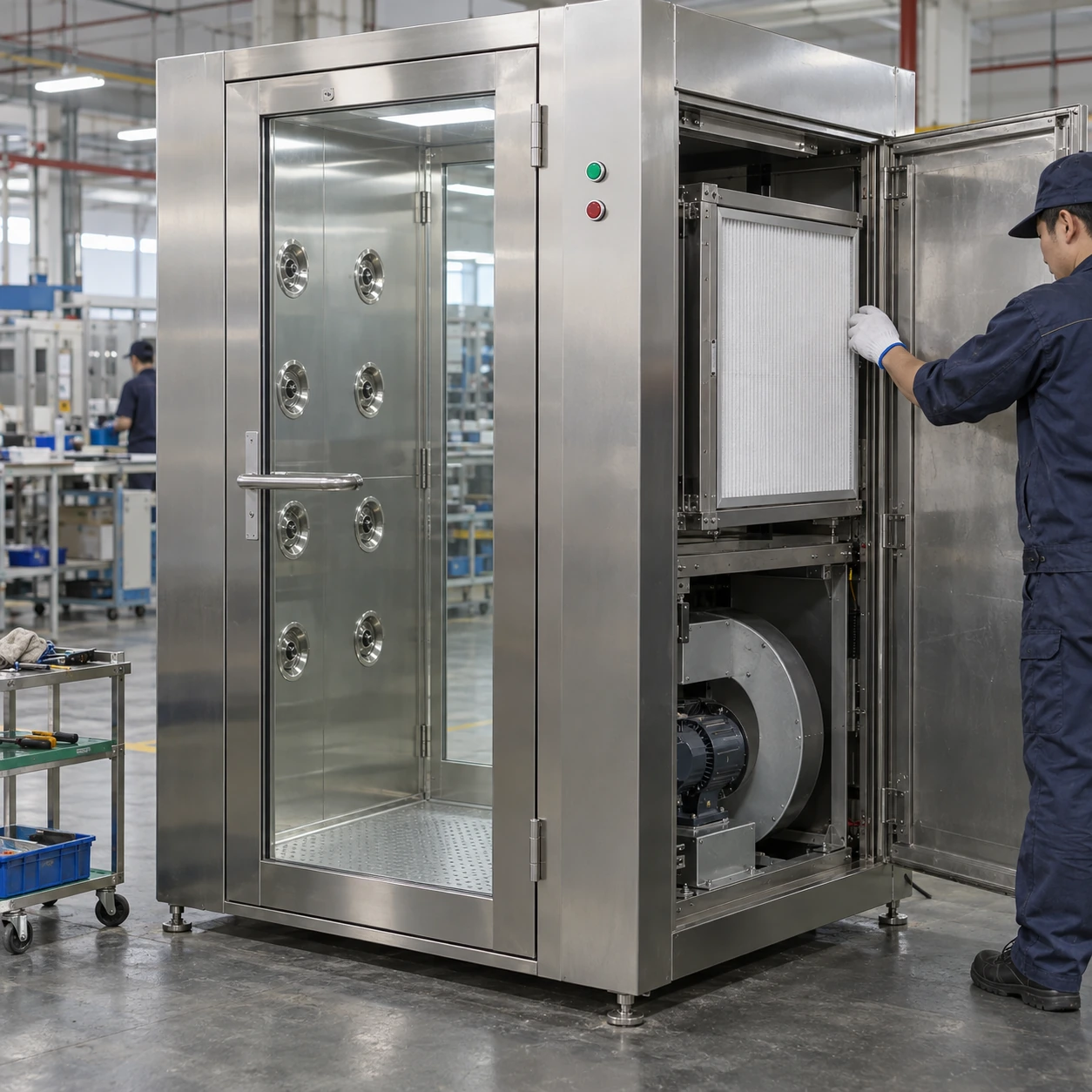
hepa air shower
Product specifications
| Spec | Configuration |
|---|---|
| Equipment construction | Filtered air shower with a gasketed final-filter housing, blower and recirculating jet supply. |
| External planning sizes | Compact cabinet: 1400 × 1000 × 2100 mm Longer cabinet arrangement: 1400 × 2000 × 2100 mm Wider layout example: 2300 × 2000 × 2200 mm External W × D × H references; final dimensions follow the approved configuration drawing. |
| Clear chamber and service space | Internal clear width and door opening dimensioned separately from the filter cabinet and its withdrawal clearance. |
| Final filter options | Documented HEPA grade, including an assessed H13 or H14 specification; ULPA is a separately selected option with compatible fan duty. |
| Filter housing | Matched frame, gasket and clamping arrangement to control air bypass around the media. |
| Prefiltration | Accessible replaceable prefilter sized for the selected return and coarse-particle load. |
| Fan selection | Blower duty matched to installed filter resistance and the intended nozzle arrangement. |
| Maintenance indication | Differential-pressure indication option with an initial operating record and defined maintenance criterion. |
| Access and control | Side or rear filter withdrawal, tool-controlled service panels and adjustable closed-door shower cycle. |
Filter class, housing access and chamber size can suit your installation space, particle load and maintenance procedure.
The filter cleans the jet supply; its installation determines whether the air actually passes through the media.
Specify a filter, a housing and an operating airflow.
HEPA describes a particle-filtration capability, not the percentage of dust removed from a person's clothing. The US EPA explains the familiar HEPA reference as at least 99.97% removal at 0.3 µm for air passing through the filter. That reference does not establish the performance of an assembled air shower or the cleanliness class of the room it serves.
Protect the final filter without starving the jets.
Return and prefilter
Return openings collect disturbed dust. An accessible prefilter captures part of the coarse load, reducing unnecessary loading of the final filter. Keep replacement dimensions and access direction in the service schedule.
Final particle filter
A documented HEPA grade is the starting option. H13 or H14 may be specified under the applicable filter classification and test documentation; do not treat the grade name as a complete equipment acceptance test. ULPA is a separate option requiring a compatible fan and filter arrangement.
Fan and nozzles
The fan has to deliver the intended jet flow against the installed filter resistance. Selecting a more restrictive filter without reviewing the fan can reduce the air reaching the garment.
Reserve space for replacement, not just for operation.
Compact external planning envelope: decide which side gives access to the final filter without dismantling the wall connection.
Longer external planning envelope: filter and blower modules may need separate identification and service positions.
Wider external planning envelope: preserve the internal clear width while locating the filter cabinets.
These W × D × H examples are layout options. The selected drawing must show internal clear space, filter size, withdrawal direction and door opening separately. Include differential-pressure indication as a maintenance option, together with an initial record and the equipment's replacement criterion. A calendar interval alone cannot account for changing dust load.
Use a replaceable prefilter where that suits the selected design, and keep access panels tool-controlled during normal use. Filter media must be handled by its frame; damaged media or an incorrectly seated seal needs correction before operation resumes.
Filtration, cabinet access and chamber dimensions can be customized for the installation space, particle load and application.