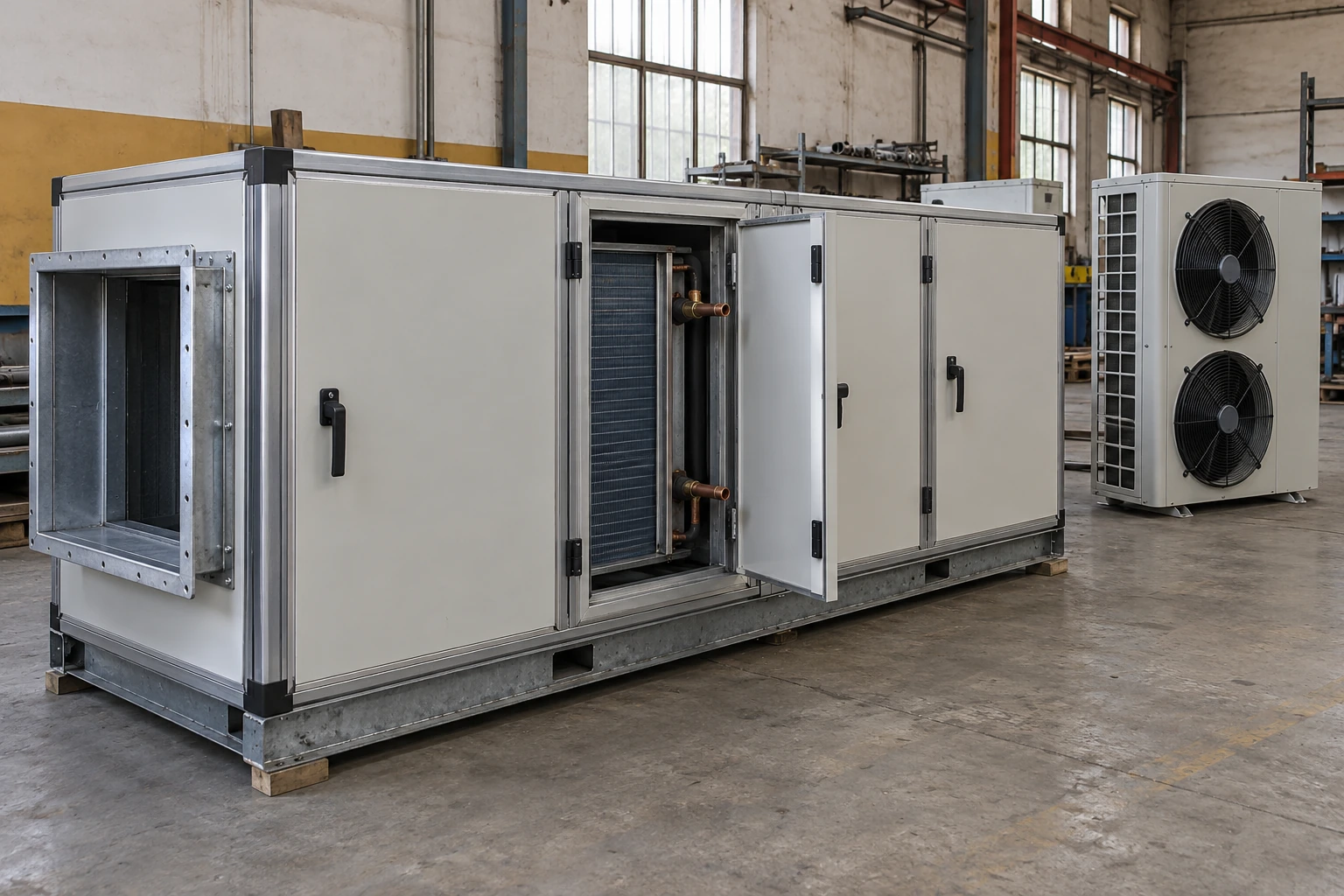
Direct-expansion air treatment
DX Air Handling Units
| System arrangement | DX-coil air handler with a separate matched outdoor unit |
|---|---|
| 3,000 m³/h cabinet (mm) | 3,400 × 1,000 × 1,600 |
| 5,000 m³/h cabinet (mm) | 3,400 × 1,400 × 1,600 |
| 7,500 m³/h cabinet (mm) | 3,400 × 1,500 × 2,200 |
| Air-side options | Variable-speed fans; staged filtration; accessible service sections |
| Heating and moisture options | Matched heat-pump system; reheat or humidification where required |
| Control options | Supply- or return-air temperature; BMS interface matched to the system |
Cabinet dimensions are L × D × H and apply to supply/extract configurations with heat recovery. Outdoor equipment, duct connections and service clearances are additional; single-flow layouts have different envelopes.
The airflow, coil arrangement, filtration, controls and cabinet layout can be customized to suit your application and site conditions.
DX air handling units use a refrigerant coil to cool the air passing through the cabinet. A matched outdoor unit provides the refrigeration duty, while the air handler filters and moves the air through the duct system. This arrangement can serve commercial premises, laboratories and production areas without a chilled-water distribution loop for the cooling coil.
One coordinated system
Connect the air path and the refrigerant circuit.
The AHU cabinet is one part of the installation. Its coil, outdoor equipment and control interface must be selected to work together.
Through the air handler
- Outdoor air, return air or a defined mixture enters the unit.
- Filters remove the particle sizes covered by the selected filtration stages.
- The DX coil absorbs heat; moisture condenses when the coil surface is below the air's dew point.
- The fan delivers the required air volume against the resistance of the unit and connected system.
The actual section order and any heat recovery, heating or humidity-control stages depend on the arrangement.
Through the cooling circuit
Refrigerant evaporates in the cooling coil and carries absorbed heat to the refrigeration system. The outdoor compressor and condenser, expansion device, refrigerant piping and controls complete the circuit.
A heat-pump arrangement can also provide heating when the selected equipment supports it. The DX coil cannot be treated as a universal connection for any outdoor unit with a similar nominal capacity.
Match the components at the operating duty.
| Selection point | Why it changes the result |
|---|---|
| Air entering the coil | Temperature, moisture content and outdoor-air proportion determine the sensible and latent load. Return-air and all-fresh-air duties are not interchangeable. |
| Coil and outdoor unit | Coil capacity, internal volume, circuiting and expansion-device selection must fall within the chosen refrigeration system's permitted combinations. |
| Refrigerant route | Pipe length, elevation and routing affect the installation. Apply the selected equipment's limits and sizing method; a nominal pipe connection does not define the whole route. |
| Control interface | Agree the sensors, capacity demand, fan operation and fault signals. A return-air temperature controller serves a different purpose from a fresh-air supply-temperature controller. |
Compare selections at the same entering-air, outdoor-air and airflow conditions. A larger headline cooling capacity is not proof of better control at a light load. For a project already served by a water loop, an air-cooled chiller with a water-coil AHU is a different system architecture to assess alongside DX.
Temperature and humidity
A cool room can still be too humid.
Cooling to a temperature setpoint does not necessarily remove enough water. During mild but humid weather, the sensible load may fall while moisture from ventilation or the process remains. A simple compressor cycling strategy can then reduce the time the coil stays cold enough to dehumidify.
Where humidity matters, select the leaving-air moisture condition as well as the temperature. Capacity modulation, appropriate airflow control and a defined humidity sequence can help address the duty. Reheat may be needed to raise the temperature after moisture has been removed; reheat itself does not remove that moisture.
Include light-load and unoccupied operation in the control brief. Agree how a heat-pump configuration behaves during defrost if continuous air delivery or tight supply conditions are important.
Plan for water, filters and maintenance before fixing the footprint.
Drain the coil section correctly.
Condensate needs a drain pan, a clear outlet and a trap arrangement suited to the pressure at the drain connection. A shallow or incorrectly arranged trap can prevent reliable drainage or allow air leakage. Include enough vertical space beneath the unit for the specified drain arrangement, together with access for cleaning.
Keep the air path within its duty.
Filter loading and duct resistance change the pressure the fan must overcome. Select the fan for the required airflow and agreed resistance conditions, including the filtration arrangement. Adding a finer filter later can affect airflow and coil operation; choose the air-filter stages as part of the original selection.
Leave a usable service side.
Opening a door is not the same as removing a filter or withdrawing a coil. Show these movements on the equipment layout, together with panel removal, pipe access and drain cleaning. Locate the outdoor unit so its airflow and service clearance remain available after surrounding equipment is installed.
Filtration and a DX coil do not by themselves establish a cleanroom classification or a guaranteed humidity tolerance. Those outcomes depend on the selected system, room arrangement, loads and operating conditions.
Define what the quotation includes.
List the AHU sections, outdoor equipment, expansion devices, control panel, sensors and any BMS interface. Assign responsibility for refrigerant piping, wiring, drains, duct connections and commissioning. This avoids a cabinet being ordered while essential connection components remain outside the supply scope.
Send the required airflow, available space, outdoor-air proportion, entering and leaving conditions, external pressure, local electrical supply and proposed pipe route. Include the filtration target and whether humidity must be controlled independently of room temperature.
shengtongjh can coordinate a configuration around this information. The resulting selection should identify the matched equipment, installation interfaces and operating checks needed for the actual facility.
The airflow, coil arrangement, filtration, controls and cabinet layout can be customized to suit your application and site conditions.