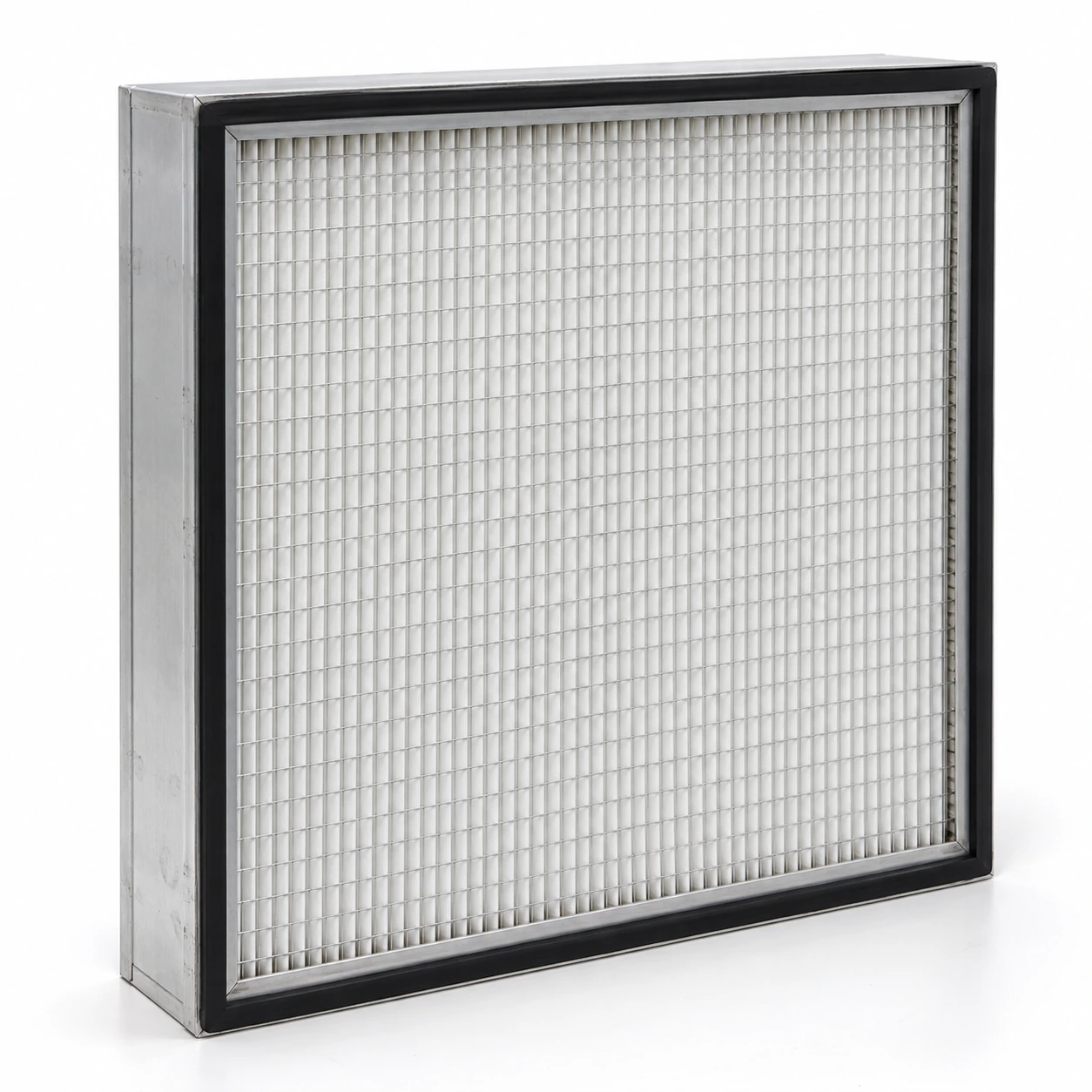
Air Filters
ulpa filter
| Brand | shengtongJH |
|---|---|
| Product form | Mini-pleat final filter panel |
| Class selection | U15 to EN 1822; exact supplied assembly requires matching test documentation |
| U15 integral efficiency criterion | At least 99.9995% at the most penetrating particle size (MPPS) |
| Panel W × H options | 305 × 610 / 610 × 610 / 1220 × 610 mm |
| Frame depth options | 66 or 90 mm; selected construction and housing must match |
| Frame material | Aluminium extrusion; stainless steel by application |
| Media choices | Microglass or suitable membrane construction selected for the process |
| Seal interface | Continuous gasket; gel-seal version requires a matching housing |
| Face protection | Protective grid where compatible with the installation |
| Airflow and resistance | Duty-specific airflow/pressure-drop curve from the offered filter |
| Supply documents | Traceable filter identity and corresponding efficiency/leak test results |
The U15 figure is a filter classification criterion, not a room cleanliness or complete-machine efficiency guarantee. Dimensions and performance must be confirmed for the selected assembly.
Panel dimensions, frame, seal arrangement and media construction can be customized to the equipment interface and process requirements.
An ULPA filter captures fine airborne particles at a very low penetration level. It is used where sensitive manufacturing or controlled work demands more than general ventilation filtration, but the panel only performs as intended when its seal, housing and airflow are matched.
Choose the filtration duty before choosing the grade
Fine particles can damage optical surfaces, interfere with precision assembly or contaminate exposed materials. ULPA filtration can be appropriate where the process requires very low particle penetration. It should be selected against that need, rather than assumed to be a universal upgrade for every ventilation system.
A higher-efficiency panel may impose a different resistance on the fan. If the fan cannot maintain the required air volume, fitting the new filter can reduce the useful clean-air flow. Compare the offered filter's pressure curve at the actual duty, including the allowance for loading during service.
Understand what MPPS means
The most penetrating particle size is the size at which the tested filter medium is least efficient under the test conditions. It is not a fixed pore opening or a claim that smaller particles all pass through. The EN 1822 classification explanation distinguishes overall efficiency from local leakage evaluation. Both matter when specifying a high-efficiency assembly.
Stop air bypassing the panel
A damaged gasket, distorted frame or poorly seated clamp can let air avoid the media. Confirm the sealing face and housing contact before ordering a replacement. A gel-seal housing and a gasket housing use different interfaces; matching width and height does not make those interfaces interchangeable.
Protect the filter through delivery and replacement
Support the frame during handling and keep fingers, tools and packaging away from the pleated face. Store the panel in its protective packaging until installation. Treat creased media, damaged potting or a distorted sealing edge as a condition requiring assessment rather than concealing it behind a retaining clamp.
Use upstream filtration to intercept larger particles and establish a replacement plan from resistance, condition and process requirements. Do not wash a disposable ULPA panel unless its manufacturer explicitly permits that method. Record the filter identity and any required installed integrity checks after replacement.
Where it fits in the air system
A filter panel does not create airflow, control humidity or remove every gaseous contaminant. For a complete recirculating unit, see the industrial ULPA air purifier. For panel replacement, provide the housing drawing, airflow and required documentation so shengtongJH can source the correct construction.
Panel dimensions, frame, seal arrangement and media construction can be customized to the equipment interface and process requirements.