Air Filters
ring panel air filters
| Construction | Layered polyester media around an internal rectangular wire frame |
|---|---|
| Nominal face series (in) | 16 × 20; 16 × 25; 20 × 20 |
| Nominal metric equivalents (mm) | 406.4 × 508; 406.4 × 635; 508 × 508 |
| Thickness series | Nominal 1 in or 2 in; assembled depth depends on layers |
| Media arrangement | Two-ply or three-ply; graded fibers and optional tackifier |
| Support / edge | Galvanized wire; extended soft media perimeter |
| Installation format | Individual panels or connected links |
| Rating / airflow | Selected media grade with pressure data at the required flow |
The dimensions above name nominal size series. Actual wire dimensions, finished soft-edge dimensions and installed thickness are separate order measurements.
Ring panel size, media layers, edge allowance and link arrangement can be customized for the filter rack and service access.
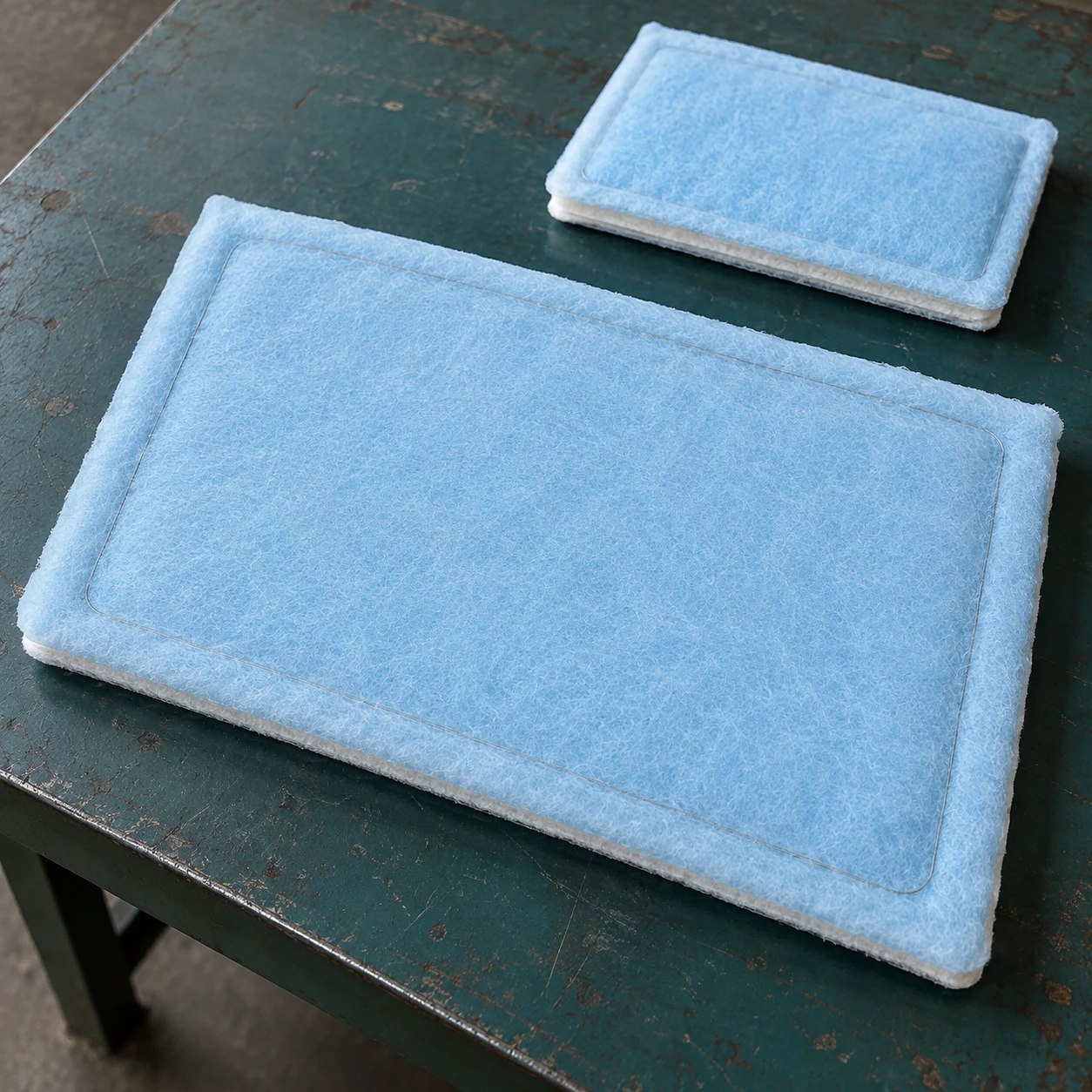
A ring panel air filter contains a rectangular wire support inside a layered synthetic pad. The soft media extends beyond that support and presses against a suitable holder, combining dust capture with an edge that can conform to the installation.
Understand the three outlines before ordering
- The nominal size
- This is the size series used to identify the replacement. It is useful for ordering history, but it does not describe every physical edge of a flexible panel.
- The internal wire frame
- The wire establishes the supported shape. Its dimensions must allow the panel to enter and sit correctly in the retaining channel without buckling or folding the media into the air path.
- The finished media perimeter
- The soft material projects beyond the wire to contact the surrounding frame. Trimming it to the wire removes that sealing allowance. Excess material can also fold over or obstruct a channel, so the correct allowance belongs in the finished-panel specification.
Layer direction matters as much as layer count
A typical arrangement places a more open layer toward incoming air and a denser layer downstream. This gives dust a path into the media instead of forcing all loading onto one thin surface. A tackified layer, where selected, helps retain captured particles within the pad.
Follow the airflow direction supplied for the finished filter. Layer color is a convenient visual distinction within a particular product family, not a universal direction or efficiency code. Two filters with the same color and number of plies can have different fibers, bonding and resistance.
When replacing an unfamiliar panel, record the original orientation before removal and compare it with the replacement documentation. A compressed or incorrectly inserted pad can present less usable area even though it appears to fill the slot.
Single panels for direct access
Separate panels suit holders that can be reached from the face. Each opening can be serviced individually, and damaged pads can be isolated. Check that the retainer grips the supported region while the soft edge remains in contact with the surrounding surface.
Do not rely on the pad to bridge a broken frame or a large gap. Repairing the holder is part of restoring filtration; adding extra loose media at the edge makes repeatable replacement difficult.
Linked panels for side-entry tracks
Connected panels can be fed into a side-access housing as a continuous set. The links help maintain coverage between adjacent sections and simplify removal where the far end cannot be reached directly.
Specify the number of panels, their sequence and the access direction. A longer chain is not automatically easier to service: the operator still needs enough withdrawal space and a clear path that will not tear the connecting media.
Where does this construction fit?
Ring panels are used for suitable ventilation and air make-up duties where a flexible supported pad fits the existing rack. A panel chosen for intake dust capture is not automatically suitable for paint overspray collection or another specialized exhaust duty. Identify which side of the process the filter serves and the contaminant it will receive.
For a rigid pleated frame, compare panel air filters. Changing from one form to the other requires a holder and seal check, not just matching the nominal face dimension.
A practical replacement record
Keep one entry for each rack with its nominal panel size, measured wire size, soft-edge allowance, airflow orientation and individual or linked format. Add the media grade and the acceptable pressure limit for that installation. This avoids repeating the same uncertainty at every service visit.
Inspect for torn bonds, exposed or bent wire, uneven compression and bypass marks around the perimeter. Replace damaged or loaded panels using the specified service method; washing or re-tackifying an ordinary disposable pad changes its construction and should not be assumed acceptable.
Ring panel size, media layers, edge allowance and link arrangement can be customized for the filter rack and service access.