Air Filters
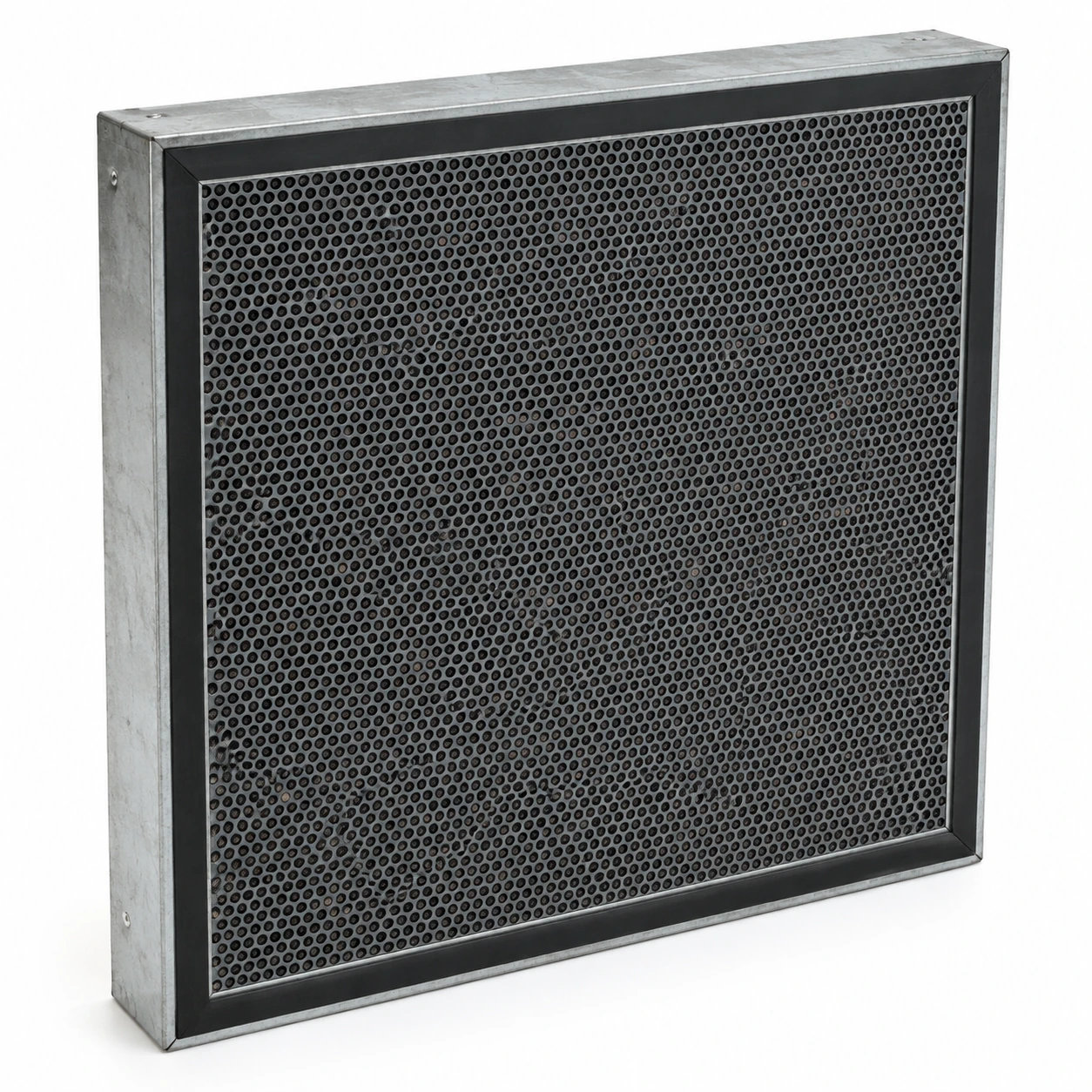
activated carbon air filter
| Brand | shengtongJH |
|---|---|
| Product form | Framed carbon panel or cassette |
| Panel W × H options | 300 × 300 / 500 × 500 / 600 × 600 mm |
| Depth options | 25 / 50 mm; deeper construction by duty |
| Frame material | Galvanized steel; stainless steel option |
| Media options | Granular or pelletized activated carbon selected for target contaminants |
| Retaining faces | Metal mesh with suitable fine-particle retaining layer |
| Seal | Continuous gasket matched to the holding frame |
| Airflow selection | Matched to bed area, contact conditions and available fan pressure |
| Upstream stage | Particle prefilter selected for incoming dust conditions |
| Service arrangement | Replaceable cassette; refillable version when specifically constructed for refill |
Dimensions are selectable construction options. Removal efficiency and service life depend on the offered media, gas challenge, airflow, temperature and humidity.
Panel dimensions, frame material, carbon grade and sealing details can be customized to the ventilation system and target contaminants.
An activated carbon air filter treats selected gases and vapours as air passes through adsorbent media. A framed panel is a practical option for ventilation systems with a defined molecular-filtration duty; it does not replace the separate particle-filter stage.
Match the carbon to what is in the air
Activated carbon provides an internal pore structure on which suitable gas molecules can be adsorbed. The effectiveness depends on the contaminant and the selected media, rather than simply whether the panel looks black. Some duties need a specifically treated adsorbent or a different treatment process.
Describe the source of the problem and, where available, the compounds and concentrations involved. An odour description can help identify the situation, but it cannot establish a complete treatment specification. Changing process materials may also change what reaches the filter even when the ventilation route stays the same.
Keep the air in contact with the media
The amount and arrangement of carbon matter. A thin bonded sheet, loose-filled panel and deeper bed provide different contact conditions and capacities. Increasing airflow through the same panel can change both removal performance and resistance. Select the construction at the actual duty instead of judging it only by outside dimensions.
Seal the perimeter
Air that passes around a cassette does not receive the intended treatment. Check the holding frame, gasket contact and retaining mechanism. A new carbon charge cannot compensate for a gap at the edge or an installation that allows most air to take an easier path.
Plan replacement around performance
Pressure drop can reveal a restriction, but it does not directly measure the remaining adsorption capacity. Carbon may become exhausted without a large resistance increase. Choose a service plan using the contaminant duty, operating history and suitable performance monitoring or media assessment where appropriate.
Do not rely on smell as a safety measurement. Some hazardous contaminants have little useful odour warning, and a general carbon panel is not proof of safe air. Any personnel-protection or hazardous-process application requires a properly specified complete control system.
Order the intended assembly
Include the housing opening, filter depth, gas duty and available airflow when contacting shengtongJH. For a housing designed for on-site media changes, the refillable version explains the servicing differences. The supply scope should identify both the adsorbent and the physical cassette, so later replacements preserve the original selection.
Panel dimensions, frame material, carbon grade and sealing details can be customized to the ventilation system and target contaminants.