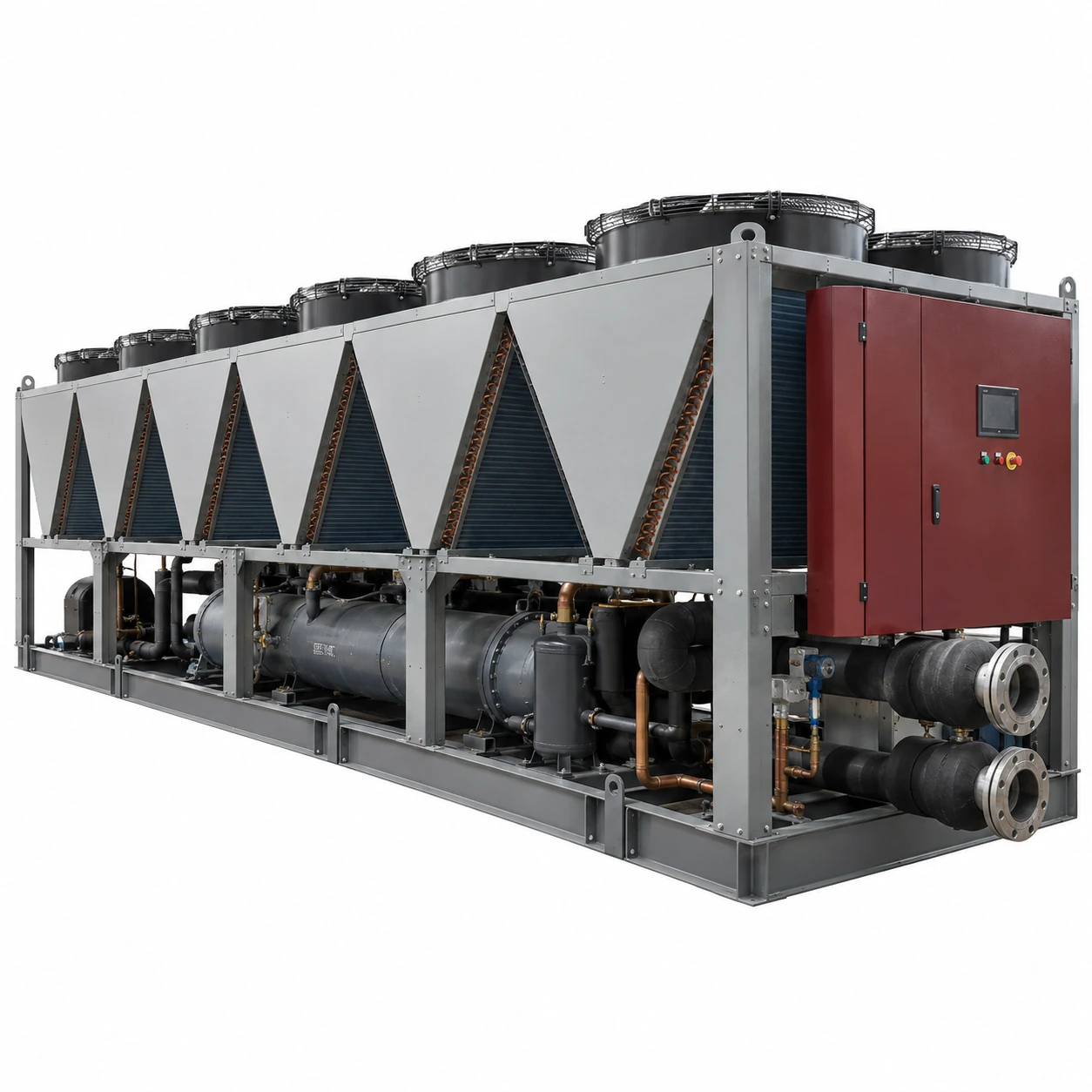
Air-Cooled Chillers
125 ton air cooled chiller
| Brand | shengtongJH |
|---|---|
| Nominal capacity | 125 US RT = 439.61 kW thermal |
| Refrigeration configurations | Screw compressor or coordinated multi-compressor package |
| Calculated water flow at 5 K rise | 75.61 m³/h |
| Operating basis | Selected leaving/entering water temperatures and maximum condenser intake-air temperature |
| Envelope options, L × W × H (mm) | Approximately 5,500–9,000 × 2,000–2,500 × 2,100–2,700 |
| Water circuit | External pump, buffer and expansion equipment selected for the installation |
| Electrical supply | Three-phase industrial supply; maximum current and input stated with equipment selection |
| Capacity management | Staged or variable control according to selected package |
| Plant connection | Remote enable, alarm, water-temperature monitoring and communication options |
Nominal RT converts to thermal kW; it does not establish summer output. Final selection must include the actual fluid and operating conditions.
Capacity control, hydraulic connections and expansion provisions can be customized around your measured load and future production plan.
A 125 ton air cooled chiller can bridge the gap between a smaller plant and a larger expansion. It should be selected from the required operating duty, with deliberate allowance for future load rather than an unexplained safety margin.
Make every capacity allowance explainable
Separate the current measured load, confirmed new equipment and any further expansion allowance. Combining several unexplained margins can lead to a much larger chiller than the process normally needs. That affects minimum-load control, footprint and initial cost.
Equally, a unit that meets the nominal duty at favourable conditions may not meet it on the hottest operating day. Ask for the actual selected output at the required water temperature, fluid mixture and condenser inlet air temperature. Do not apply a universal derating percentage to every machine.
Match the temperature difference to the process
A wider supply/return difference reduces the flow needed for the same heat transfer, but only if the process and evaporator can operate that way. Changing the design temperature difference solely to reuse a smaller pipe can compromise cooling at the load.
Keep expansion physically possible
Reserve a practical pipe route, electrical provision and service access for future equipment. If a second chiller is planned, its airflow should not conflict with the first. A spare patch of concrete is not sufficient on its own.
Compare real selections, not model numbers
Manufacturers may use nominal tonnage or a model code that does not exactly equal delivered US refrigeration tons. Compare thermal kW at common conditions, along with input power, minimum capacity and water pressure drop. This makes alternatives technically comparable.
Use commissioning to establish the new baseline
Confirm sensor locations, water flow and branch balance, then record operation at representative production loads. If future equipment is added, compare its effect with that baseline. This is more reliable than assuming that any rise in return temperature means the original chiller was undersized.
Where the confirmed load is likely to grow significantly, compare a staged 150 ton expansion arrangement with the current duty rather than selecting extra capacity without a plan.
Capacity control, hydraulic connections and expansion provisions can be customized around your measured load and future production plan.