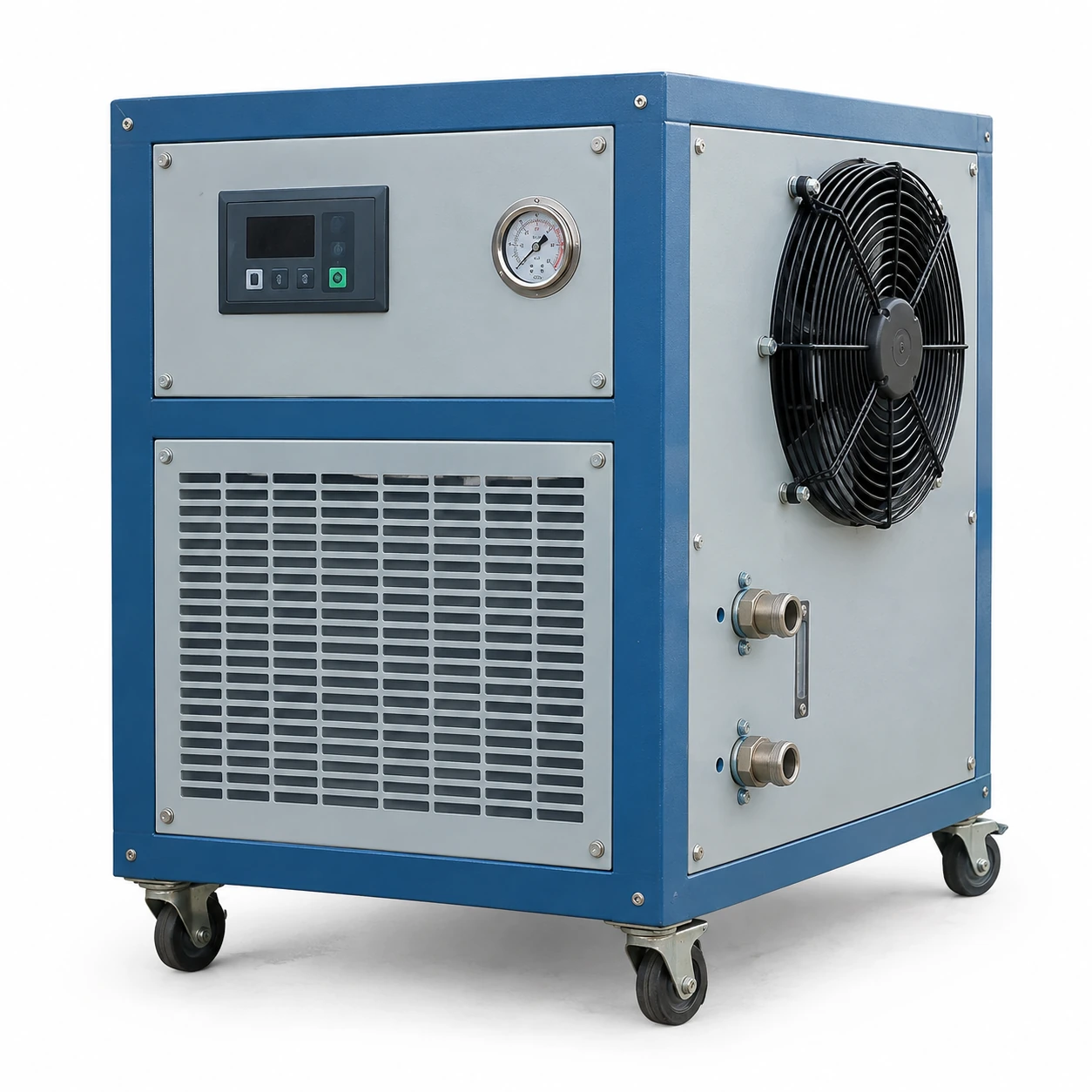
Air-Cooled Chillers
1 ton air cooled chiller
| Brand | shengtongJH |
|---|---|
| Nominal duty | 1 US RT = 3.52 kW thermal |
| Package | Compact compressor, air-cooled condenser, reservoir and circulation pump |
| Calculated water flow at 5 K rise | 0.60 m³/h |
| Temperature selection | Process-specific positive-temperature duty; precision or low-temperature applications selected separately |
| Envelope options, L × W × H (mm) | Approximately 500–750 × 450–650 × 700–950 |
| Electrical options | 220–240 V single-phase configurations; exact frequency and current by selected unit |
| Fluid compatibility | Treated water or approved coolant, matched to tool and chiller materials |
| Connections | Hose or threaded process connections selected for flow and pressure |
| Controls | Temperature display, fluid-level/flow supervision and equipment alarm options |
Cooling output depends on fluid and ambient conditions. Calculated flow is a thermal requirement, not the rating of every compact pump.
Pump pressure, coolant compatibility, connections and controls can be customized for your industrial tool or test application.
A 1 ton air cooled chiller is a small industrial recirculating cooling unit. It supplies a controlled liquid circuit for compatible tools, test equipment and production auxiliaries; it is not a room air conditioner or household appliance.
Start with the tool's cooling requirement
A small production tool can need a specific water temperature, minimum flow and maximum pressure. All three must match. A unit with enough nominal cooling can still be unsuitable if its pump cannot move water through the tool or if its pressure exceeds the tool's limit.
Obtain the equipment manufacturer's cooling specification where available. Include whether the load is continuous or intermittent and whether the water circuit requires special material compatibility. A temperature display alone does not establish suitability for a precision application.
Do not overcool exposed parts
Water below the surrounding air's dew point can cause condensation on hoses, fittings or cooled surfaces. That can be undesirable near electronics or precision work. Choose the process temperature deliberately and insulate cold surfaces where necessary rather than always selecting the lowest available setting.
Small reservoirs respond quickly
A low-volume loop can change temperature rapidly when a tool switches on or off. Suitable compressor control and active water volume help keep operation stable. Oversizing the refrigeration unit can make minimum-load behaviour more difficult instead of improving it.
Leave room for the warm air
A compact cabinet is easy to push under a bench, but its condenser still needs unobstructed intake and discharge. Check the selected unit's clearance and cleaning access. A confined space that heats up during the shift reduces the available cooling.
Keep daily checks straightforward
Make fluid level, hose condition and alarm status easy to inspect. Use the specified coolant and keep the reservoir clean. A decline in cooling should prompt checks of circulation, fluid level and condenser condition before changing the setpoint.
For a tool with a larger sustained load, compare the 2 ton configuration using the same operating temperatures rather than comparing model names alone.
Pump pressure, coolant compatibility, connections and controls can be customized for your industrial tool or test application.