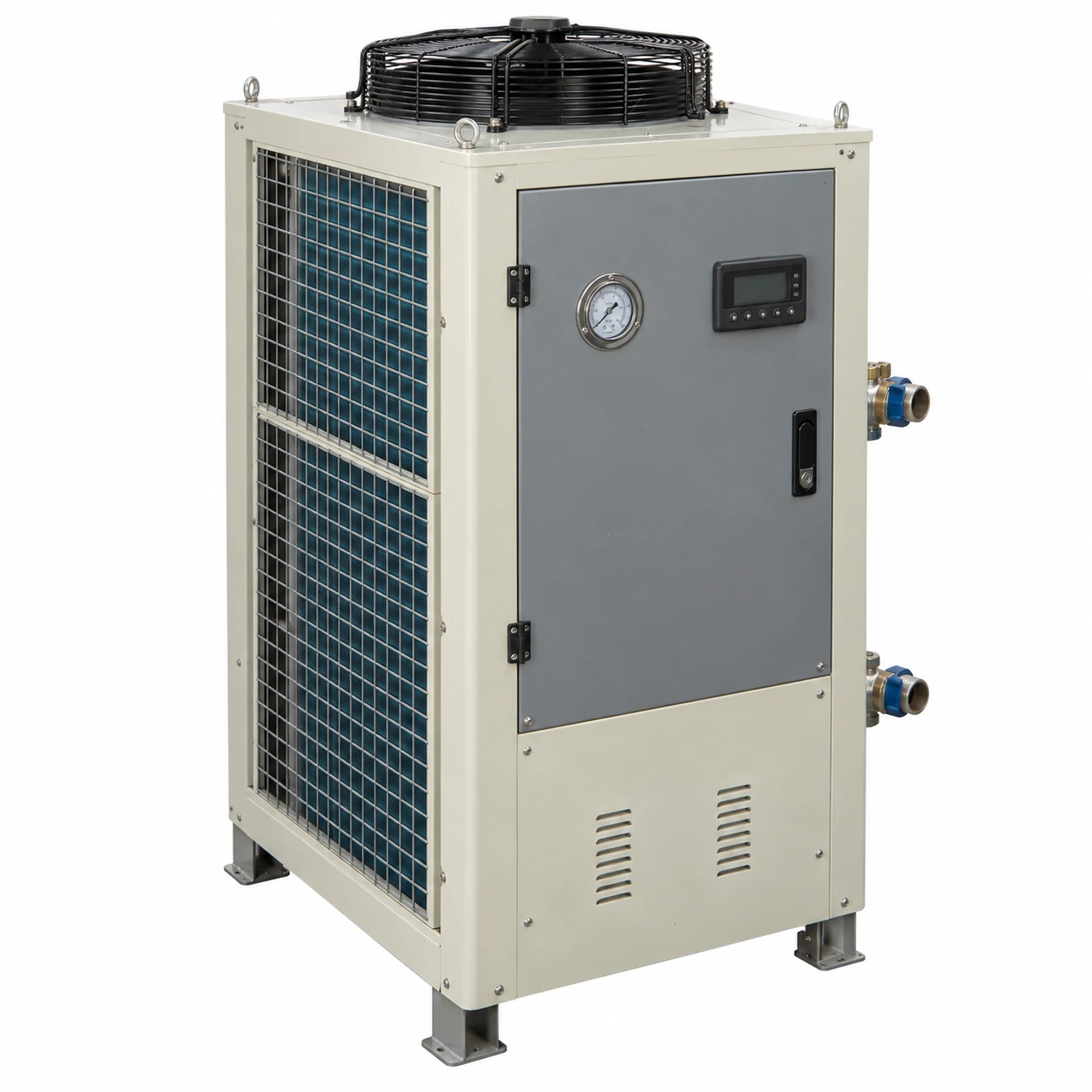
Air-Cooled Chillers
2 ton air cooled chiller
| Brand | shengtongJH |
|---|---|
| Nominal cooling capacity | 2 US RT = 7.03 kW thermal |
| Condenser / compressor | Air-cooled finned condenser with compact compressor package |
| Calculated flow at 5 K water rise | 1.21 m³/h |
| Water circuit | Integral reservoir and tool-specific circulation pump |
| Envelope options, L × W × H (mm) | Approximately 850–1,100 × 550–750 × 1,000–1,250 |
| Electrical configurations | Single- or three-phase package according to selected compressor and destination supply |
| Coolant | Water or compatible inhibited mixture; material selection for special water quality |
| Temperature control | Process setpoint with suitable control deadband or capacity regulation |
| Interfaces | Flow/temperature alarm and machine permissive options |
The tool's allowable pressure and required flow govern pump selection. Confirm capacity, electrical input and dimensions at the agreed operating conditions.
The pump, fluid circuit, reservoir and machine interfaces can be customized for your industrial equipment.
A 2 ton air cooled chiller can provide dedicated cooling where a tool needs a cleaner or more tightly controlled circuit than the factory's general water supply. The pump and wetted materials are as important as the refrigeration capacity.
Cooling capacity cannot compensate for poor circulation
Narrow passages, long flexible hoses and restrictive couplings can create substantial resistance. A pump selected only by its maximum flow can deliver much less once connected. Compare its operating point with the complete circuit pressure drop and the tool's pressure limit.
Choose the coolant and materials together
Some equipment specifies low-conductivity water or a particular inhibitor package. The chiller's pump, reservoir, seals and heat exchanger must be compatible with that requirement. Adding an arbitrary antifreeze or water-treatment chemical can introduce a new material problem even if it prevents freezing.
Where the tool needs a specialised fluid, a separated secondary circuit may be preferable. Account for the extra heat-exchanger temperature difference and pumping resistance before selecting the refrigeration package.
Handle idle periods
When production pauses, the heat load may fall nearly to zero. Suitable control and water volume limit frequent starts. Do not widen temperature limits beyond what the process can tolerate merely to reduce cycling.
Give the machine a useful permissive
A signal that the chiller is powered on does not prove adequate cooling. If the process requires it, use an agreed flow and temperature permissive so the machine starts only when the cooling circuit is ready.
Set up a maintainable local circuit
Keep hoses short where practical, avoid kinks and provide isolation for tool changes. Position the reservoir fill and drain where fluid can be handled cleanly. Leave access for condenser cleaning so workshop dust does not progressively reduce performance.
At commissioning, record normal flow and return temperature under the real load. Those values help distinguish a later blocked tool circuit from a refrigeration fault. shengtongJH can coordinate the selected chiller and connections around the equipment's actual cooling specification.
The pump, fluid circuit, reservoir and machine interfaces can be customized for your industrial equipment.