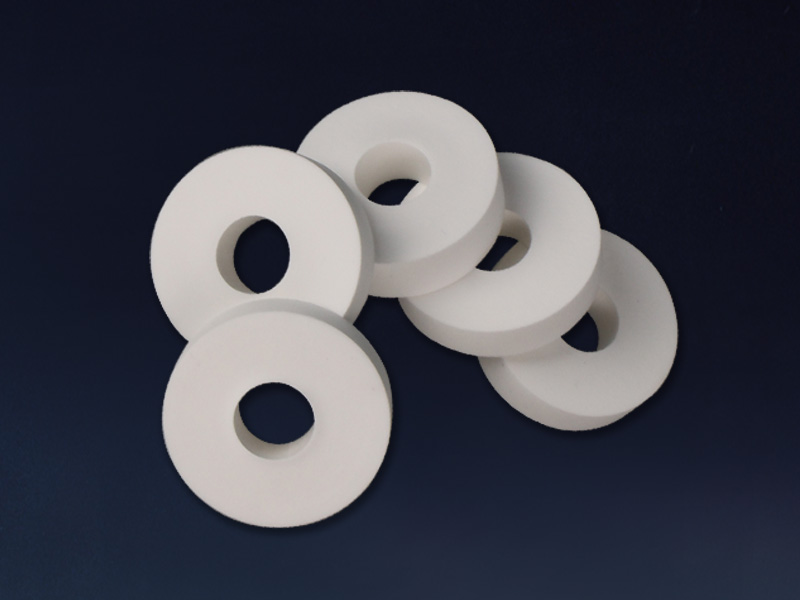
Product overview
Absorbent Sponges & Rollers
White PU Absorbent Sponge Roller 14 x 40 x 10 mm
| Material | PU sponge |
|---|---|
| Form | Sponge ring |
| Catalogue size designation | 14 × 40 × 10 mm |
| Use | Water absorption and process cleaning |
| Listed packing | 25 pieces/pack |
| Customization | Dimensions and assembly details by agreement |
Confirm the dimension order, bore, outside dimensions, covered length and core interfaces on an approved drawing. Material data depend on grade and conditioning.
Sponge dimensions, core arrangement and material grade can be customized for the process.
White PU sponge rings provide replaceable contact elements for a compatible shaft or holder. The visible ring geometry allows an assembly to be configured around the required working span and support arrangement.
Match the bore and the assembled surface
Confirm the bore fit independently from the ring's outer profile. For a stack of elements, check that the finished surface is even and that side retention does not overcompress the sponge. Record the dimension order explicitly on the agreed drawing.
Do not substitute the black PU listing by color preference alone: its published title and size image are inconsistent, and its exact dimensions require confirmation.
Inspect contact marks as well as absorbency
Changes in a ring's shape, local contamination or uneven mounting can create a repeated pattern on the workpiece. Review these mechanical causes if the process begins leaving stripes or isolated wet areas.
Set cleaning and replacement intervals for the actual liquid and loading. Material-family data help initial comparison, while the installed ring needs qualification in the intended operating cycle.
Material data
| Hardness designation | 5–70; test scale unspecified |
|---|---|
| Pore diameter | 15–100 µm |
| Tensile strength | 120 kPa |
| Porosity | 75–90% |
| Water-retention value | 300–400%; test basis unspecified |
| Heat-resistance values | 130 °C in air; 100 °C in water |
These material-level values support grade comparison; they are not guaranteed finished-roller test results. Confirm the test method, conditioning and allowable operating conditions for the selected grade. Chemical compatibility must be assessed for the actual fluid, concentration and temperature.
Sponge dimensions, core arrangement and material grade can be customized for the process.