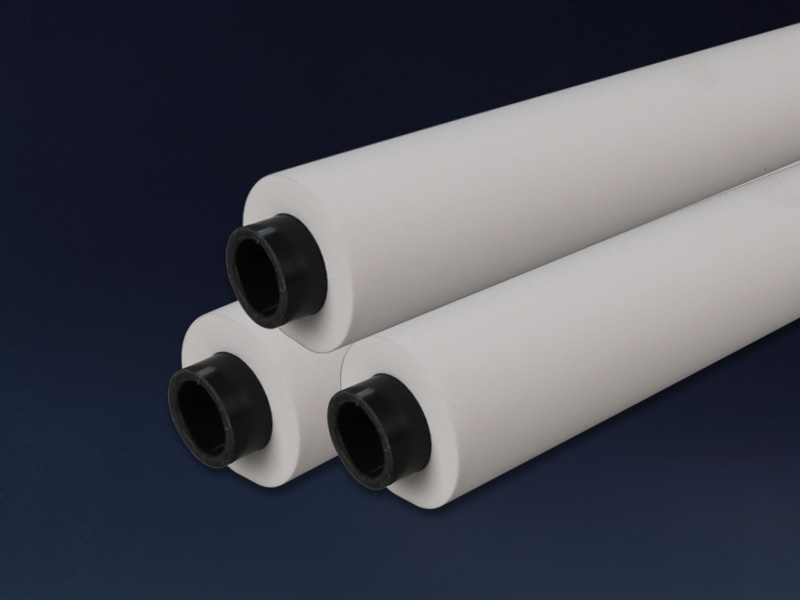
Product overview
Absorbent Sponges & Rollers
PVC Absorbent Sponge Roller 40 x VP16 x 240 x 260 mm
| Material | PVC sponge |
|---|---|
| Form | Smooth sponge roller with tube core |
| Catalogue size designation | 40 × VP16 × 240 × 260 mm |
| Use | Water absorption and process cleaning |
| Listed packing | Custom roller/large-roll format |
| Customization | Dimensions and assembly details by agreement |
Confirm the dimension order, bore, outside dimensions, covered length and core interfaces on an approved drawing. Material data depend on grade and conditioning.
Sponge dimensions, core arrangement and material grade can be customized for the process.
A continuous PVC sponge sleeve surrounds the supporting tube, creating an uninterrupted contact surface across the working span. This compact roller format is intended for a compatible water-removal or liquid-transfer assembly.
Separate the contact span from the mounting length
The foam-covered section and the projecting core serve different purposes. Confirm the covered length, overall length, outside diameter and core connections on the approved drawing. The VP16 designation should be matched to the actual core dimensions and machine interface.
Set the contact, then assess the result
Align the roller with its opposing surface and begin with the approved compression setting. Too little contact can leave liquid behind; excessive squeezing can distort the sleeve and increase wear. Assess the surface after the roller under representative loading.
Inspect the bond and core ends during maintenance. Keep the sponge free of abrasive debris and confirm compatibility with the liquid used for cleaning. Replacing the complete assembly is preferable to forcing a mismatched core into the mounting arrangement.
Material data
| Hardness designation | 15; adjustable range 10–70, scale unspecified |
|---|---|
| Tensile strength | 420 kPa |
| Elongation | 220% |
| Average pore diameter | 60 µm; stated adjustment range 30–150 µm |
| Porosity | 75% |
| Heat-resistance value | 70 °C |
These material-level values support grade comparison; they are not guaranteed finished-roller test results. Confirm the test method, conditioning and allowable operating conditions for the selected grade. Chemical compatibility must be assessed for the actual fluid, concentration and temperature.
Sponge dimensions, core arrangement and material grade can be customized for the process.