Product overview
Absorbent Sponges & Rollers
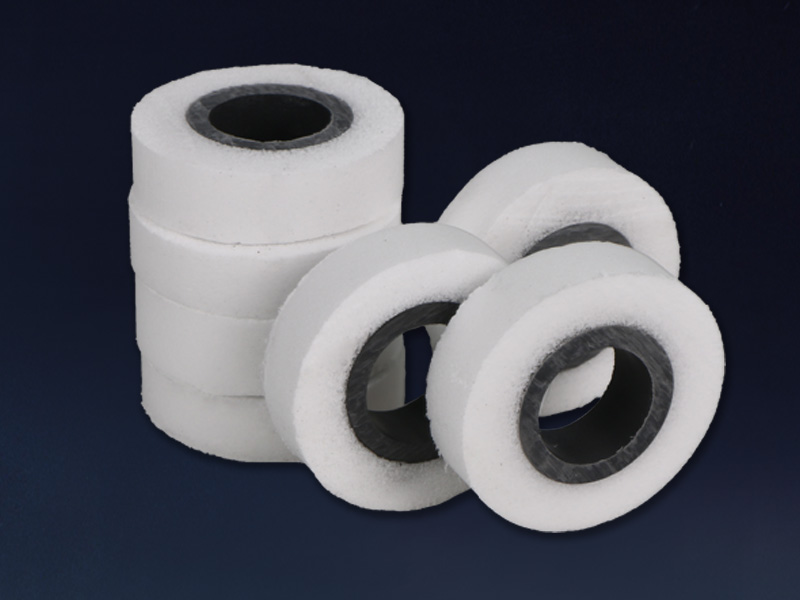
PVA Absorbent Sponge Roller 15 x 38 x 10 mm
| Material | PVA sponge |
|---|---|
| Form | Sponge ring with core bushing |
| Catalogue size designation | 15 × 38 × 10 mm |
| Use | Water absorption and process cleaning |
| Listed packing | 25 pieces/pack |
| Customization | Dimensions and assembly details by agreement |
| Preparation | Hydrate fully before use; source guidance specifies at least 30 minutes of soaking |
Confirm the dimension order, bore, outside dimensions, covered length and core interfaces on an approved drawing. Material data depend on grade and conditioning.
Sponge dimensions, core arrangement and material grade can be customized for the process.
PVA sponge rings combine a water-absorbent contact body with a separate core bushing. The material requires suitable hydration before operation, making preparation part of the replacement procedure.
Prepare the PVA before loading it
PVA can become firm when dry. Follow the approved soaking procedure and verify that the sponge has softened throughout before applying working pressure. The source guidance calls for at least 30 minutes of soaking, followed by gentle squeezing to identify and soften remaining hard areas.
Do not force a dry, hard element into contact with a sensitive workpiece.
Check the bushing and ring as one assembly
Confirm the bore, retention and conditioned outside dimensions on the installation drawing. Inspect the sponge around the bushing for damage and check that the ring remains secure during rotation.
Establish a shutdown storage method that preserves the required moisture condition while controlling contamination. A hydrated sponge still needs clean handling and a defined replacement interval; water retention does not make the element self-cleaning.
Material data
| Tensile strength | 420 kPa |
|---|---|
| Elongation | 250% |
| Porosity | 90% |
| Water-retention value | 1100%; test basis unspecified |
| Average pore diameter | 150 µm |
| Heat-resistance value | 60 °C |
These material-level values support grade comparison; they are not guaranteed finished-roller test results. Confirm the test method, conditioning and allowable operating conditions for the selected grade. Chemical compatibility must be assessed for the actual fluid, concentration and temperature.
Sponge dimensions, core arrangement and material grade can be customized for the process.