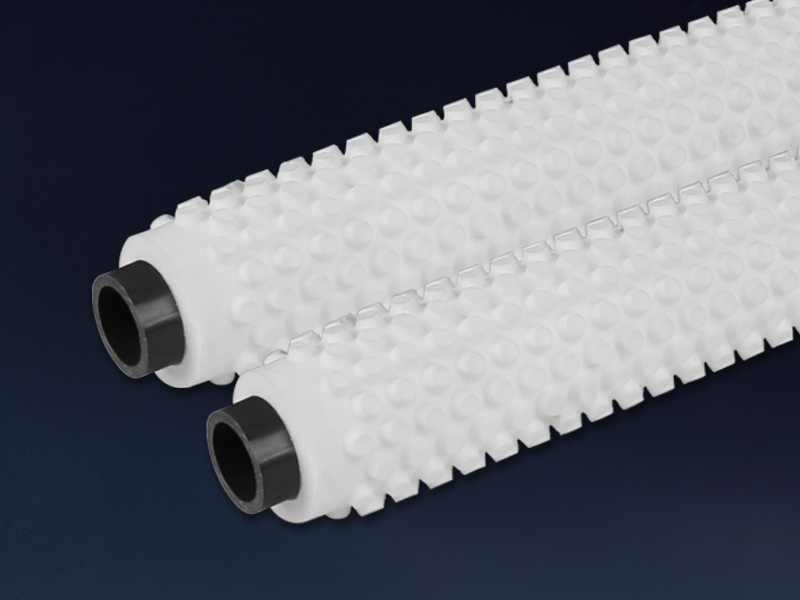
Product overview
Absorbent Sponges & Rollers
PU Absorbent Sponge Roller 20 x VP45 x 360 x 380 mm
| Material | PU sponge |
|---|---|
| Form | Profiled sponge roller with tube core |
| Catalogue size designation | 20 × VP45 × 360 × 380 mm |
| Use | Water absorption and process cleaning |
| Listed packing | Custom roller/large-roll format |
| Customization | Dimensions and assembly details by agreement |
Confirm the dimension order, bore, outside dimensions, covered length and core interfaces on an approved drawing. Material data depend on grade and conditioning.
Sponge dimensions, core arrangement and material grade can be customized for the process.
The profiled PU sponge surface distinguishes this roller from a smooth sleeve. Its raised and recessed pattern changes the contact arrangement and should be selected around the workpiece and the machine's approved operating method.
Evaluate the profile against the surface
A textured roller contacts the workpiece differently from a continuous smooth cylinder. Check the pattern, compression and resulting surface condition on representative material. Thin films or sensitive finishes need particular attention to localized loading and possible marking.
Do not substitute a smooth roller solely because its outside envelope appears similar. The surface profile is part of the working geometry.
Keep recesses free of deposits
The profile creates areas where residue can accumulate. Inspect the recesses and clean them using a method compatible with the sponge and core. Hard particles trapped in the surface should be removed before the next production run.
The catalogue's VP45 notation and dimension sequence require a drawing to resolve the core and sleeve geometry. Confirm those details, together with the required material grade, before manufacturing or replacement.
Material data
| Hardness designation | 5–70; test scale unspecified |
|---|---|
| Pore diameter | 15–100 µm |
| Tensile strength | 120 kPa |
| Porosity | 75–90% |
| Water-retention value | 300–400%; test basis unspecified |
| Heat-resistance values | 130 °C in air; 100 °C in water |
These material-level values support grade comparison; they are not guaranteed finished-roller test results. Confirm the test method, conditioning and allowable operating conditions for the selected grade. Chemical compatibility must be assessed for the actual fluid, concentration and temperature.
Sponge dimensions, core arrangement and material grade can be customized for the process.