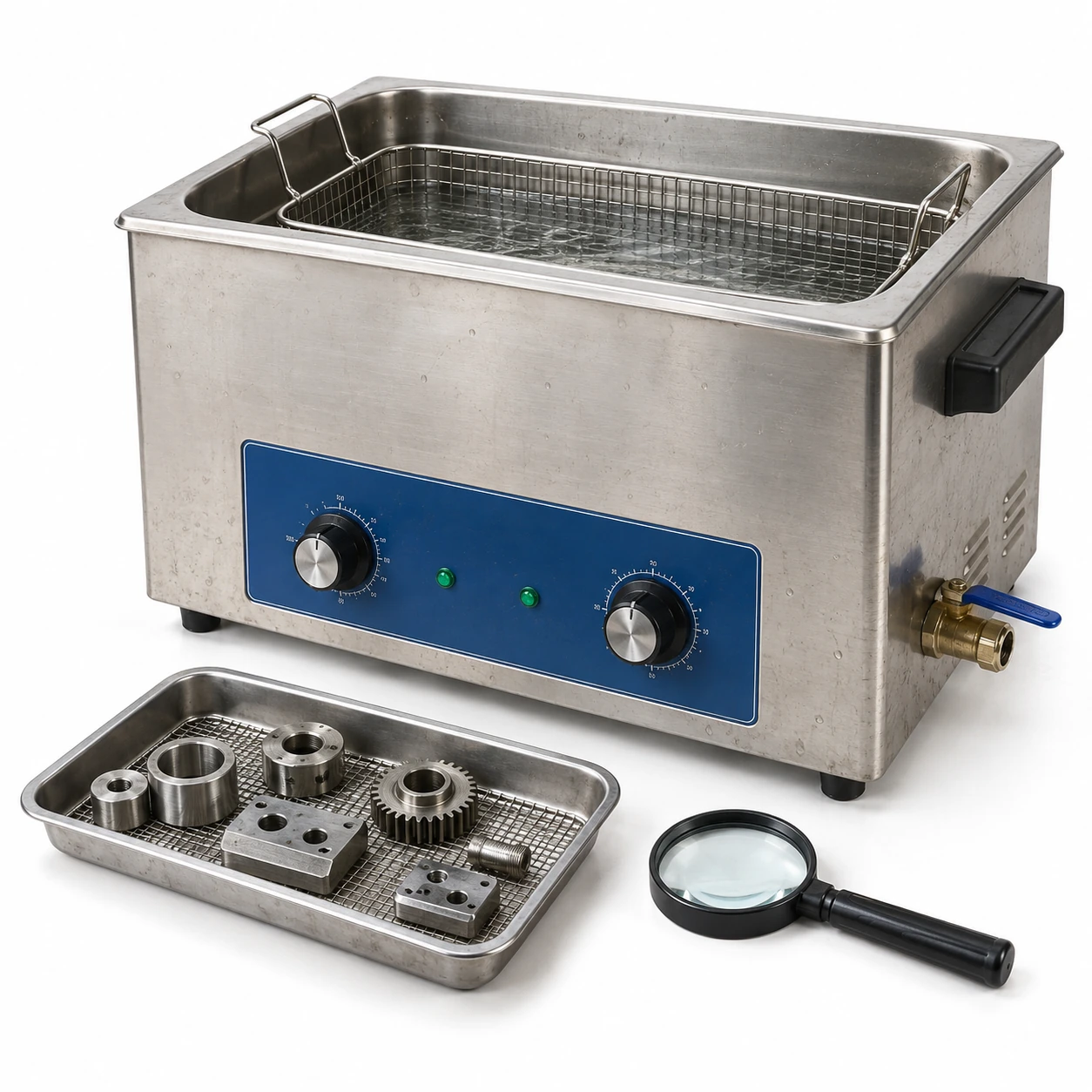
Ultrasonic Cleaners
good ultrasonic cleaner
| Tank family | 10 / 15 / 30 L nominal capacity |
|---|---|
| Internal tank W × D × H (mm) | 300 × 240 × 150 / 330 × 300 × 150 / 500 × 300 × 200 |
| External W × D × H (mm) | 330 × 270 × 310 / 360 × 330 × 310 / 530 × 330 × 350, respectively |
| Ultrasonic frequency / power | 40 kHz; 240 / 360 / 600 W options by tank size |
| Heating | 200 / 300 / 500 W; adjustable up to 80 °C, subject to chemistry and material limits |
| Controls | Timer up to 30 minutes; rotary or digital controls; selectable degassing function |
| Construction / accessories | 304 stainless steel tank and case; suspended basket, lid and drain valve |
| Electrical supply | 220–240 V, 50/60 Hz; 100–120 V variants by configuration |
Configuration values describe equipment options, not a quality ranking. The suitable size and settings depend on the actual component and cleaning requirement.
A cleaner configuration can be selected around your parts, inspection requirement and working conditions.
A good ultrasonic cleaner is one that produces an acceptable result on the intended parts and can be operated consistently in the available workspace. The most useful comparison is a defined cleaning task, not the largest litre or wattage figure.
Ask what evidence would make the purchase convincing
Use a representative component with the normal contamination and the areas that are hardest to clean. Inspect it after the intended rinse and drying steps. This reveals whether the proposed process addresses the requirement rather than merely making an easy external surface look brighter.
A supplier demonstration should state the solution, loading, temperature and exposure used. Without those conditions, a successful sample result is difficult to reproduce at your site.
Read specifications in the right order
- Useful space before nominal volume
- Check the basket, immersion depth and loading clearance. A tank label does not show how much room remains around the work.
- Power definition before power comparison
- Keep nominal ultrasonic output, peak figures and heater power separate. A higher combined number may simply describe a larger heater.
- Control functions before display appearance
- A timer and temperature display help operators repeat settings. They do not measure residual contamination or prove that the load is clean.
- Maintenance access before cabinet finish
- Look for a usable drain, accessible service components and a way to identify replacement parts. Surface polish does not establish process reliability.
Include the running task
Consider solution consumption, warm-up, basket handling and bath changes. A compact machine may be economical for occasional work yet labour-intensive when a production lot requires many separate cycles.
Suitable chemistry and rinsing can matter more than an extra control mode. Avoid buying functions that have no role in the intended process.
Recognise unsupported promises
No ordinary bath can guarantee compatibility with every material or sterilize any component merely by increasing time. Be cautious when an offer substitutes universal claims for a defined application.
The purchase should identify the selected configuration and the basis for acceptance. Any certification or compliance requirement must be checked against that equipment.
Bring the comparison back to your work
Give shengtongJH the component material, difficult features, residue and required finish. A small ultrasonic cleaner can be a good fit for a precision toolroom, while a large production basket may require a completely different arrangement.
A cleaner configuration can be selected around your parts, inspection requirement and working conditions.