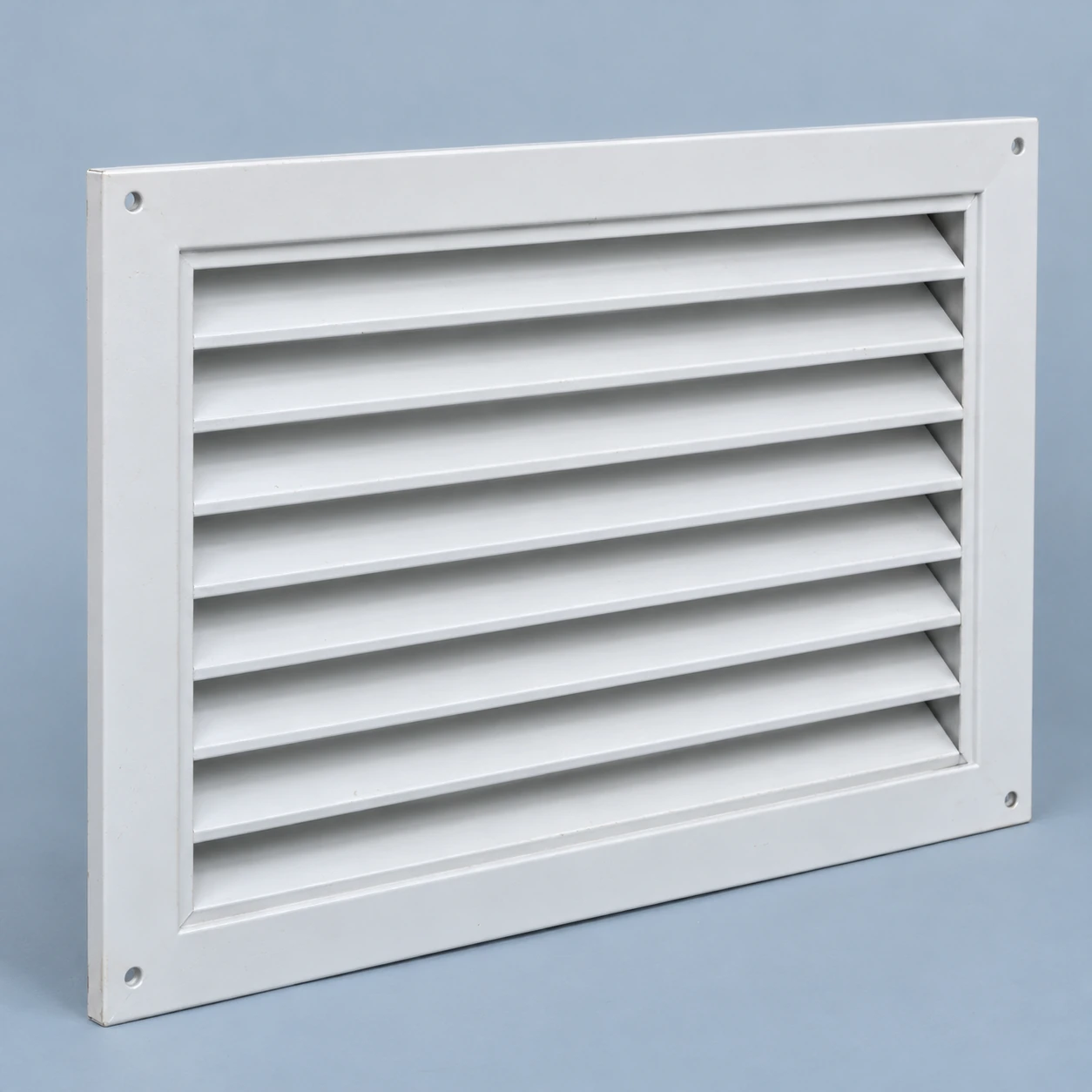
Return Air Grilles
louvered return air grille
| Brand | shengtongJH |
|---|---|
| Nominal opening choices | 12 × 12 / 20 × 20 / 24 × 14 in |
| Metric equivalents | 304.8 × 304.8 / 508 × 508 / 609.6 × 355.6 mm |
| Blade material | Formed steel or extruded aluminium |
| Blade arrangement | Fixed angled blades, long-side or short-side orientation |
| Spacing | Selected for appearance, free area and duty |
| Frame choices | Surface flange, recessed or selected lay-in border |
| Finish | White / grey powder coat; aluminium finish option |
| Core access | Fixed face or removable louver core |
| Filter option | Separate accessible holder when specified |
| Location | Protected indoor commercial or industrial return-air use |
| Selection basis | Airflow, pressure loss, sound and required sight screening |
The grille does not regulate airflow by itself. Outdoor rain resistance and adjustable damper functions require separately specified products or accessories.
Blade direction, spacing, frame and finish can be customized to the air duty, sightline and installation detail.
A louvered return air grille uses fixed angled blades to admit return air while reducing a direct view into the duct or plenum. Its blade pattern is an air-inlet face, not an adjustable damper or an outdoor weather louver unless separately designed for those functions.
Choose the view through the blades
Angled louvers can reduce the direct line of sight into a service void. The useful direction depends on where people normally view the grille. A high wall opening and a low fascia may need different blade orientation to screen the same type of plenum.
Specify the viewing direction on the elevation rather than describing the face only as horizontal or vertical. This helps avoid a correctly sized grille revealing the very equipment the blades were intended to conceal.
Preserve enough open area
Blade spacing and angle affect how air passes through the face. A tighter sight-screening pattern can impose a different resistance from an open core. Use the selected product's performance data for the required airflow instead of treating all louvered faces as equivalent.
Do not ask fixed blades to balance the system
A fixed louver is not a volume-control device. If the branch requires balancing, provide the appropriate separately selected damper or system adjustment. Bending blades on site to change flow can damage the face and creates an unrecorded configuration.
Likewise, an indoor return grille should not be substituted for an exterior weather louver. Rain management and outdoor exposure require a product designed for that service.
Make cleaning and replacement straightforward
Return louvers collect visible dust along their edges. Choose a removable core where access behind the face is useful and select a finish compatible with the cleaning routine. Keep the blade direction, frame dimensions and fixing method in the site record. That information lets shengtongJH coordinate a like-for-like replacement without relying on an image of the front alone.
Blade direction, spacing, frame and finish can be customized to the air duty, sightline and installation detail.