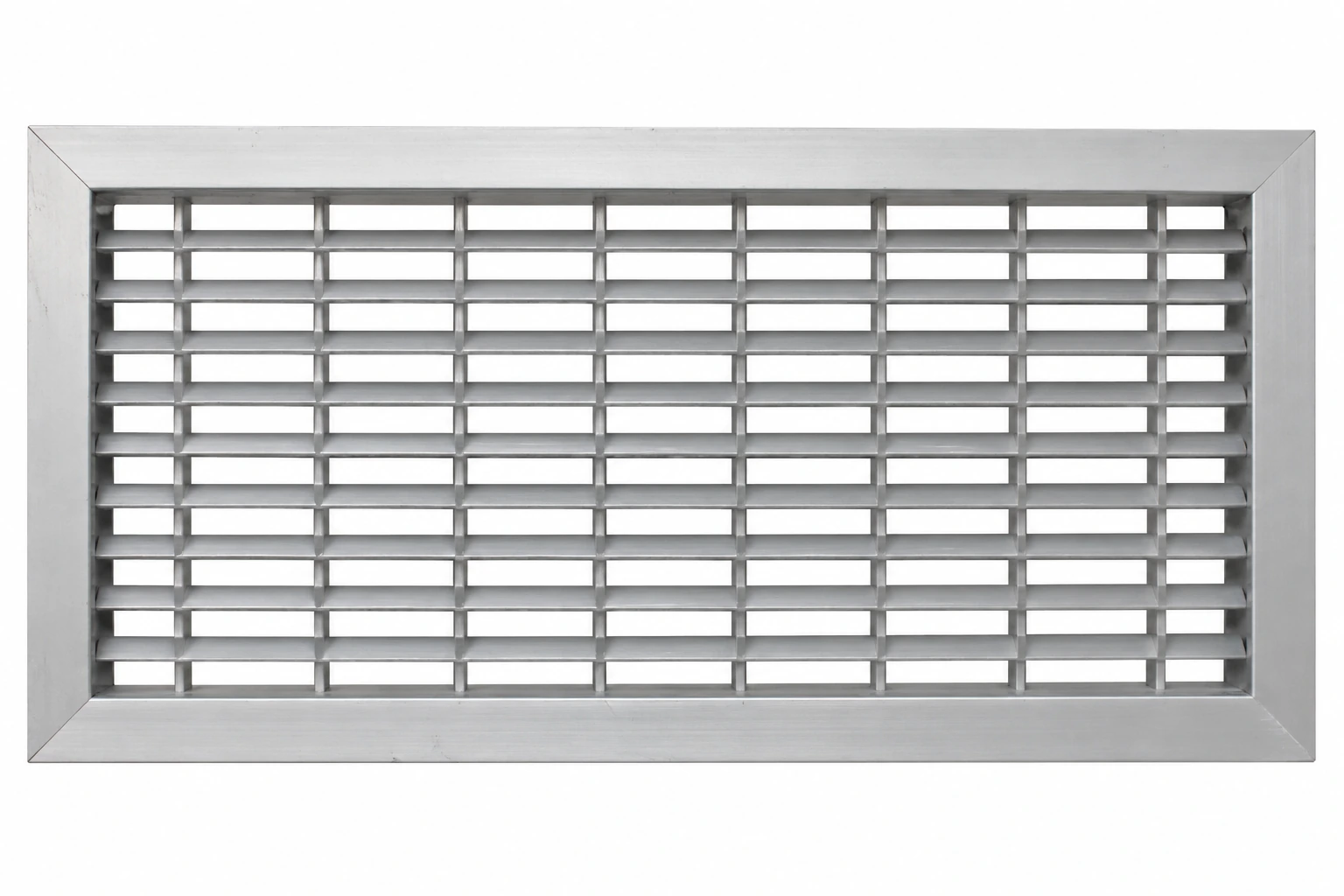
Return Air Grilles
high velocity return air grille
| Brand | shengtongJH |
|---|---|
| Opening options | 400 × 400 / 600 × 400 / 600 × 600 / 800 × 600 mm |
| Face choices | Open grid, wide-spaced bars or selected return louvers |
| Material | Aluminium or reinforced coated steel |
| Free area | Declared for the selected core and border |
| Airflow duty | Project air volume specified in m³/h or L/s |
| Pressure selection | Grille plus filter and rear-transition losses considered |
| Sound requirement | Project criterion checked against selected product data |
| Mounting | Rigid perimeter frame with secure core retention |
| Filter option | Separate sized holder; pressure allowance required |
| Rear connection | Plenum depth and approach geometry coordinated with the grille |
High velocity is an operating condition, not a guarantee of increased airflow. No fixed velocity or sound rating is implied by these configuration options.
Face area, core geometry, frame and rear connection can be customized to the required flow, pressure allowance and installation space.
A high velocity return air grille enquiry should identify the required air volume and the pressure and sound limits of the installation. A return grille does not generate airflow; it is a passive opening in a fan-driven system.
Separate face velocity from free-area velocity
The gross panel area includes the frame and the material forming the blades or grid. Air passes through the remaining openings, where its local velocity is higher than a calculation using the gross face alone would suggest. A comparison based only on nominal width and height can therefore miss an important difference between two designs.
Use the selected grille's free-area and performance information when checking the duty. Include a filter or rear obstruction if it forms part of the ordered assembly.
Noise is a design signal
A return that whistles or produces noticeable rushing sound may be operating with excessive restriction or an uneven approach. Increasing fan speed can make that symptom worse. Investigate the core, filter, transition and branch before treating the grille as an isolated part.
Provide a stable installation
A loose core or thin unsupported frame can add rattling to the airflow sound. Select the retention and perimeter support for the intended duty and access frequency. Fasteners should hold a sound assembly rather than pull a distorted panel into shape.
Make room for a lower-resistance solution
Where the existing face is too restrictive, a larger opening, a more open core or several properly arranged returns may be preferable to forcing more air through the same panel. The rear plenum must also support that change. shengtongJH can coordinate a grille selection around the stated duty, but does not present a high-velocity label as a performance upgrade independent of the fan system and installation.
Face area, core geometry, frame and rear connection can be customized to the required flow, pressure allowance and installation space.