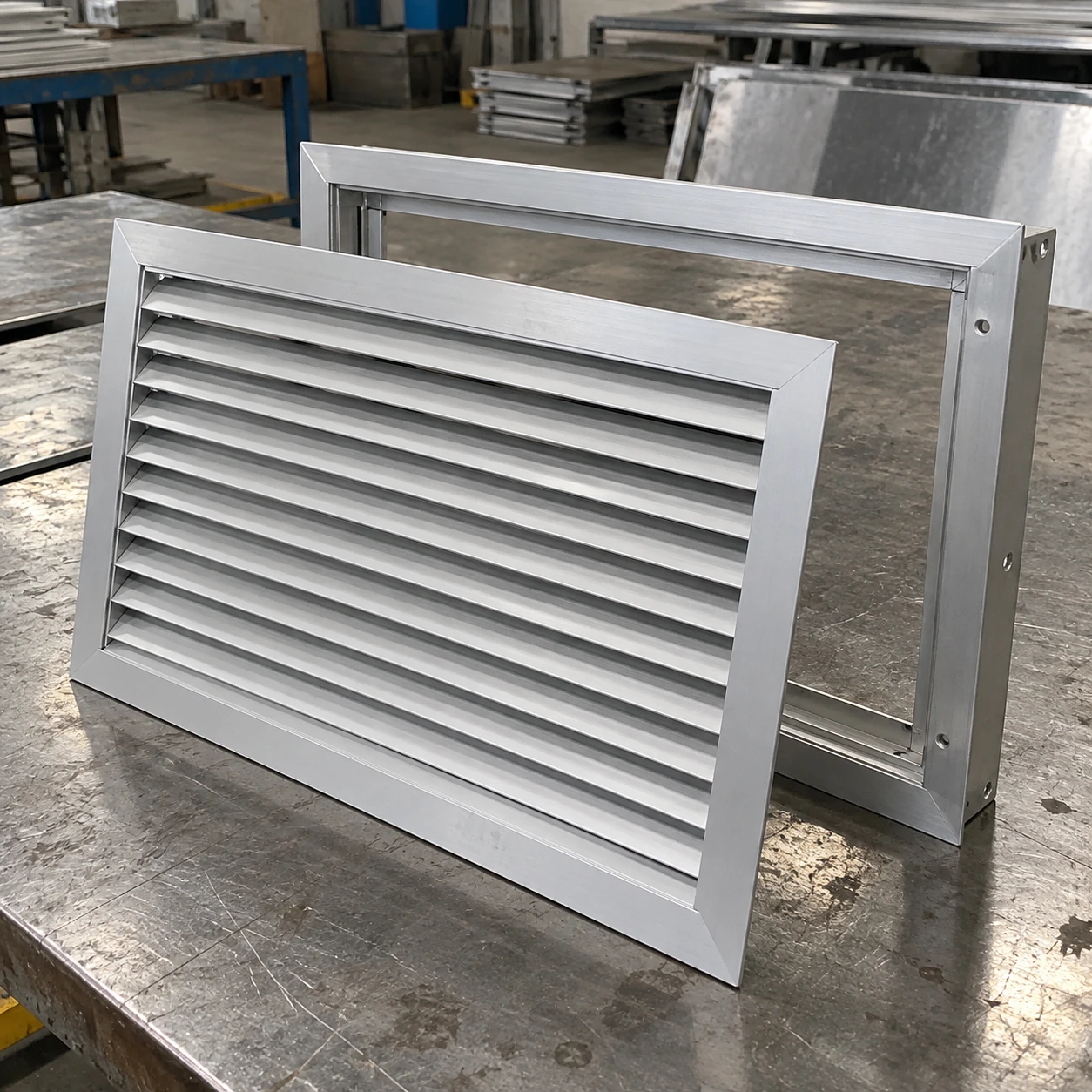
Return Air Grilles
custom return air grille
| Brand | shengtongJH |
|---|---|
| Opening dimensions | Width × height in mm, or inch dimensions explicitly identified |
| Common size options | 300 × 300 / 400 × 400 / 600 × 300 / 600 × 600 mm; other openings by drawing |
| Face dimensions | Overall width and height scheduled separately from the neck |
| Material options | Steel, aluminium or stainless steel to suit the environment |
| Core options | Fixed louvers, egg-crate, linear bars or perforated face |
| Border | Surface flange, recessed frame or ceiling-grid interface |
| Access choices | Screw-removable core or hinged face with retained hardware |
| Finish | Powder coat or suitable bare-metal finish |
| Filter provision | Optional frame sized for the selected actual filter |
| Order definition | Opening tolerance, fixing pattern and orientation shown on drawing |
A custom dimension is not a performance rating. Airflow selection, structural requirements and any project certification must be addressed for the chosen assembly.
Dimensions, core, border, filter access and finish can be customized to the installation and maintenance requirements.
A custom return air grille is useful when a standard frame does not fit the opening or the installation needs a particular removal method, border or finish. Customization should resolve a real interface problem while preserving the required return-air path.
Turn the site problem into a complete drawing
A request for a non-standard width is only the beginning. Record the clear opening, wall or ceiling build-up, rear depth and the area available for fixing. Then define the visible face size and how much overlap is needed to cover the opening. These dimensions describe different parts of the assembly and should not share one ambiguous label.
For replacement work, record whether the existing frame is staying. A new core intended to fit an old frame needs the frame's internal details, not simply the dimensions printed on an old filter.
Appearance
Choose blade direction and border width in relation to nearby panels. A narrow border can look tidy but leaves less room for fixing and covering irregular edges. Decide which requirement matters before reducing the frame.
Air path
Changing the face pattern changes the open path through it. A visually dense pattern may require a larger face or a different selection to keep pressure loss and sound acceptable at the required flow.
Access
Show the space needed to withdraw the core or swing a door. An elegant hidden fixing is not useful if the face cannot be removed after adjacent services are installed.
Approve the interface, not just the front view
The procurement drawing should include a section through the frame, mounting holes or brackets, the rear connection and any filter retaining detail. Identify the finish and cleaning conditions as well. shengtongJH coordinates this purchasing information with the selected supplier; we do not treat a customized face as proof of an unverified airflow, fire or structural rating. A well-defined order reduces site cutting and makes future replacement much easier.
Dimensions, core, border, filter access and finish can be customized to the installation and maintenance requirements.