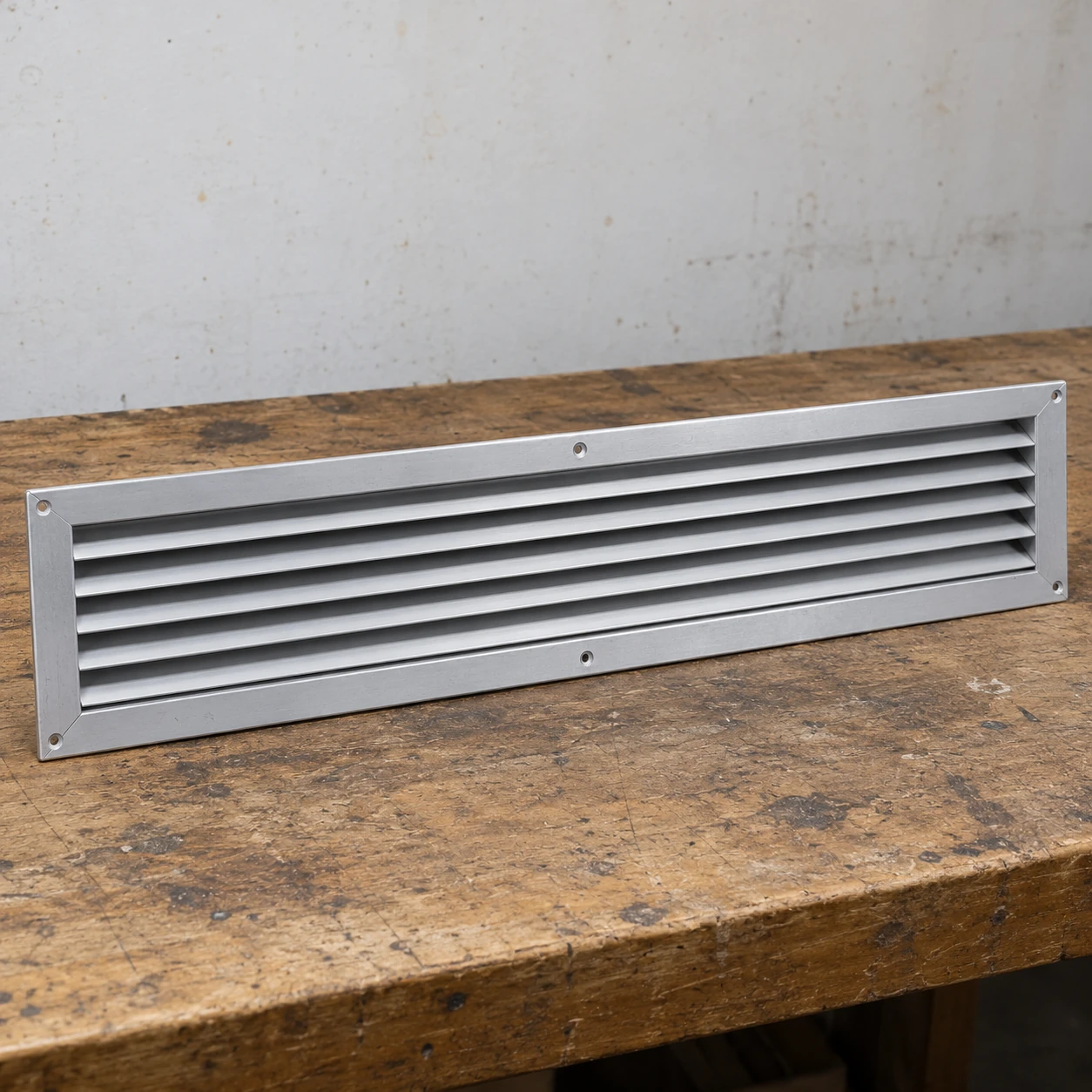
Return Air Grilles
24x6 return air grille
| Brand | shengtongJH |
|---|---|
| Nominal opening W × H | 24 × 6 in / 609.6 × 152.4 mm |
| Face construction | Extruded aluminium louvers or formed steel |
| Blade arrangement | Fixed parallel blades, direction specified |
| Border | Flat surface flange or slim recessed option |
| Finish | Anodized aluminium / white or grey powder coat |
| Access choices | Fixed face or removable insert |
| Rear neck | Selected to match shallow plenum and wall build-up |
| Filter option | Separate arrangement only after access and resistance review |
| Fixing positions | Distributed along the long frame edges |
| Air duty | Ordinary commercial or industrial return-air branch |
| Service clearance | Space to release and withdraw the full face |
The small height limits the available active area; do not assign an airflow from overall face length alone.
Face length, neck depth, blade layout and fixings can be customized to the available fascia and return-air duty.
A 24x6 return air grille is a narrow landscape option for commercial service fascias and restricted-height return openings. Its elongated shape makes the opening easy to integrate visually, but the limited height can become an airflow or maintenance constraint.
Use the available length effectively
A narrow return face can fit a service strip where a taller grille would conflict with nearby finishes. The air must still move through the openings between the blades and into the plenum behind them. A long border surrounding a small active core does not provide the same air path as a full-width grille.
Check the usable core area and the connected duct arrangement before selecting the face. Where height is severely restricted, several planned return points or a revised plenum may be more useful than making one grille increasingly long.
Support the long edges
A slender frame can reveal uneven backing or excessive screw tightening. Provide straight, sound fixing surfaces and distribute attachment points according to the selected construction. The frame should hold its shape without the wall or fascia forcing it into alignment.
Plan how dust is removed
Low-height openings can be awkward to clean behind. If the location is dusty, a removable core gives better access than trying to reach through narrow blades. Make sure the insert can actually be released without removing the surrounding trim.
Keep the filter decision separate
A thin fascia may not leave space for a useful filter holder and its removal path. If filtration is required, examine whether it belongs at a more accessible point upstream or at the equipment. Putting a small, difficult-to-reach filter behind the grille can create a maintenance bottleneck.
For procurement, provide the clear opening, finished fascia thickness and rear plenum depth. Those details allow shengtongJH to coordinate a practical frame and neck rather than supplying a face that fits visually but cannot be installed or maintained properly.
Face length, neck depth, blade layout and fixings can be customized to the available fascia and return-air duty.