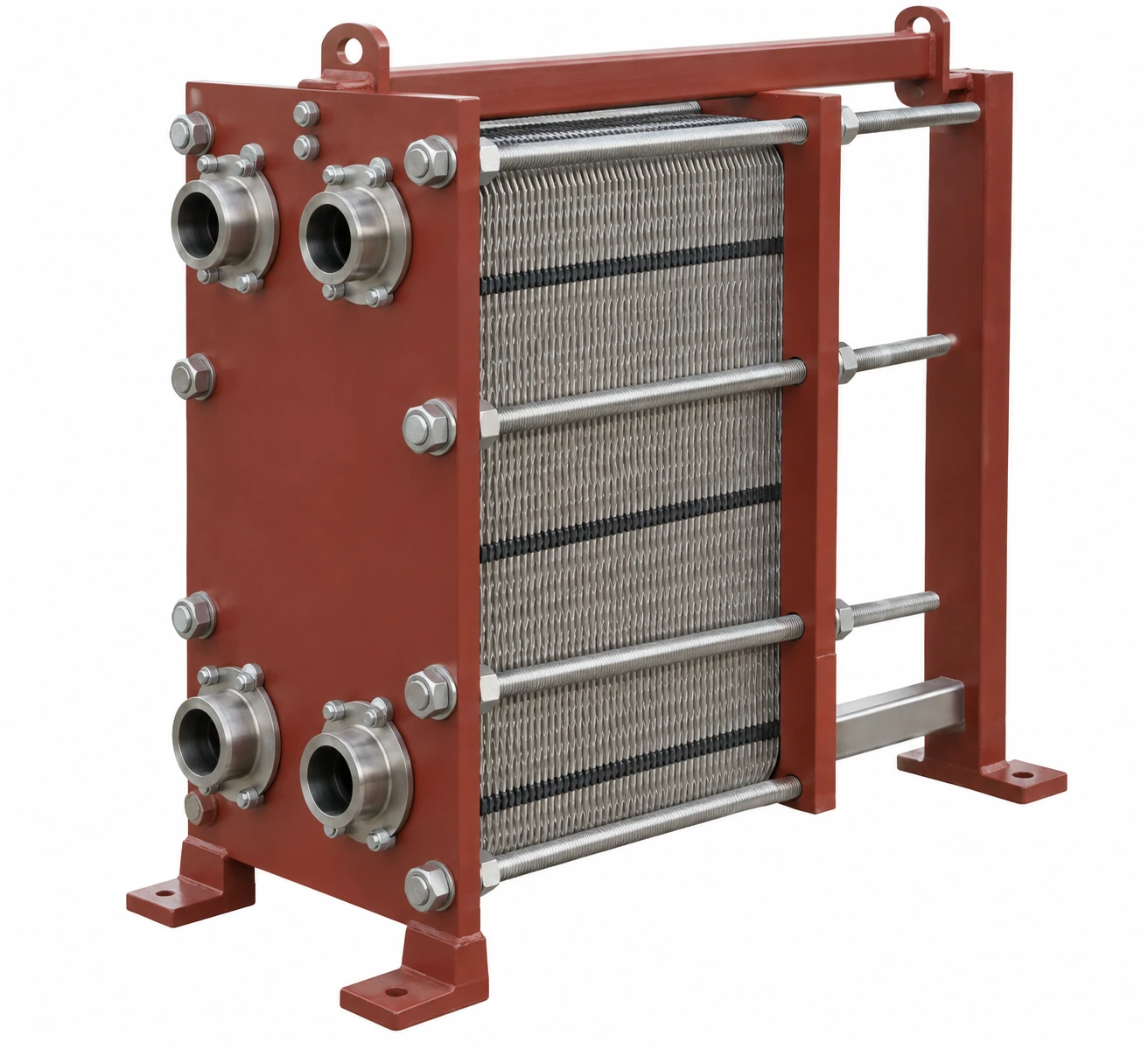
Plate Heat Exchangers
frame and plate heat exchanger
| Brand | shengtongJH |
|---|---|
| Frame structure | Fixed plate, movable pressure plate, carrying bar, guide bar and support |
| Frame material | Painted carbon steel; stainless option |
| Plate material | 304 / 316L stainless steel |
| Gaskets | EPDM or NBR matched to service |
| Frame face classes | Approx. 250 × 750 / 330 × 950 / 500 × 1,100 mm, width × height |
| Frame depth | Selected for plate pack, rear support and required opening travel |
| Port choices | DN25 / DN50 / DN65 / DN100 |
| Pressure classes | 10 / 16 bar selected assembly options |
| Service features | Accessible tightening bolts and removable insulation |
| Expansion provision | Spare frame length only where allowed by the selected mechanical and thermal design |
Frame length alone does not establish expansion capacity. Plate pattern, port size, permissible compression and thermal selection must all support a change.
Frame length, connection positions, support layout and maintenance access can be customized to the installation.
A frame and plate heat exchanger uses a fixed frame plate, a movable pressure plate and a carrying structure to hold the heat-transfer pack. Its frame arrangement determines installation access, opening travel and how readily routine servicing can be completed.
The frame is working equipment
Carrying and guide bars position the plates while the pressure plates and bolts maintain the required compression. Corrosion, misalignment or poor access can make servicing difficult even when the heat-transfer plates remain usable. Check the complete frame condition when evaluating an older exchanger.
During installation, the supports should suit the floor or base without forcing the frame out of alignment. Pipework should have its own support rather than relying on the exchanger to correct an awkward connection route.
Draw the opening space before fixing the pipes
The movable pressure plate needs to travel back before the pack can be opened. A wall, pump or overhead service may block that movement. Leave a practical route for handling individual plates and reaching the compression bolts, not merely a narrow gap around the exterior.
Removable insulation should be designed around those service movements. An installation that saves a small amount of floor area but requires major pipe removal at every service can be expensive to operate.
Keep compression data with the unit
The correct plate-pack dimension and assembly sequence come from the selected design. Do not use extra tightening as a general response to leakage. Record maintenance changes so the next service starts with reliable information.
Plan expansion honestly
Extra bar length may make a future change possible, but the ports and channel arrangement still limit the selection. State the likely future duty now so the supplier can assess whether useful expansion provision is feasible.
Define the installation-ready supply
For procurement, include connection orientation, available floor space and the preferred service side. Confirm whether feet, insulation, spare gaskets and lifting provisions form part of the order. shengtongJH can coordinate these details for an ordinary industrial unit without turning a straightforward replacement into an unnecessarily elaborate package.
Frame length, connection positions, support layout and maintenance access can be customized to the installation.