Pass Boxes & Material Transfer
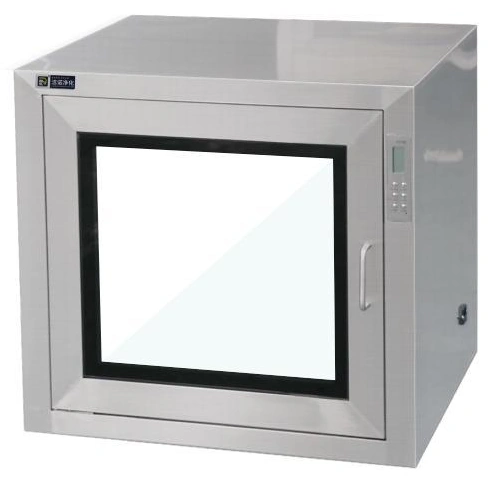
Electronic Interlock Pass Box
| Specification | JN-EIPB-600 | JN-EIPB-700 | JN-EIPB-800 | JN-EIPB-900 | JN-EIPB-1000 |
|---|---|---|---|---|---|
| External dimensions (mm) | 800 × 680 × 740 | 900 × 780 × 840 | 1000 × 880 × 940 | 1100 × 980 × 1040 | 1200 × 1080 × 1140 |
| Working chamber dimensions (mm) | 600 × 600 × 600 | 700 × 700 × 700 | 800 × 800 × 800 | 900 × 900 × 900 | 1000 × 1000 × 1000 |
| Enclosure and doors | Brushed 304 stainless steel | ||||
| Door style | Inset | ||||
| Door interlock | Electronic / magnetic | ||||
| Observation glazing | Double glazing; 5 mm tempered panes | ||||
| Electrical supply | 220 V / 50 Hz | ||||
| Controls | Door indication, adjustable timing and abnormal-operation alarm | ||||
| Size customization | Available | ||||
Dimensions and configurations can be customized for your application.
Transfer small materials between controlled rooms without sending personnel through the main entrance. Electronic interlocking keeps the opposite door locked during access, with indicators and alarms that help both operators follow the transfer sequence.
Give both sides a clear handover
A pass box replaces repeated personnel trips with a smaller, controlled transfer point. The electronic interlock coordinates the two doors: when one side is accessed, the other remains locked. Operators can place and receive materials without opening a direct passage between the rooms.
Status indication matters when the two operators cannot see one another. An occupied or locked indication explains why a door is unavailable, while an abnormal-operation alarm draws attention to an incomplete closure or incorrect sequence. Agree the meaning of each indication and the response to a fault before the transfer point enters daily use.
Choose the chamber around the handling task
The material must fit through the usable door opening as well as inside the box. Allow room for gloved hands, tray handles and lifting the item out without scraping the frame. A tightly fitting carton may be easy to push in but difficult to retrieve from the opposite side.
Consider the receiving work surface and transfer height. Long reaches into a deep chamber become uncomfortable when items are heavy or transfers frequent. Avoid using the box as storage: a clear chamber gives the next operator space to inspect, load and clean it properly.
What this version provides
This is a static transfer enclosure with electronically controlled access. It does not include the fan-driven clean-air cycle of a dynamic pass box. Choose that format when the process also needs filtered chamber airflow between transfers.
Keep the wall connection as deliberate as the door control
The cabinet must be supported without distorting the door frame. Match the wall opening, wall thickness and finished trim to the selected enclosure, then seal the surrounding joint using materials compatible with the cleaning routine. An interlocked door cannot correct an unsealed gap around the outside of the cabinet.
Plan where the electrical connection and controller can be serviced. Maintain access to door contacts, locks and replaceable seals so a small fault does not require dismantling the wall finish. If access control or another room system must exchange signals with the box, define those interfaces as part of the selected configuration.
A controlled transfer still needs a cleaning routine
Interlocking limits simultaneous opening; it does not remove contamination already carried on the item. Use the material preparation and wipe-down routine required by your process, and inspect spills, corners and door seals before the next transfer. Where a UV lamp is selected, its exposure and safety controls need to match the load; it does not replace physical cleaning or establish sterility.
Test both door directions, the indications and the agreed response to loss of power during commissioning. Chamber size, mounting height, door arrangement and control functions can be customized for your transfer scenario. Request a suitable configuration.