Operating Room Fixtures
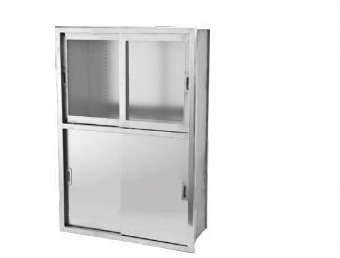
Recessed Instrument Cabinet
| Specification | Compact | Tall |
|---|---|---|
| Brand | shengtongJH | |
| Configuration size, W × D × H (mm) | 900 × 350 × 1300 | 900 × 350 × 1700 |
| Body material | 304 stainless steel | |
| Front arrangement | Glazed upper doors and enclosed lower storage | |
| Shelving | Adjustable stainless steel shelves; removable configuration | |
| Door selection | Sliding or hinged doors | |
| Wall interface | Recessed frame with perimeter trim | |
| Customization | Tray clearance, shelf arrangement, depth and locking | |
Dimensions and configurations can be customized for your application.
Store prepared instrument packs in an accessible wall cabinet while keeping floor space available for staff and mobile equipment.
The tray decides the usable shelf
The outside width of a cabinet does not tell you whether a prepared instrument set will fit. Check the tray, its wrapping or rigid container, handles and the clearance needed to lift it out without dragging it against adjacent packs. Door overlap, shelf supports and the cabinet frame all reduce usable access.
Store heavy sets at a practical handling height. Group items by procedure or replenishment sequence so that a worker can identify the correct pack without moving several others. Glazed doors help with this visual check, but internal organization remains essential.
Protect the storage route
Locate the cabinet where clean replenishment can reach it without crossing a dirty return route. Doors should open clear of passing trolleys. If the opening is narrow, sliding doors can reduce aisle intrusion; if wide trays need full access, compare the clear opening of a hinged configuration.
Storage is not sterilization
This cabinet holds prepared supplies. It does not clean or sterilize instruments, and it does not replace suitable packaging or the facility's sterile-storage procedures. Soiled instruments belong in a separate collection and processing workflow.
Build a cabinet that can be cleaned and replenished
Removable shelves simplify wiping the back and sides. Avoid sharp edges that can damage wraps and avoid overloading shelves with unsupported stacks. A clear shelf-load specification should be agreed for the actual tray arrangement before heavy sets are stored.
For installation, coordinate the cabinet body depth with wall framing and any services behind it. Finish the perimeter junction so that it can be routinely cleaned. Door runners and stops are service items, so allow access for adjustment rather than enclosing them permanently. Shelf spacing, cabinet depth and compartment organization can be customized for your instrument packs and replenishment process.