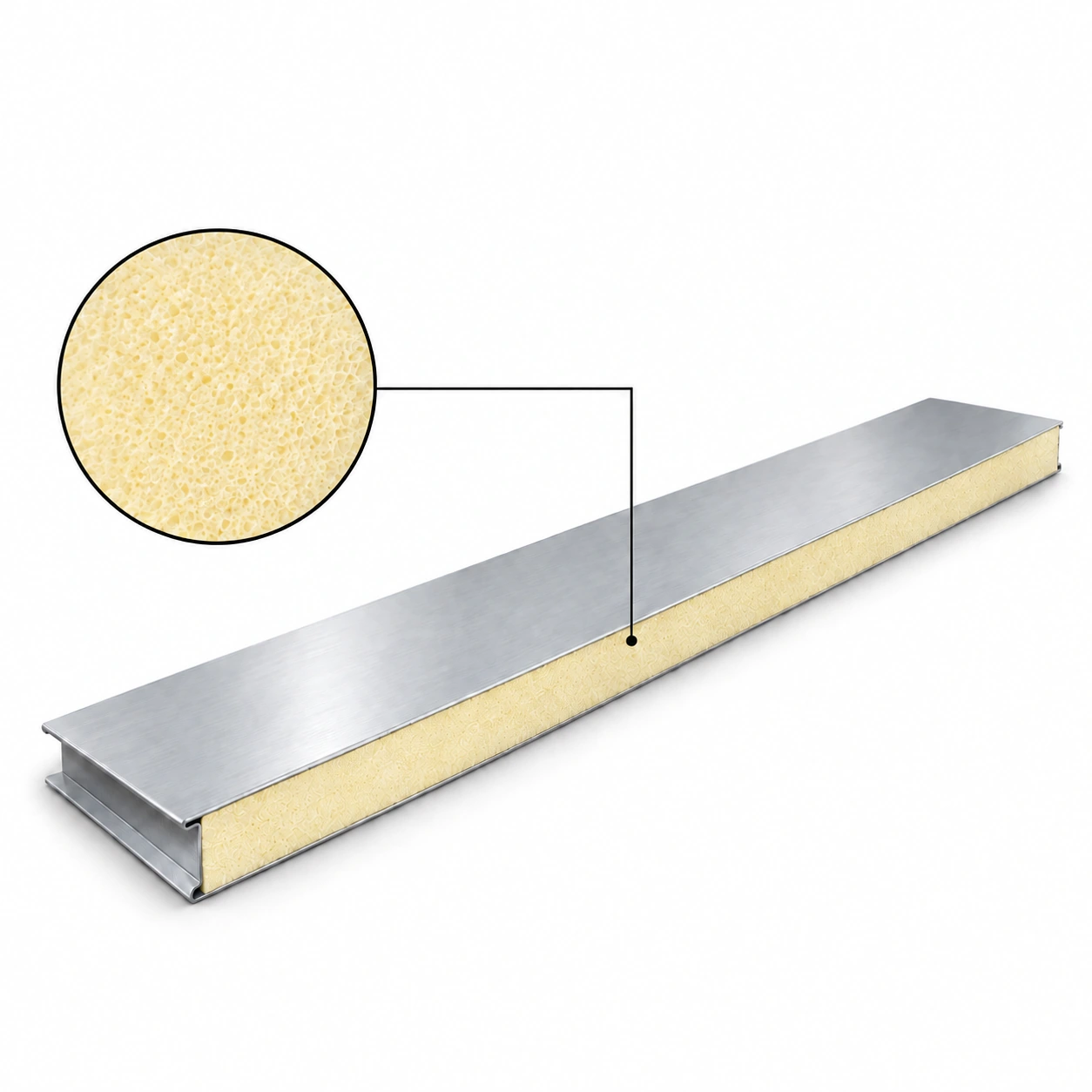
Insulated Wall Panels
insulated wall panels for food processing
| Brand | shengtongJH |
|---|---|
| Use | Food-processing partitions and insulated room boundaries |
| Core options | PUR / PIR or rock wool by assembly requirements |
| Width options | 900 / 1150 mm for selected wall systems |
| Thickness options | 50 / 75 / 100 / 150 / 200 mm |
| Facings | Coated galvanized steel or SS304 stainless steel |
| Joints | Closed profiles with compatible sealing and trims |
| Length | Cut to process-room elevation |
Panel dimensions, surface finish and connection details can be configured for your application.
Food-processing walls must separate the environment while remaining practical to clean and maintain. Insulated panels can provide a continuous finished surface, but the hygiene of the room also depends on joints, penetrations, the floor junction and operating routines.
Start with the cleaning process
Describe the actual cleaning chemicals, concentration, contact time, temperature and rinse method. These conditions help determine the appropriate facing and sealant. Stainless steel or a smooth coating should not be treated as universally resistant to every cleaning regime.
A material suitable for a room lining is not automatically certified for direct food contact. Identify the surfaces that food may touch and address that requirement explicitly where it applies.
Wall-to-floor junction
Coordinate the panel base with the floor finish, kerb and any coved transition. Avoid exposed insulation and inaccessible ledges that retain water. The lower detail needs to tolerate cleaning and traffic without losing its seal.
Services and equipment
Close pipe and cable penetrations neatly and leave space to clean around equipment. Provide independent support for heavy services. A wall face that can be wiped easily is less useful if equipment traps residue against its joints.
Traffic routes
Protect corners and lower walls where trolleys or bins pass. Place guards so they can also be cleaned. Repeated small impacts can open a seam or damage a coating long before a panel appears structurally distressed.
Temperature zones
Where adjacent rooms operate at different temperatures, coordinate insulation and vapour-control details. Condensation control involves the enclosure and air conditions together, not only the visible finish.
Maintain the wall as part of the room
Include joints, damaged facings and perimeter seals in routine inspection. Repair defects using compatible materials and verify that the repair can be cleaned. shengtongJH can coordinate panel dimensions, surface selection and junction accessories around the processing, cleaning and temperature-control scenario.