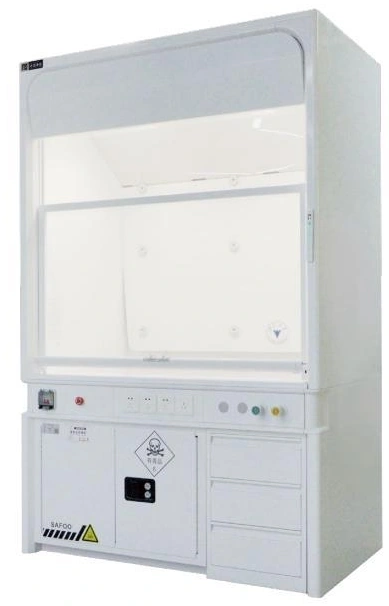
Laboratory Fume Hoods
Ducted Laboratory Fume Hood
| Specification | Compact | Medium | Wide |
|---|---|---|---|
| Brand | shengtongJH | ||
| Configuration size, W × D × H (mm) | 1200 × 800 × 2200 | 1500 × 800 × 2200 | 1800 × 800 × 2200 |
| Construction options | Coated steel, stainless steel or polypropylene selected for chemical compatibility | ||
| Worktop options | Chemical-resistant surface selected for reagents and temperature | ||
| Sash | Adjustable vertical opening; opening limit and monitor options | ||
| Exhaust | Ducted connection; fan, ductwork and discharge designed for the process | ||
| Accessories | Service taps, cupsink, lighting and airflow alarm | ||
| Customization | Width, lining, worktop and service arrangement | ||
Dimensions and configurations can be customized for your application.
Provide a ventilated enclosure for suitable laboratory processes, with inward airflow carrying emissions into a dedicated exhaust system.
Capture emissions before they enter the room
A ducted fume hood draws room air through the work opening and carries emissions towards the exhaust connection. It is selected for the substances and operations taking place inside, not simply because a laboratory needs an enclosed bench. Chemical compatibility, heat release and the type of emission all affect the construction and ventilation arrangement.
The hood needs a complete exhaust path. Duct resistance, fan performance, discharge location and replacement air must be coordinated with the building. Connecting a cabinet to an arbitrary fan does not establish effective containment.
Give the sash and work area a defined operating condition
The sash opening influences airflow and access. Select the opening around the equipment and hand movements required, then establish the intended working position. An airflow monitor provides useful indication, while a sash limit can help keep the opening within its designed range.
Keep the work zone organized so that large equipment does not block the rear flow path. Avoid using the hood as a general storage cupboard. Room doors, supply grilles and passing traffic can disturb the opening; positioning should consider those influences before the laboratory furniture is fixed.
Materials follow the chemistry
A liner or worktop suitable for one reagent may be unsuitable for another. Review the actual chemicals, concentrations, heat sources and cleaning agents. Specialized processes such as perchloric-acid digestion or highly hazardous powders require purpose-designed containment arrangements rather than a generic configuration.
Commission the installed system
Verify the hood, airflow indication and exhaust operation after installation and after significant changes. A clean bench is not an alternative chemical-containment device. Cabinet size, materials and service positions can be customized around the laboratory process and its exhaust design.