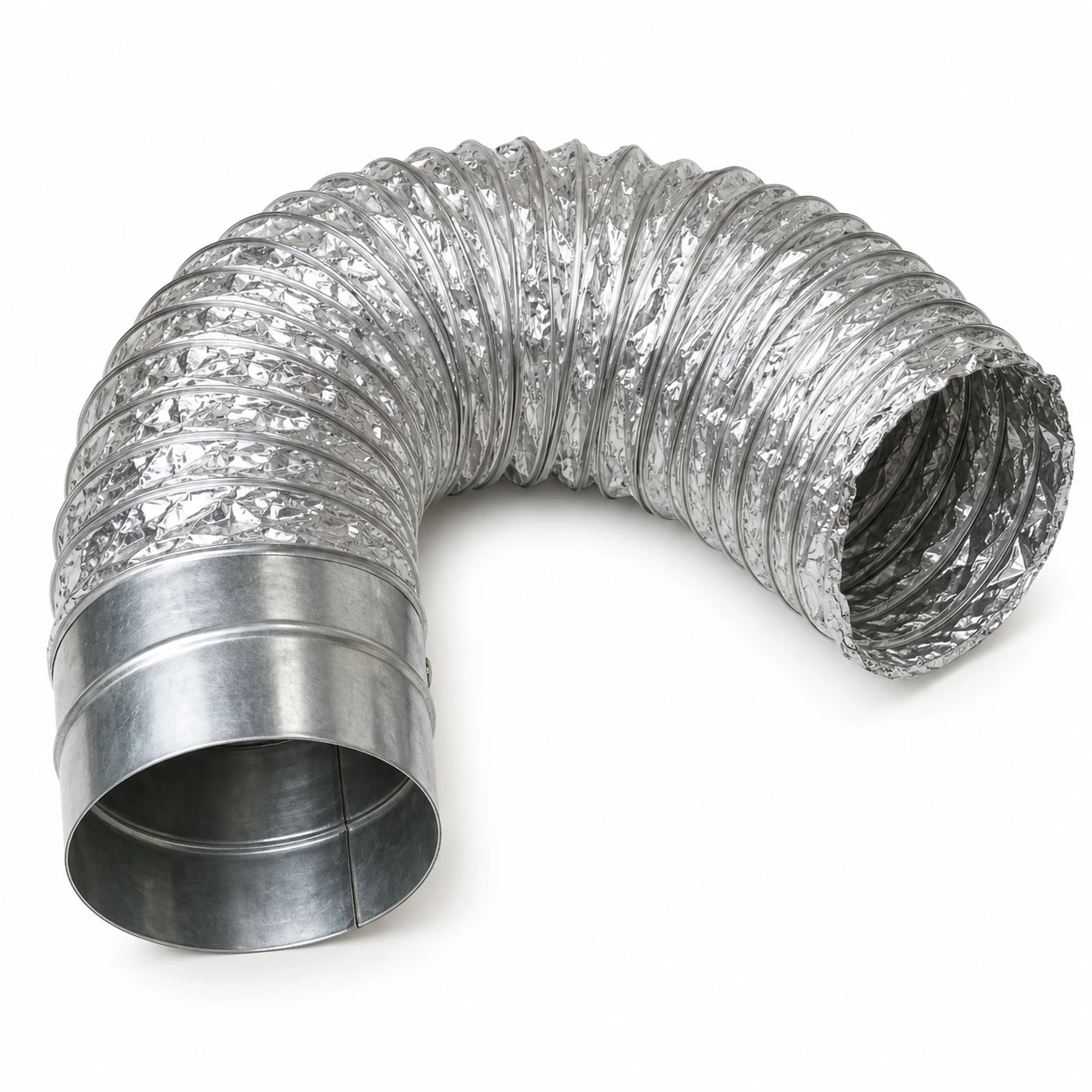
Flexible Air Ducts
6 flexible air duct hose
| Brand | shengtongJH |
|---|---|
| Nominal inside diameter | 6 in = 152.4 mm; commonly designated 152 mm |
| Related sizes | 5 in / 6 in / 8 in selected by required airflow and connection |
| Metric fit | Check 150 mm versus 152 mm spigot and hose compatibility |
| Hose wall | Aluminium/polyester laminate with steel-wire support |
| Length formats | 10 m extended pack or specified cut length |
| Thermal configurations | Uninsulated or insulated with a selected vapour jacket |
| Insulated outside envelope | Approximately 202 mm for a nominal 25 mm insulation layer |
| End attachment | Round collar, compatible seal and correctly sized clamp |
| Service air | Ordinary ventilation air within material and temperature limits |
| Mechanical exposure | Protect from abrasion, impact and repeated dragging |
| Optional accessories | Adapters, replacement collars and broad support bands |
The keyword is interpreted here as a 6-inch nominal bore. Confirm the actual equipment spigot and air duty before selecting the hose construction.
Hose length, insulation, adapters and fixing accessories can be customized to the industrial equipment or ventilation connection.
This page covers a nominal 6-inch flexible air duct hose for industrial and commercial ventilation. The hose carries air between suitable round connections; it is not a general-purpose substitute for dust-conveying, chemical-extraction or high-temperature process hose.
Ventilation hose and process hose do different jobs
A foil air hose is useful for a stationary ventilation link, where it is supported and protected from damage. A hose dragged across a workshop floor, repeatedly bent by a moving machine or used to carry abrasive particles faces a different mechanical duty. Matching the opening diameter alone cannot make those uses equivalent.
Describe what passes through the hose and how the connection moves during normal work. Clean ventilation air, oil mist, corrosive vapour and dust call for different material decisions. Where the service includes a hazardous atmosphere or material, the complete extraction arrangement needs a suitable engineering assessment.
Fit without tearing the liner
The reinforcing wire helps hold the bore open, but it does not make the liner edge immune to damage. Check the collar for sharp burrs and provide the engagement required by the selected product. A clamp should secure the correct joint, not compensate for a spigot that is too small or a hose that has been forced over an oversized fitting.
Allow maintenance without repeated damage
If equipment is removed regularly, plan a serviceable connection detail. Repeatedly cutting and re-clamping the same short hose can leave insufficient sound material at the end. Keep an accessible replaceable section and record the connection dimensions for future orders.
Buy the intended hose, not just the same-looking coil
A photograph can show the general construction but cannot establish pressure capability, temperature limits or chemical compatibility. Specify the air duty and installed length with the required bore. For stationary conditioned-air use, an insulated version may protect the surrounding space from heat gain or condensation. For repeated movement or rough handling, select a different construction designed for that mechanical service rather than adding more tape to a damaged lightweight ventilation hose.
Hose length, insulation, adapters and fixing accessories can be customized to the industrial equipment or ventilation connection.