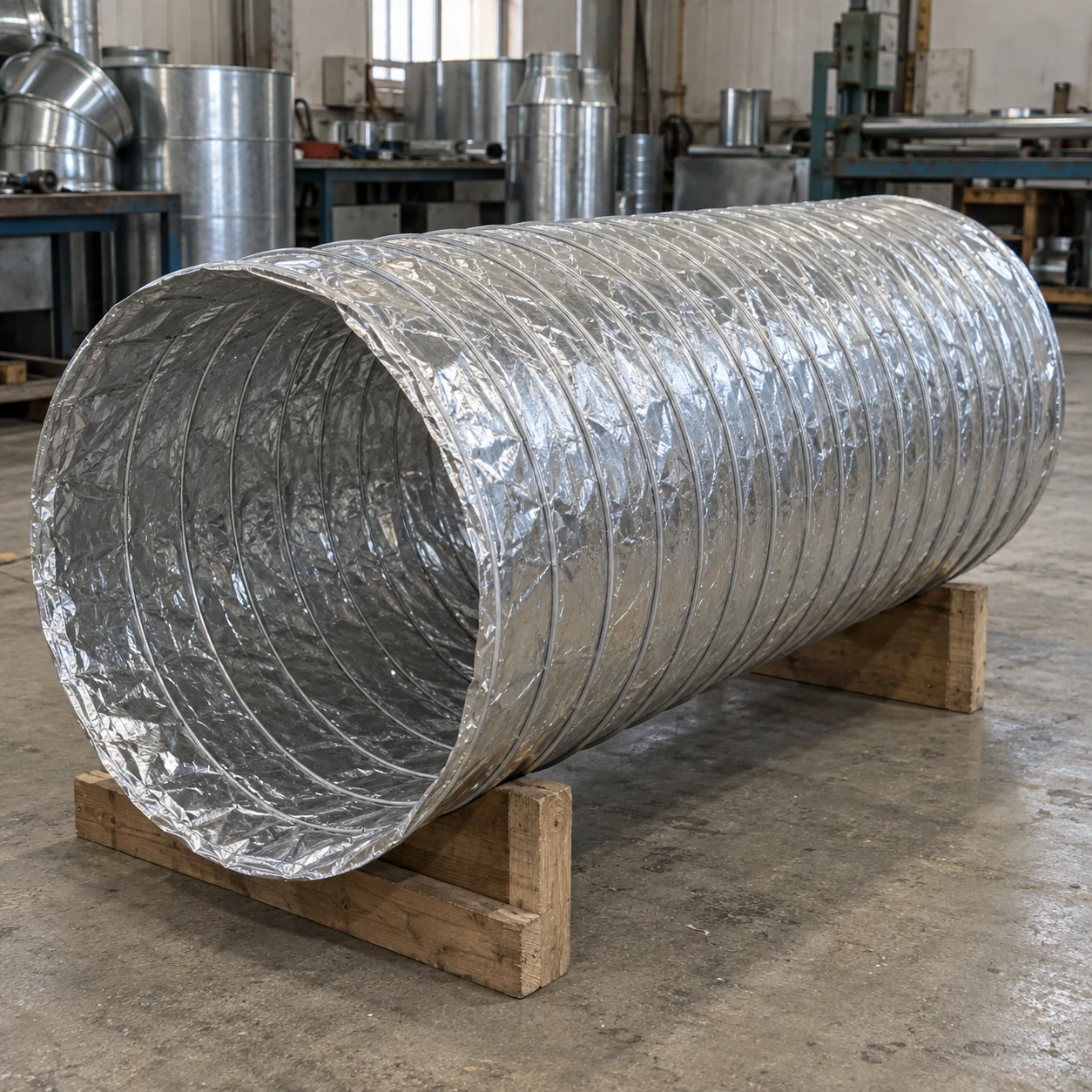
Flexible Air Ducts
24 inch flexible air duct
| Brand | shengtongJH |
|---|---|
| Nominal inside diameter | 24 in = 609.6 mm |
| Connection confirmation | Match actual collar drawing; 600 mm and 630 mm are not automatic substitutes |
| Adjacent selection sizes | 20 in / 24 in; metric alternatives require matching adapters |
| Wall configuration | Wire-reinforced laminate selected for large-bore service |
| Length | Cut connection lengths specified on the installation drawing |
| Insulation options | Uninsulated or thermally selected insulated assembly |
| Outside space | Allow bore plus twice insulation thickness, then fittings and support clearance |
| Mechanical interface | Rigid circular collars with accessible mechanical fastening |
| Support arrangement | Wide cradles; no load from attached rigid duct or equipment |
| Rating evidence | Diameter-specific positive/negative pressure and temperature data |
| Delivery format | Protected ends and packaging that avoids permanent deformation |
This is a large-bore procurement configuration, not a claim that every liner or insulation option is stocked or rated at this diameter.
Bore interfaces, short-section length, insulation and handling provisions can be customized to the large-duct installation.
24 inch flexible air duct is a nominal 609.6 mm bore product for large air connections. Availability, reinforcement and ratings must be checked for this specific size; a smaller duct range cannot simply be scaled up on paper.
Design the space around the connection
At this size, the flexible section is a substantial part of a service route. It must fit through the delivery path as well as into the final installation space. Check access doors, ceiling openings and the sequence of nearby pipework before choosing the assembled length and connection arrangement.
A large bore should remain round after installation. If the available opening requires a flattened shape, specify a proper rigid transition instead of squeezing a flexible product into place. The apparent saving in fittings can otherwise create an unpredictable restriction and difficult support detail.
Plan lifting and storage
A lightweight-looking foil surface can be easily damaged during handling. Keep sharp straps and projecting screws away from the liner and jacket. Use supports that spread the load, and store the duct so that other materials cannot flatten it. Inspect ends before fitting because damage hidden under a clamp is difficult to correct later.
Specify a usable connection length
Choose the shortest practical route that permits the intended movement or offset without tension. A long unsupported span can sag, while a short piece stretched between poorly aligned collars can pull at the joints. Show the actual connection planes and space for support hardware on the installation sketch.
Compare a flexible link with a rigid alternative
For a long straight trunk, rigid ductwork generally provides a clearer structural and pressure-design basis. Flexible material is more useful at an intentional transition or final connection. shengtongJH can source against that defined scope, including the required diameter-specific technical data. Where a selected flexible range stops at a smaller size, the answer is a different suitable construction or a revised connection design, not an unsupported rating copied from another product.
Bore interfaces, short-section length, insulation and handling provisions can be customized to the large-duct installation.