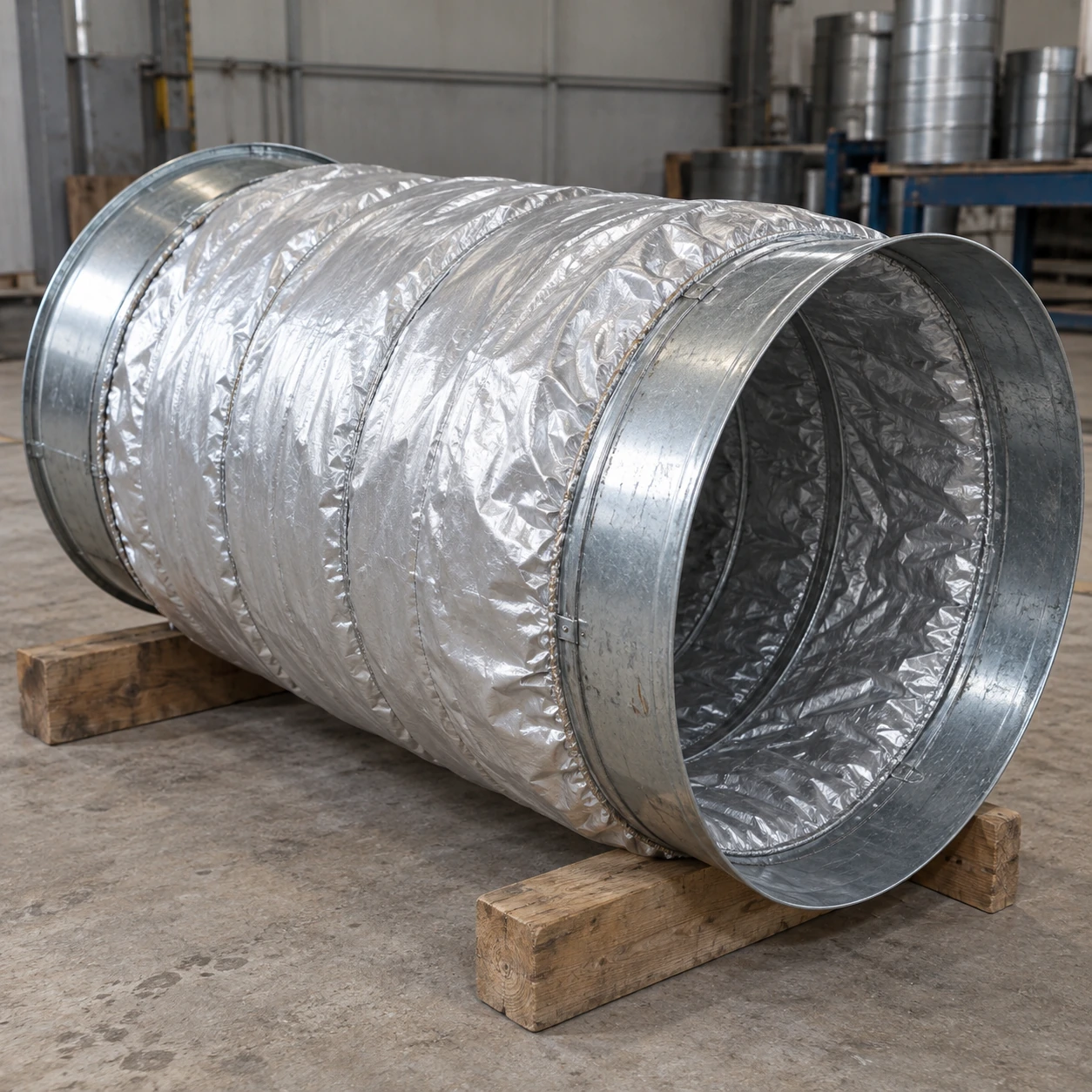
Flexible Air Ducts
20 inch flexible air duct
| Brand | shengtongJH |
|---|---|
| Nominal inside diameter | 20 in = 508 mm |
| Related large-bore options | 16 in / 20 in / 24 in, by system design |
| Construction | Reinforced foil liner; insulated assembly where required |
| Length ordering | Short connecting sections or extended pack length agreed with construction |
| Thermal option | 25 mm insulation; thicker construction by thermal design |
| Outside envelope | Approximately 558 mm with 25 mm insulation, before collars and supports |
| Connections | Sized rigid collars with independently supported adjacent ductwork |
| Supports | Broad cradles selected for complete assembly weight |
| Positive pressure | Maximum supply pressure must be below the selected duct rating |
| Negative pressure | Separate suction rating required for return or extract service |
| Location | Accessible protected indoor equipment or branch connection |
Large diameters can have lower pressure limits than smaller sizes in the same product family. Confirm the rating for the ordered diameter, not a range headline.
Large-bore lengths, jacket, collars and support arrangements can be customized to the equipment connection and site clearance.
20 inch flexible air duct has a nominal 508 mm bore and needs considerably more support and turning space than a small terminal hose. It is best considered as a planned connection within a larger air system, with the adjacent rigid ductwork defining the route.
Keep the main route supported by rigid ductwork
A flexible connection is useful when a large branch and an equipment connection do not align perfectly. It should not be expected to carry a suspended rigid duct or hold a heavy terminal in position. Support both adjacent assemblies independently, then provide the flexible section with a suitable cradle arrangement of its own.
Consider maintenance access before closing the ceiling. A large hose can block access to dampers, fan panels or nearby pipe valves even if the drawing shows enough room for its nominal bore. The outside jacket and its supports consume additional space.
Pressure ratings change with construction and diameter
Do not apply a small-size catalogue limit to a larger hose without checking the actual size entry. A large flexible wall experiences different loading, and its reinforcement and joints need to be selected accordingly. Positive pressure and suction also load the wall differently; one stated pressure value is not automatically a rating for both directions.
Tell the supplier whether the connection is on the fan inlet or discharge and include the maximum expected condition, including operation with dampers changing position. If a flexible construction cannot meet that duty, retain a rigid route and use a purpose-designed connection appropriate to the equipment.
Make the transition predictable
Where a rectangular plenum feeds the round connection, provide a suitable transition rather than pulling the hose into an oval opening. Preserve the connection shape through the first bend and keep the fixing accessible. For replacement work, a sketch showing the two connection planes, offset and surrounding obstructions is more useful than a photograph of a coil. It allows the duct length, transition and support scope to be agreed before materials arrive on site.
Large-bore lengths, jacket, collars and support arrangements can be customized to the equipment connection and site clearance.