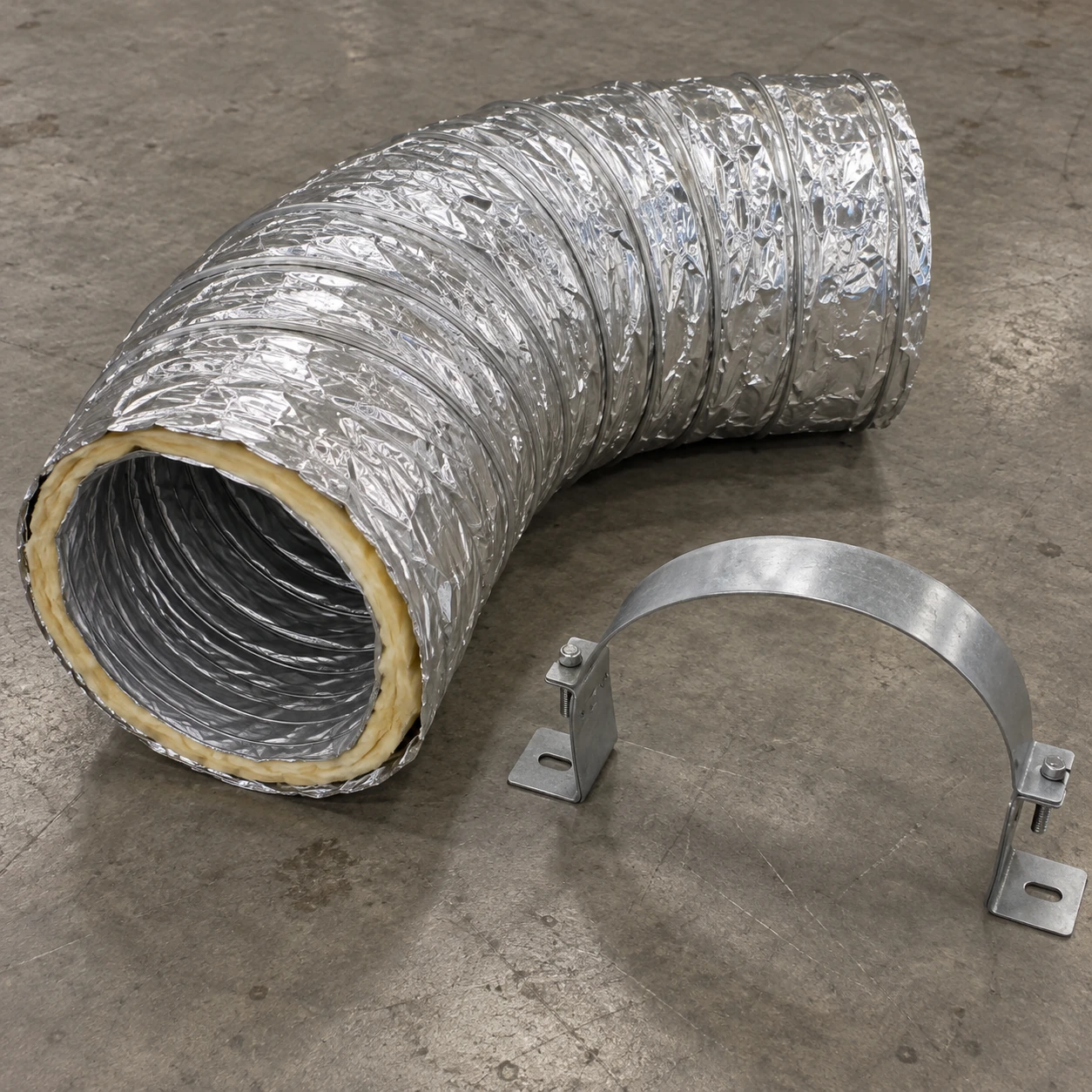
Flexible Air Ducts
16 inch flexible air duct
| Brand | shengtongJH |
|---|---|
| Nominal inside diameter | 16 in = 406.4 mm; commonly designated 406 mm |
| Other large-branch sizes | 12 in / 16 in / 20 in |
| Connection check | Confirm actual collar outside diameter and insertion detail |
| Length choices | Specified short link or extended supply length by construction |
| Core | Steel-wire-reinforced foil laminate |
| Thermal alternatives | Uninsulated or 25 mm glass-wool insulated assembly |
| Insulated outside envelope | Approximately 456 mm before collars and support clearance |
| Supply service | Diameter-specific positive pressure rating required |
| Return service | Diameter-specific negative pressure rating required |
| Supports | Broad saddle or support band, independent of equipment panels |
| Maintenance space | Clearance for filter doors, fan panels and joint access |
A pressure limit quoted for smaller bores must not be applied to this size without supporting product data. The chosen assembly determines its permitted duty.
Bore interfaces, insulation, cut length and support details can be customized to the equipment and maintenance layout.
16 inch flexible air duct connects a nominal 406.4 mm air opening. On equipment branches and larger return-air routes, support, suction resistance and access around the connection need to be considered together.
Do not let the connection block the service door
A connection can fit neatly on a plan and still obstruct a filter door when installed. Check the equipment's removal path and panel swing before fixing the duct route. Include the insulated outside envelope and support hardware, not just a circle showing the nominal airway.
If the hose must be removed for every filter change, reconsider the arrangement. A short rigid offset or a different collar position may make routine maintenance easier and reduce the chance of damaging the flexible connection.
Suction can expose a weak selection
A return-air hose experiences inward loading. A construction that performs adequately under modest positive pressure may not have the same suction capability. Select the negative-pressure rating explicitly and consider the fan operating conditions when filters or dampers increase resistance.
Do not treat visible flattening during operation as a normal feature of flexible duct. It is a reason to inspect the support, restriction and pressure selection before continuing to use the connection in that condition.
Separate structural support from flexibility
The flexible section should bridge the intended connection without carrying adjacent ductwork. Use support geometry that spreads the weight and retains the open section. Avoid tightening a narrow band until it dents the insulation or liner; that creates a restriction and may damage the jacket.
At the equipment end, provide enough accessible collar length for the required fastening and seal. A tightly crowded connection is difficult to inspect after installation. Where vibration control is important, review the equipment isolators and the complete connection arrangement rather than assuming any flexible hose provides a measured vibration-isolation performance.
Define the replacement boundary
For an existing installation, identify whether the order includes only hose or also collars, supports and insulation closures. Supplying those parts to a common connection drawing reduces the chance of a technically suitable hose arriving with incompatible fixing hardware.
Bore interfaces, insulation, cut length and support details can be customized to the equipment and maintenance layout.