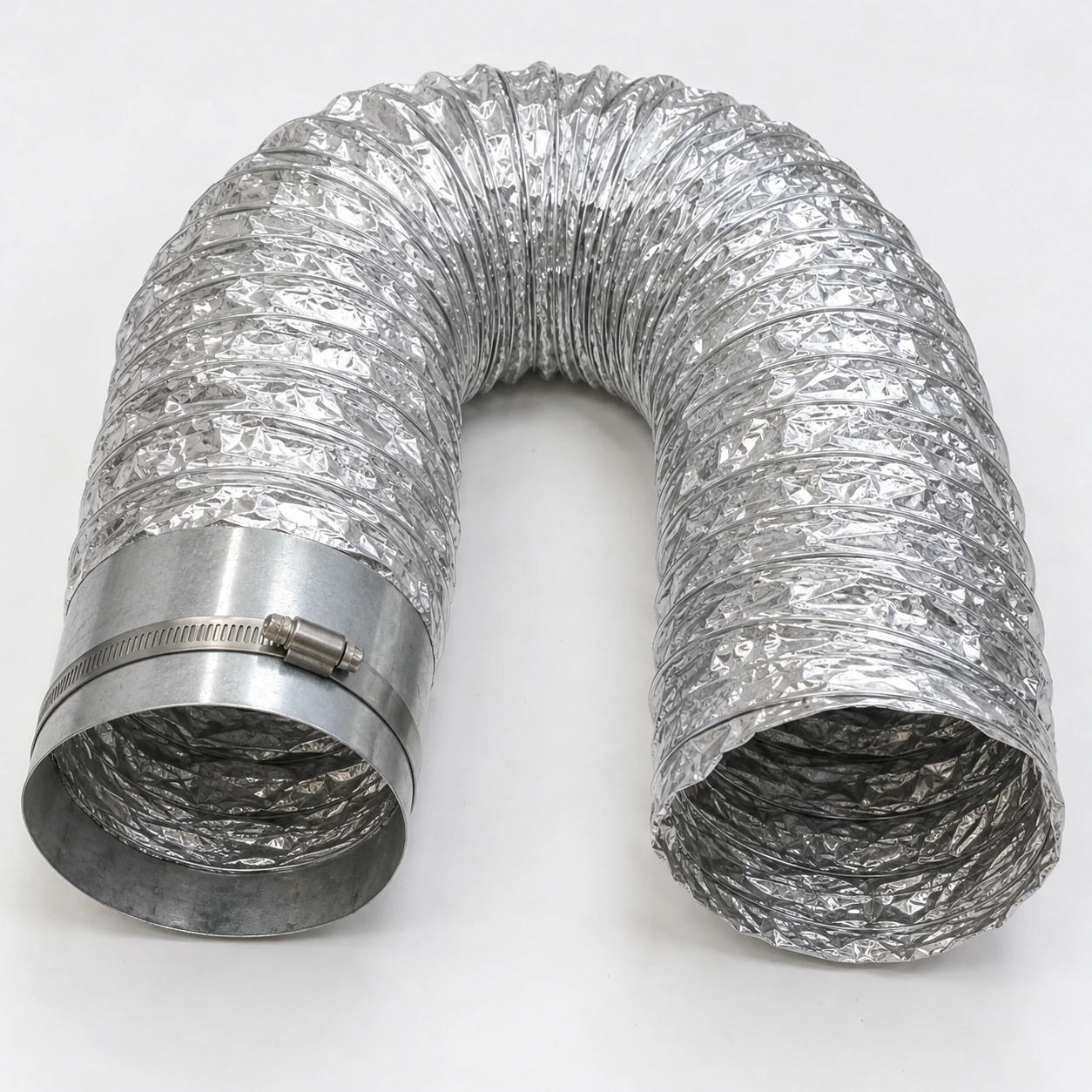
Flexible Air Ducts
12 inch flexible air duct
| Brand | shengtongJH |
|---|---|
| Nominal inside diameter | 12 in = 304.8 mm; commonly designated 305 mm |
| Adjacent sizes | 10 in / 12 in / 16 in; select each branch from its duty |
| Collar compatibility | Match the selected 12 in collar and insertion allowance; 300 or 315 mm requires a fit check |
| Extended supply length | 10 m pack or cut-to-length connection |
| Wall choices | Uninsulated foil laminate or insulated reinforced liner |
| Insulation option | 25 mm glass-wool layer; higher thermal resistance by selection |
| Outside clearance | Approximately 355 mm with a 25 mm layer, plus fittings and supports |
| End fittings | Round galvanized collar and mechanically secured seal |
| Support | Broad cradle or band that preserves the circular airway |
| Operating limits | Pressure and temperature according to the selected complete duct |
| Intended duty | General supply, return or ventilation air within the selected rating |
Diameter is a nominal connection size, not a guaranteed airflow. Final airflow depends on the installed route and fan-system pressure.
Connection length, insulation, collar geometry and support accessories can be customized to the terminal or equipment layout.
A 12 inch flexible air duct is a nominal 304.8 mm bore connection for industrial and commercial air distribution. It is often considered for larger terminals or short equipment branches, where the connecting space and pressure allowance matter as much as the diameter.
A large terminal needs a clear approach
A flexible section can join a branch to a larger grille or terminal box without a complicated set of small fittings. The benefit disappears if the last part of the duct turns abruptly immediately before the inlet. That arrangement uses up space inside the bend and can deliver an uneven approach to the connected component.
Set the terminal location first and arrange the branch take-off so the connecting duct has a broad approach. Where the equipment requires a straight inlet section, provide it rather than assuming flexible hose will compensate for an awkward take-off position.
Check the actual collar
Inch and metric descriptions are easily mixed on purchase orders. A nearby metric size may look similar in a photograph but still need a reducer or a different collar. Record the spigot outside diameter, its available engagement length and any bead or fixing detail. Confirm these against the selected duct connection before shipment.
Keep the ceiling opening separate
The size of a grille face or ceiling opening does not identify the duct inlet behind it. A terminal may include a plenum with a smaller or differently oriented connection. Use the terminal drawing for the flexible connection and the architectural opening drawing for the ceiling work.
Resolve low airflow at the source
If an existing outlet is weak, inspect the branch damper, connection and duct condition before ordering a bigger hose. A crushed section or a closed damper can waste an otherwise suitable branch. If the route itself is too restrictive, compare a revised rigid approach with a shorter flexible link. shengtongJH can coordinate the duct and connection accessories around that agreed arrangement, without treating diameter alone as a promise of system performance.
Connection length, insulation, collar geometry and support accessories can be customized to the terminal or equipment layout.