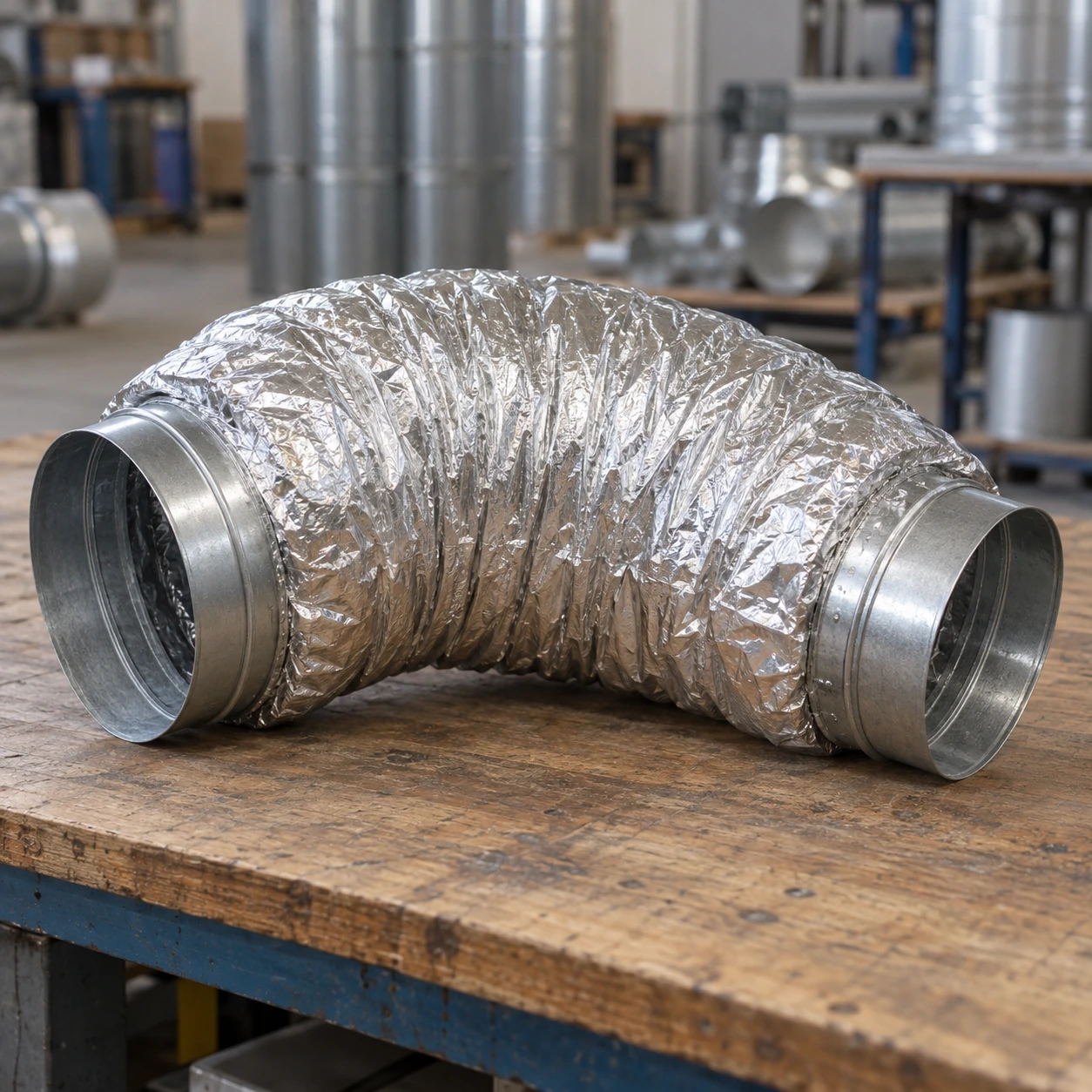
Flexible Air Ducts
10 inch flexible air duct
| Brand | shengtongJH |
|---|---|
| Nominal inside diameter | 10 in / 254 mm |
| Other branch sizes | 8 in / 12 in available as separate connection choices |
| Length choices | Project cut length or 10 m fully extended pack |
| Core construction | Steel-wire-supported aluminium/polyester laminate |
| Thermal options | Bare duct or 25 mm insulated construction |
| Insulated outside envelope | Approximately 304 mm with a 25 mm layer, excluding collars |
| End connection | Slip collar, compatible seal and clamp |
| Jacket | Foil laminate on insulated configurations |
| Pressure service | Supply or return; select a suitable pressure rating for each |
| Support interface | Broad bands or saddles with access at the joints |
| Installation use | Indoor branch replacement and terminal connections |
A nominal 250 mm metric connection is not automatically interchangeable with 254 mm. Confirm actual fit before ordering duct and collars together.
Replacement lengths, insulation and connection fittings can be customized to existing industrial or commercial branches.
10 inch flexible air duct serves a nominal 254 mm connection. For replacement work, matching the original opening is only the first step: the selected duct also needs to suit the air conditions and the route left by adjacent services.
Replace the cause of the restriction
An old branch often develops a problem after something else has been installed nearby. A cable tray may push it sideways, or maintenance access may leave a section flattened. Photograph and measure the route before removing the damaged duct so the replacement does not repeat the same obstruction.
Look at the condition of the liner as well as the outer sleeve. An apparently intact jacket can hide a separated inner connection. Replacing only a visible outer patch will not restore an airway that has pulled away from its collar.
Reuse the collar carefully
Check that the spigot is round, firmly mounted and free from sharp damage. Old adhesive and broken fixings should not determine how the new duct seats. Include replacement collars in the order when the existing parts cannot provide a secure connection.
Measure the useful route
Order enough length for the planned bend and engagement at each end, while avoiding surplus coils. A flexible pack's shipping size says little about its installed length. Compare quotations on fully extended supplied length and the number of separate runs required.
Restore the thermal layer
For cooled supply air, reconnect the insulation and vapour jacket around the collar as part of the job. Leaving a bare neck in a humid void can move the condensation problem from the old hose to the new fitting.
Check the branch after replacement
Replacing duct can change resistance and shift airflow between neighbouring outlets. Return any balancing damper to its recorded position, then have the branch airflow checked under normal operation. If an outlet remains weak, the fan setting, main branch or terminal may still require attention. A hose replacement cannot correct every upstream limitation, but it should leave a secure, accessible connection that is easier to maintain.
Replacement lengths, insulation and connection fittings can be customized to existing industrial or commercial branches.