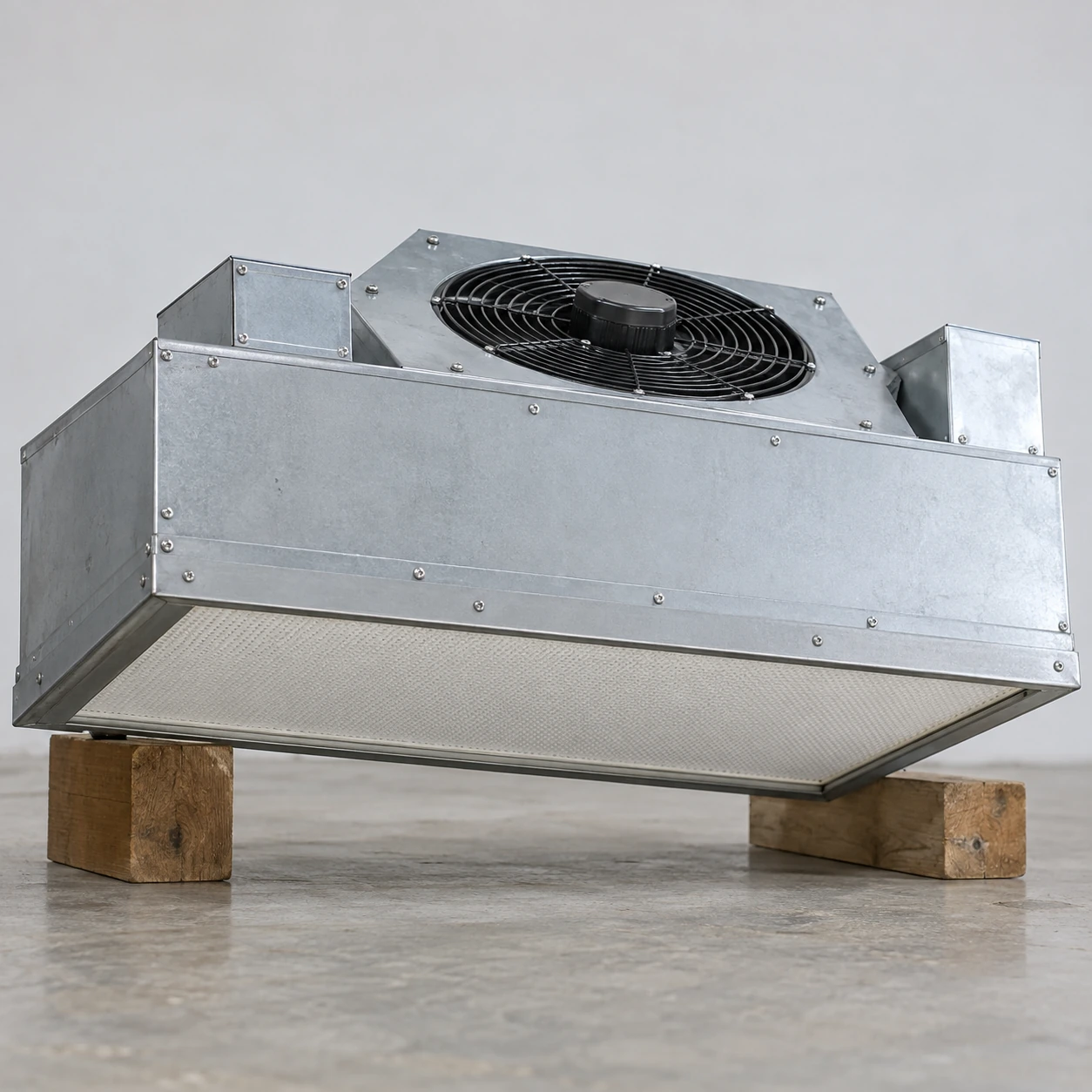
Fan Filter Units & Air Terminals
hepa fan filter unit
| Brand | shengtongJH |
|---|---|
| Equipment | Powered HEPA final-filter supply module |
| Housing W × D × H options | 575 × 575 × 280 / 1175 × 575 × 280 mm |
| Filter W × D × H | 570 × 570 × 70 / 1170 × 570 × 70 mm |
| Filter class choices | H13 / H14 to EN 1822 |
| Integral classification criteria | H13 ≥99.95% / H14 ≥99.995% at MPPS |
| Housing material | Galvanized steel or stainless steel |
| Fan/drive | AC or EC centrifugal arrangement |
| Power supply | 220–240 V, 50 Hz; other supply by specification |
| Operating airflow | Selected against filter resistance and the required supply duty |
| Sealing | Compatible perimeter gasket or gel-seal design |
| Verification provisions | Filter identity, corresponding test record and accessible test interfaces as specified |
The listed percentages define filter classes. They do not state the measured performance of the complete FFU, work zone or room.
Filter grade, housing dimensions, seals and verification interfaces can be customized to the process and installation.
A HEPA fan filter unit supplies air through a high-efficiency particle filter. The filter class matters, but useful protection also depends on sealing, air distribution and conditions at the work position.
Read the efficiency claim correctly
HEPA classification concerns particle penetration under defined test conditions. The most penetrating particle size, or MPPS, identifies the challenging particle-size region for that filter medium and test condition. It is not a fixed pore diameter or a promise that every particle smaller than it passes through.
Request documentation that belongs to the supplied filter, with its identity and applicable test conditions. A general brochure statement cannot establish that a different panel, assembled into a different housing, has the same result.
Protect the product beyond the filter face
Filtered air can mix with less-clean surrounding air before reaching the task. Cross-drafts, operator movement and hot machinery affect that path. Put the protected operation within the intended supply arrangement and keep avoidable obstructions out of it.
A local enclosure can help define the work zone, but its access openings and return path still need attention. More air is not always the answer: excessive disturbance can make a poorly organized zone harder to control. Select the airflow around the process rather than treating maximum fan speed as the desired setting.
Prevent bypass
The final filter only treats air passing through its media. Air leaking around a damaged gasket avoids that treatment. Correct seating, uniform retention and a compatible housing are therefore part of filtration performance, not minor installation details.
Maintain enough delivery
A fan must overcome the selected filter's resistance and the intake path. Review the duty when changing filter construction. A higher-grade element may be suitable, but it should not be installed without checking the resulting airflow.
Choose protection appropriate to the hazard
These units are useful for many particle-sensitive industrial tasks. They do not automatically provide operator containment for toxic material or remove gases and vapours. Those hazards require a separate assessment and appropriate capture or treatment equipment.
Evaluate the finished work area using the measurements required by the process. Keep filter documentation, installed checks and room or work-zone results distinct so that each conclusion is supported by the right evidence.
Filter grade, housing dimensions, seals and verification interfaces can be customized to the process and installation.