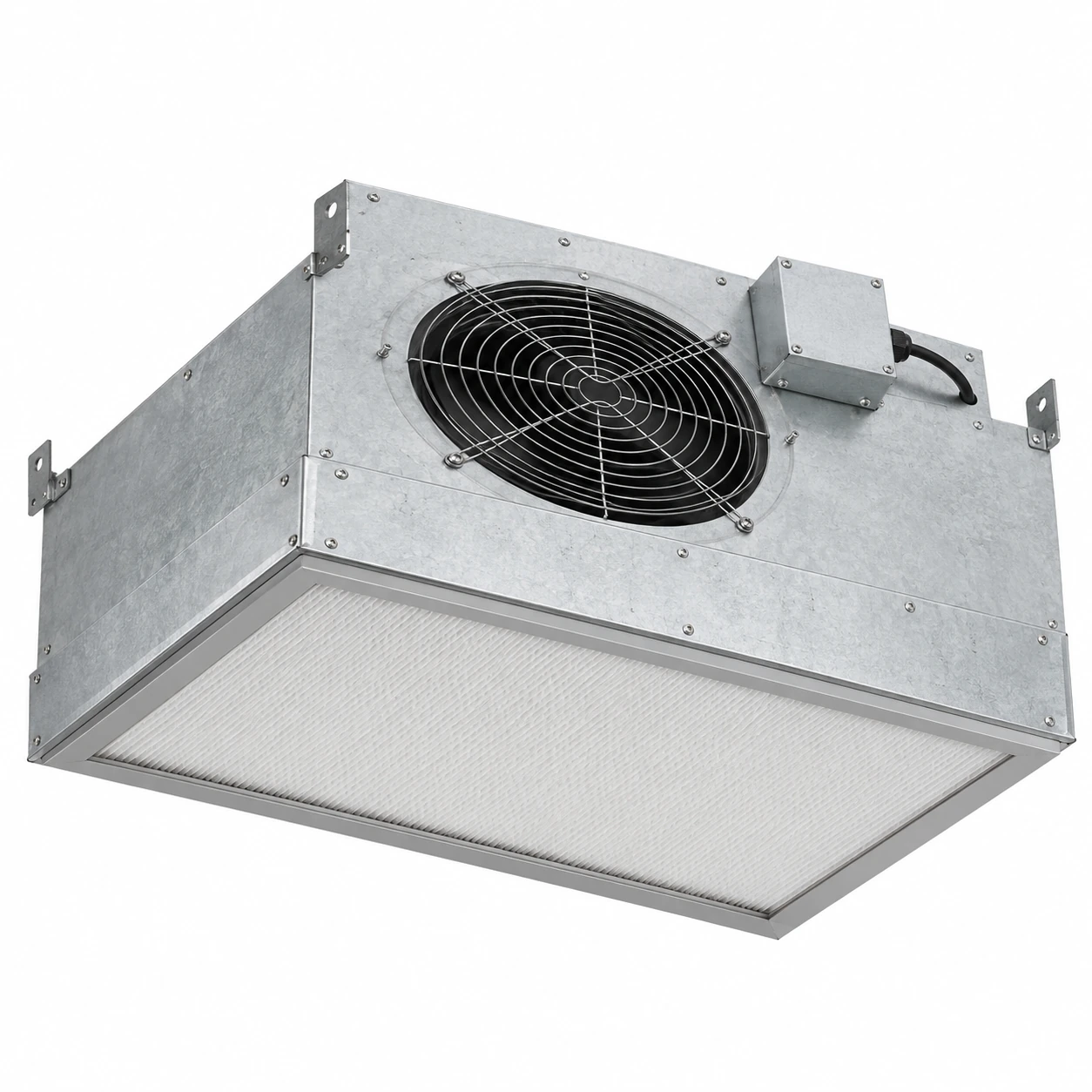
Fan Filter Units & Air Terminals
ffu
| Brand | shengtongJH |
|---|---|
| Equipment | Self-powered fan and final-filter module |
| Housing W × D × H | 575 × 575 × 280 / 1175 × 575 × 280 mm |
| Matched filter W × D × H | 570 × 570 × 70 / 1170 × 570 × 70 mm |
| Housing material | Galvanized steel; stainless steel option |
| Final filter | H13 or H14 HEPA, selected with matching test documentation |
| Fan | Centrifugal AC or EC arrangement |
| Electrical supply | 220–240 V, 50 Hz; destination-specific components by selection |
| Airflow setting | Adjustable to the selected fan/filter duty |
| Prefilter | Accessible inlet prefilter where the intake arrangement permits |
| Controls | Local speed adjustment; grouped control option |
| Mounting | Supported ceiling grid or purpose-built equipment frame |
Dimensions describe selectable equipment formats. Delivered airflow, electrical input and noise depend on the complete selected configuration and operating condition.
Housing dimensions, filter selection, support interfaces and controls can be customized to the industrial application.
An FFU combines a powered fan and a final particle filter in a compact supply module. It directs filtered air towards exposed industrial work, with the fan and filter housed in one serviceable assembly.
Put filtered air where the work needs it
Dust entering an open assembly or inspection operation can lead to cleaning, rework or rejected components. A local FFU arrangement is useful when the sensitive area is smaller than the surrounding production floor. Examples include optical inspection, precision assembly and nonhazardous component preparation.
The fan draws air into the housing and moves it through the final filter. The outlet should face the protected work, with a clear route for the air to continue out of that area. A tall machine directly below the filter can interrupt this path; increasing fan speed may simply make the surrounding air more turbulent.
What is inside the module?
The casing supports the fan and creates a distribution space above the filter. The filter removes particles from the passing air, while its perimeter seal prevents air taking a shortcut around the media. The controller sets the fan operation. These parts must work together: a high-efficiency filter on an unsuitable fan does not automatically provide adequate clean-air delivery.
What stays outside its scope?
A standard FFU does not generate outdoor air, cool a room or control humidity. It also does not substitute for extraction of hazardous vapours or dust. Those functions require suitable building services or dedicated process equipment. Filtered supply and contaminant extraction should be planned together where both are necessary.
Buy the interface as well as the equipment
Check the structural support, ceiling opening, inlet clearance and filter replacement route before ordering. The filter frame is smaller than the overall housing, and nominal ceiling sizes are not sufficient for confirming fit. Make the perimeter seal accessible without removing unrelated services.
For a small installation, an identifiable local adjustment may be enough. Several modules serving one work area benefit from coordinated settings so one unit does not overpower its neighbours. After installation, establish airflow and pressure baselines under the intended operating conditions. This provides a useful reference when output changes later.
shengtongJH can source the module and matching configuration around the process, available space and maintenance access. Room cleanliness remains an outcome of the complete installation and its operation.
Housing dimensions, filter selection, support interfaces and controls can be customized to the industrial application.