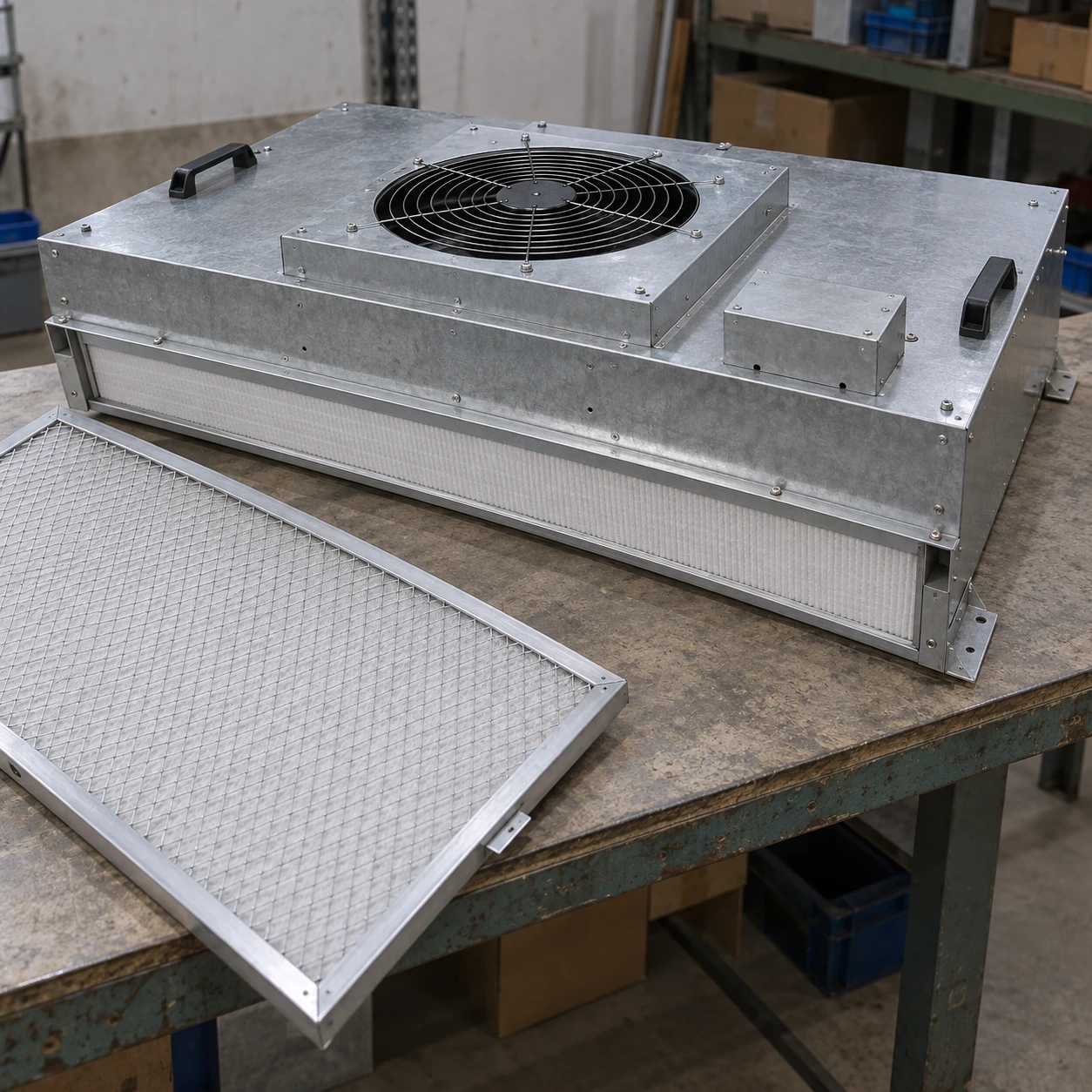
Fan Filter Units & Air Terminals
ffu filter fan unit
| Brand | shengtongJH |
|---|---|
| Configuration | Serviceable fan housing with removable final filter |
| Housing W × D × H | 575 × 575 × 280 / 1175 × 575 × 280 / 1175 × 875 × 280 mm |
| Filter W × D × H | 570 × 570 × 70 / 1170 × 570 × 70 / 1170 × 870 × 70 mm |
| Housing material | Galvanized steel; stainless steel available |
| Filter grade | H13 or H14 HEPA to match the process |
| Motor alternatives | Compatible AC or EC centrifugal fan |
| Supply options | 220–240 V, 50 Hz; destination supply by selection |
| Service access | Fan access and filter removal direction selected for the site |
| Prefilter | Replaceable inlet stage where specified |
| Diagnostic interfaces | Pressure test points; airflow and fault indication options |
| Replacement details | Identifiable filter seat, seals and controller connection |
Replacement parts must match the existing mechanical and electrical interfaces. A controller or motor cannot be substituted solely by its power rating.
Access panels, filter retention, monitoring connections and module dimensions can be customized to the maintenance conditions.
An FFU filter fan unit should be easy to service without losing its filter seal or established air delivery. Accessible components and a clear fault-finding sequence can reduce unnecessary replacement of complete modules.
Low airflow does not always mean a failed fan
Begin with the operating setting and the accessible air path. A covered inlet, loaded prefilter or obstructed room return can reduce delivery. If output declined gradually, filter loading is one possible cause; if it changed suddenly, also examine power, controls and recently moved equipment.
Compare measurements with the commissioning baseline using the same locations and conditions. A single reading beside the outlet edge is not a reliable description of the whole face. Avoid increasing speed beyond the selected equipment's limits to hide a restriction.
New vibration needs investigation
A loose mounting, damaged impeller or contact between parts can cause vibration. Check supports and accessible fasteners with the equipment safely isolated. Persistent imbalance requires assessment of the rotating assembly, not improvised weights or bending of blades.
Sound can also travel through the ceiling support. Establish whether the source is the fan itself, an intake restriction or vibration transmitted into the frame before selecting a remedy.
Separate filter condition from filter sealing
A loaded filter usually changes resistance; a damaged seal can allow bypass without producing the same warning. Pressure monitoring therefore cannot replace an integrity assessment where the process requires one. Inspect the frame and seating arrangement during replacement and investigate any damage before returning the unit to use.
Handle HEPA panels by their frames and keep tools clear of the media. A replacement should preserve the specified filter class, pressure compatibility and seal geometry. A panel that is easier to force into the opening is not necessarily the correct part.
Order parts against the actual assembly
Record motor and controller details, supply, connector arrangement and mechanical fixing positions before requesting a replacement. An apparently similar fan may rotate differently, demand another controller or provide an unsuitable pressure curve.
For maintainable new purchases, provide sufficient withdrawal space and a sensible isolation point. Keep filter and drive identities with the equipment location. After repairs, verify airflow and any required integrity checks before restarting the protected operation. shengtongJH can source a complete unit or compatible replacement configuration once those interfaces are defined.
Access panels, filter retention, monitoring connections and module dimensions can be customized to the maintenance conditions.