Fan Filter Units & Air Terminals
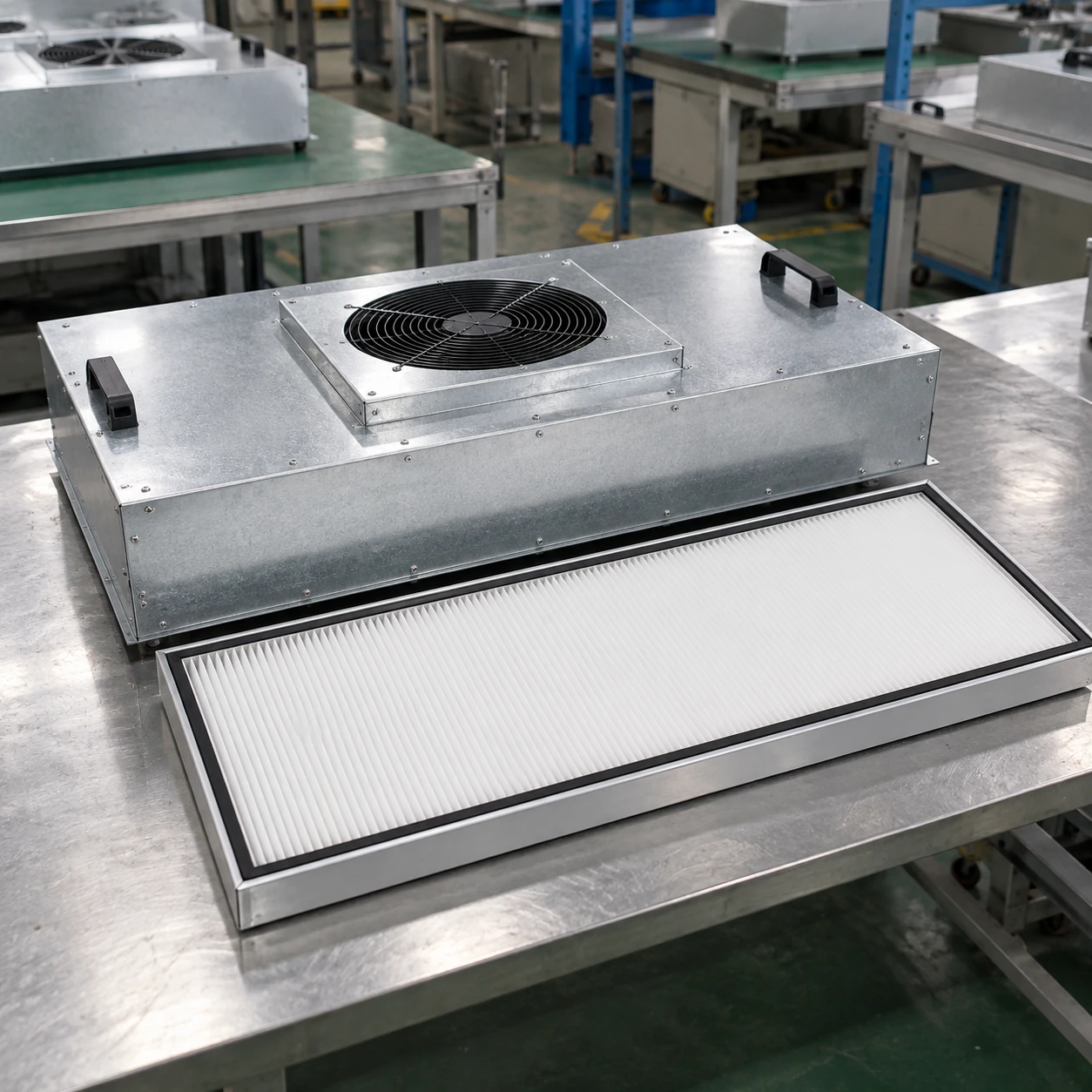
ffu fan filter
| Brand | shengtongJH |
|---|---|
| Assembly | Fan module with matched final-filter panel |
| Housing W × D × H options | 575 × 575 × 280 / 1175 × 575 × 280 / 1175 × 875 × 280 mm |
| Corresponding filter sizes | 570 × 570 × 70 / 1170 × 570 × 70 / 1170 × 870 × 70 mm |
| Filter grade options | H13 or H14 to EN 1822, subject to supplied-item documentation |
| Housing finish | Galvanized sheet or stainless steel |
| Fan selection | AC or EC centrifugal fan |
| Power supply | 220–240 V, 50 Hz; other supply to match the selected drive |
| Duty selection | Required airflow at combined filter and air-path resistance |
| Loading allowance | Fan operating margin selected from the duty curve |
| Adjustment | Compatible local speed control or group controller |
| Service options | Replaceable prefilter and accessible final-filter retention |
Fan free-air capacity is not the output of the assembled FFU. Confirm the selected duty with the final filter and intended intake arrangement in place.
Fan/filter combinations, enclosure dimensions and service arrangements can be customized to the operating space and required airflow.
The fan and filter in an FFU must be selected as a working pair. A replacement filter that fits the frame can still change the delivered airflow if its resistance differs from the original selection.
Start with useful airflow, not motor wattage
Two fans with the same electrical input can deliver different air volumes through the same filter. Impeller geometry, motor control and the pressure capability all influence the result. A useful comparison therefore states the required airflow and the resistance the fan must overcome, rather than comparing power labels alone.
The resistance includes the final filter and any inlet screen, prefilter, duct connection or restricted plenum. Selecting the fan against the clean filter alone can leave too little adjustment as dust accumulates. The assembly needs a practical service limit as well as an initial setting.
A different filter may change the operating point
Higher efficiency does not identify the pressure drop of every available panel. Media area, pleat construction and filter depth also matter. Ask for the offered panel's resistance at the actual duty. If a proposed replacement is substantially different, review the fan setting and available pressure before fitting it.
Raising speed to overcome resistance may increase sound and electrical demand. If the fan is already at its permitted operating limit, more controller adjustment cannot solve the mismatch. A different filter construction or a suitably selected fan may be required.
Match the physical seat
Measure the panel frame and depth, then check the sealing surface and retaining arrangement. Similar width and length do not establish compatibility between gasket and gel-seal designs.
Keep the inlet usable
Leave clearance above the fan. An inlet close to a beam or cable tray can reduce output and create uneven supply even when the filter is serviceable.
Record a baseline
Record airflow, controller setting and relevant pressure readings after commissioning. Later comparisons are meaningful only when measurement positions and operating conditions are consistent.
Resolve uneven delivery before replacing everything
If one part of the work zone receives little air, examine the outlet obstruction, seating and surrounding return route before assuming the motor is too small. A local blockage or bypass requires a different correction from a loaded filter. shengtongJH can coordinate a matched purchase when the existing housing dimensions, desired duty and control arrangement are known.
Fan/filter combinations, enclosure dimensions and service arrangements can be customized to the operating space and required airflow.