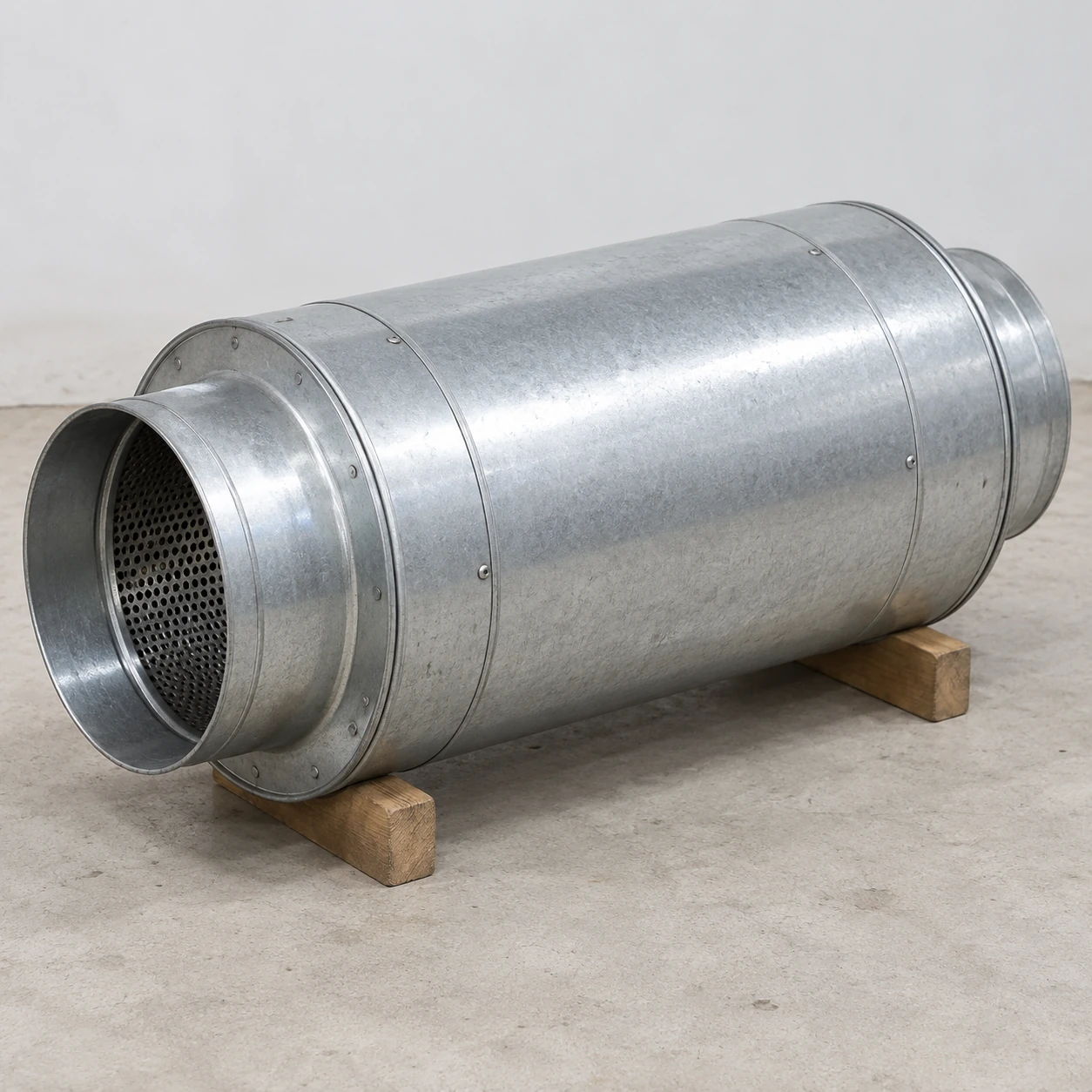
Duct Silencers
inline duct silencer
| Brand | shengtongJH |
|---|---|
| Air connection bore | 160 / 200 / 250 / 315 mm |
| Body length options | 600 / 900 mm |
| Air passage | Straight-through perforated inner tube |
| Nominal lining depth | 50 mm construction option |
| Casing | Galvanized steel cylinder |
| Acoustic protection | Perforated inner wall with compatible fibre-retaining layer |
| End interfaces | Spigot connection or specified circular flanges |
| Outer diameter | Selected body drawing; larger than the nominal bore |
| Mounting | Suitable clamps or cradles independent of the fan connection |
| Accessories | Matching couplers, transitions and accessible joint fixings |
Bore, body diameter and total end-to-end length are different dimensions. Confirm the final connection drawing before ordering clamps or support hardware.
Circular bore, body length, casing material and connection fittings can be customized to the branch and installation conditions.
An inline duct silencer fits into a circular air route with aligned inlet and outlet connections. It offers a straightforward installation format, but the lined outer body is larger than the air connection and needs its own clearance and support.
Fit the body, not just the spigot
A round duct may pass between existing services while a lined silencer of the same nominal bore cannot. The acoustic layer and outer skin increase its diameter. Check clearance to structure, pipe insulation and adjacent ducts along the whole body, including the space needed to tighten the joint.
Specify whether the quoted length includes the connecting ends. A body that appears to match the available gap can become too long once couplers, flanges or a required removable joint are added.
Do not load the fan casing
A silencer installed near an inline fan still needs a suitable support arrangement. Its weight and connection forces should not distort the fan housing or pull nearby flexible joints out of alignment. Match clamps or cradles to the actual body rather than the smaller connecting bore.
Straight-through does not mean zero resistance
The clear passage, internal surface and end geometry all affect pressure loss. Some circular silencers include a centre element, while others have an open bore. These constructions cannot be compared only by outside diameter or total length. Request data for the specific arrangement at the intended airflow.
Nearby bends and fan discharge can create an uneven velocity profile. Follow the selected equipment's installation guidance when deciding the adjacent layout; there is no single spacing rule that suits every fan and silencer combination.
Choose a serviceable branch assembly
Provide a way to disconnect or inspect the unit without dismantling unrelated services. Check whether the air contains dust, moisture or substances unsuitable for the lining. A general ventilation attenuator should not be substituted into a harsh process-extraction route merely because its spigot fits.
For a compact procurement brief, include bore, airflow, available length, neighbouring fittings and the noise issue. shengtongJH can then source the silencer and connection accessories as a coordinated assembly rather than treating each round component as interchangeable.
Circular bore, body length, casing material and connection fittings can be customized to the branch and installation conditions.