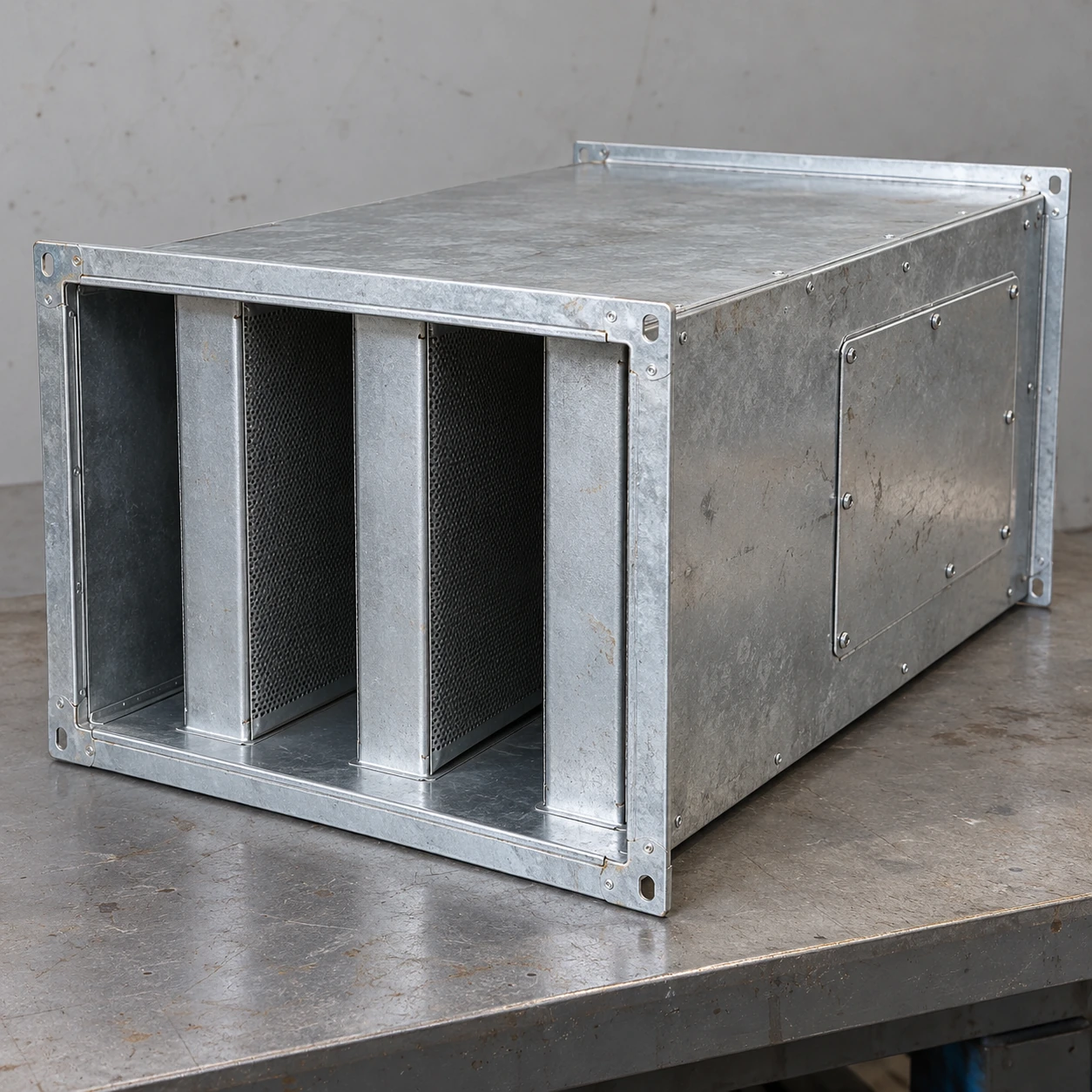
Duct Silencers
duct silencer hvac
| Brand | shengtongJH |
|---|---|
| Retrofit format | Rectangular flanged silencer with accessible inspection option |
| Connection W × H | 300 × 300 / 500 × 400 / 600 × 400 mm |
| Body lengths | 500 / 750 / 1000 mm |
| Materials | Galvanized casing with protected perforated-metal acoustic surfaces |
| Baffle selection | Matched to available length and required free passage area |
| Existing duty checks | Measured airflow and fan operating condition |
| Pressure allowance | Available system margin after existing component losses |
| Joint options | Matching flanges or separately specified transitions |
| Access provision | Removable section or suitable inspection panel |
| Installation envelope | Body plus joints, insulation and maintenance clearance |
The retrofit connection and selected acoustic construction determine final dimensions. Check the existing system duty before adding resistance.
Body size, transition pieces, access details and flange interfaces can be customized for the existing HVAC installation.
For an existing HVAC installation, selecting a duct silencer starts with understanding why the system is noisy now. A retrofit should address the actual sound path while preserving required ventilation and access to existing equipment.
Do not silence a symptom without checking its cause
A system that has become louder may have a dirty filter, an unbalanced fan, a loose damper or a changed operating schedule. Adding an attenuator before examining those conditions can leave the underlying fault in place. Compare the current behaviour with the period when the installation worked acceptably.
Listen for the difference between mechanical vibration, a narrow whistle and broad air rush. Note which fan speeds or damper positions trigger the problem. This information helps determine whether the appropriate action is maintenance, airflow correction, a changed fitting or additional duct attenuation.
Check what the fan can still deliver
Existing systems may have little spare pressure available. An added silencer can reduce airflow, particularly where filters and coils already impose significant resistance. Establish the actual duty and assess the proposed component at that duty before ordering a unit solely because it fits the opening.
If a quieter solution requires a larger passage, consider whether an enlarged local section and suitable transitions can fit. A short, highly restricted box is not automatically the best answer to limited ceiling space.
Measure more than the opening
Record flange positions, nearby beams, hangers, cable trays and access panels. Include the route by which the new component reaches its location. A sectional supply or removable adjacent duct may simplify installation, but its joints and reassembly requirements need to be agreed.
Keep the retrofit maintainable
Arrange a method to inspect the air passage and reach the fasteners. Avoid enclosing a new access panel behind permanent finishes. After fitting, rebalance as required and compare noise at equivalent airflow and operating conditions; otherwise a lower reading may simply reflect reduced ventilation.
For an enquiry, provide the existing duct sketch, operating observations and available acoustic information. That gives shengtongJH a defined sourcing brief rather than an ambiguous request for the strongest possible silencer.
Body size, transition pieces, access details and flange interfaces can be customized for the existing HVAC installation.