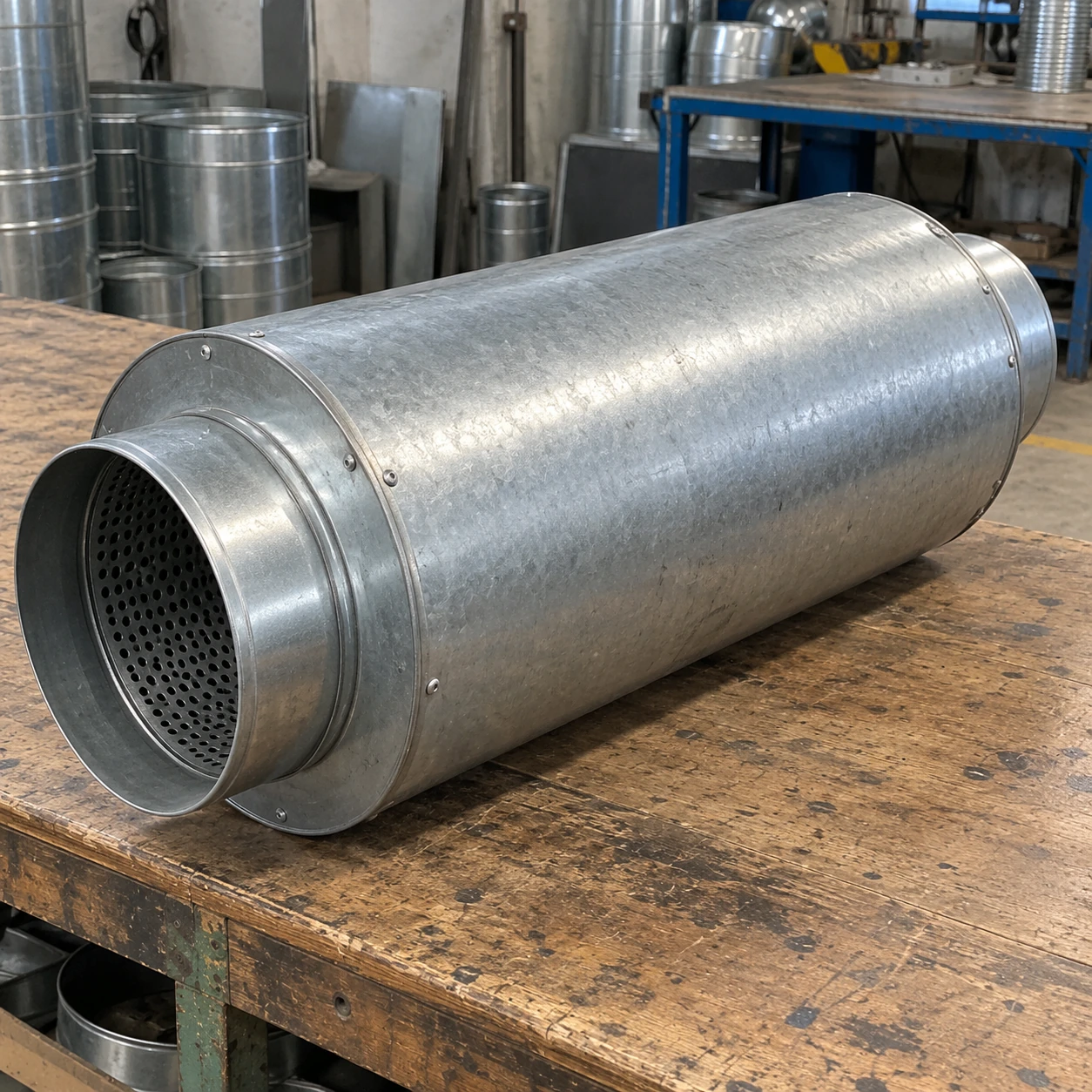
Duct Silencers
air duct silencer
| Brand | shengtongJH |
|---|---|
| Form | Circular absorptive silencer with straight air passage |
| Nominal bore | 160 / 200 / 250 / 315 mm |
| Body length | 600 or 900 mm |
| Absorber depth | 50 mm nominal construction option |
| Outer casing | Galvanized steel |
| Inner passage | Perforated galvanized liner |
| Fibre protection | Air-permeable retaining layer matched to the absorber |
| End connection | Circular spigot or matching flange |
| Outside diameter | Determined by bore, absorber and casing construction |
| Air duty | Ordinary non-corrosive ventilation air; other services require a suitable build |
The nominal bore is the air connection size. Outer casing diameter and connection allowances must be checked separately on the selected drawing.
Bore, length, lining protection and end fittings can be customized to the air route and maintenance conditions.
An air duct silencer treats sound carried between equipment, branches and occupied work areas. A circular lined unit can suit a round distribution route, provided its bore and outer casing both fit the installation.
Control transmission between connected spaces
A shared air route can carry more than fan noise. Conversations, machine sound and activity in one work area may reach another through a common duct or plenum. A suitable silencer can reduce this duct-borne transmission, but openings, wall penetrations and other flanking paths also influence the result.
Locate the treatment according to the path being controlled. Placing a silencer near a central fan does not necessarily resolve sound travelling between two downstream branches. Identify the source and receiving area before deciding which section of the route needs attenuation.
Preserve the intended bore
A round casing can contain a smaller effective air passage than its outside appearance suggests. Check the clear passage and any centre element. Use appropriate transitions where the adjacent duct differs, and account for their resistance as part of the air route.
Protect the lining
The perforated inner skin supports the acoustic construction while a suitable retaining layer separates fibres from the passing air. The chosen facing must suit air velocity and service conditions. A bare absorbent surface is not equivalent to a protected ventilation assembly.
Leave a way to inspect it
Provide access to joints and the internal passage. Dust accumulation, damaged lining or moisture can change operating conditions. A section hidden permanently behind services is difficult to inspect or replace even when its initial acoustic selection was correct.
Match cleaning to construction
Do not assume every lined silencer can be washed internally. Water or cleaning chemicals reaching absorbent filling can create a maintenance problem. Select a documented cleaning method and suitable facing for the actual air service. Grease-laden extraction, corrosive process air and wet exhaust need a specific construction assessment rather than an ordinary ventilation product.
For procurement, include duct diameter, flow direction, access restrictions and the type of air carried. Those details help distinguish a simple branch attenuator from a product requiring different lining, casing or maintenance provisions.
Bore, length, lining protection and end fittings can be customized to the air route and maintenance conditions.