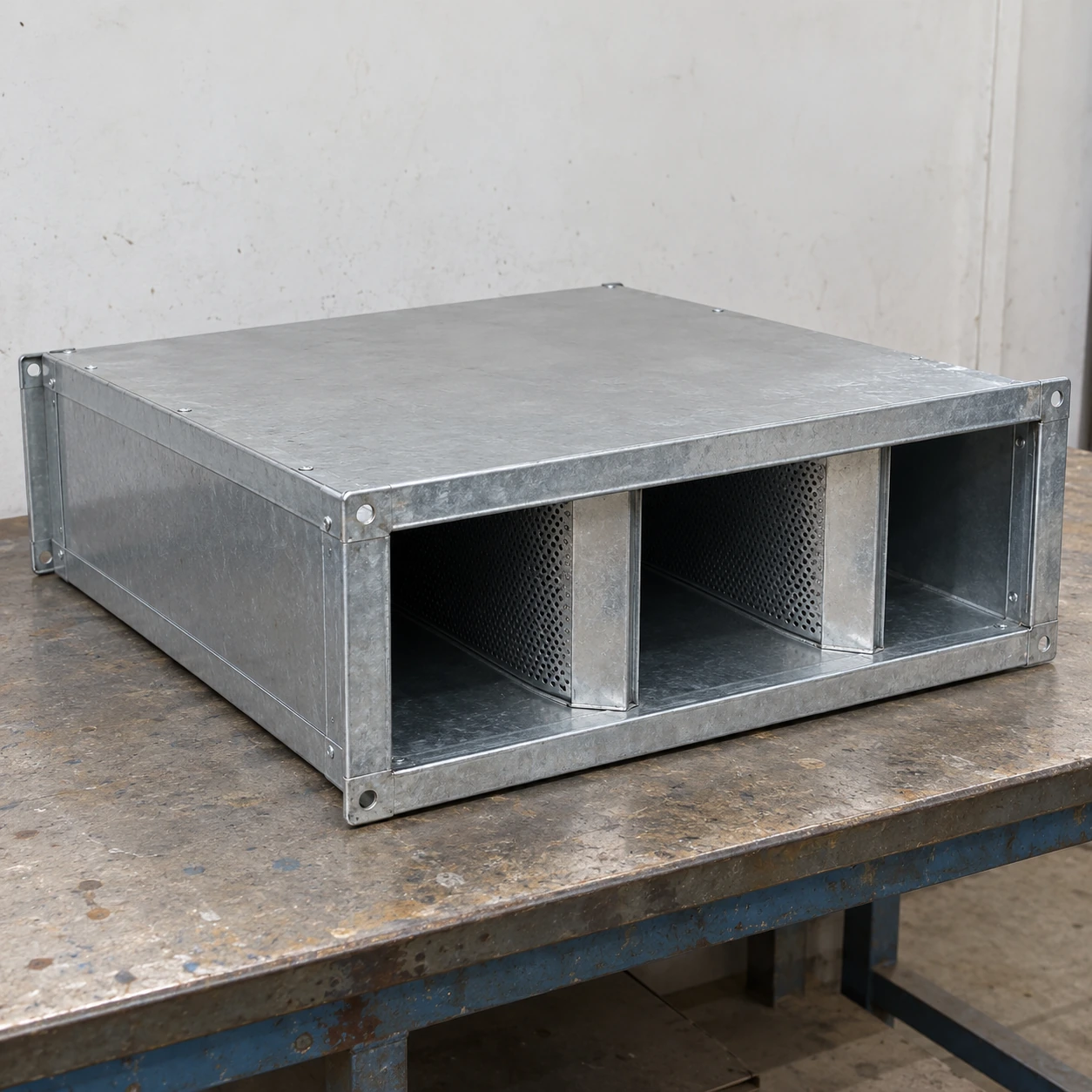
Duct Silencers
ac duct silencer
| Brand | shengtongJH |
|---|---|
| Application | Commercial or industrial conditioned-air branch |
| Connection W × H | 300 × 200 / 500 × 250 / 600 × 250 mm |
| Body length | 500 / 750 / 1000 mm |
| Construction | Low-height rectangular absorptive arrangement |
| Casing material | Galvanized steel |
| Air-facing protection | Perforated metal with compatible retaining layer |
| Acoustic layout | Thin-profile passages selected for airflow and attenuation |
| Thermal treatment | External insulation selected for air and ambient conditions |
| Vapour control | Continuous sealed outer layer where condensation control requires it |
| Maintenance arrangement | Reachable joints and access to adjacent AC service panels |
Acoustic filling does not automatically provide adequate external thermal insulation or vapour control. Select both functions for the actual operating conditions.
Low-height dimensions, acoustic construction, connection details and thermal treatment can be customized for the commercial AC installation.
An AC duct silencer can reduce duct-borne sound from commercial air-conditioning and fan-coil systems. The selection must preserve cooling airflow and account for the cold casing, service access and limited space often found above ceilings.
Separate equipment sound from outlet noise
A noisy air-conditioning branch may carry fan sound, but its terminal can also generate noise when the air velocity is too high or a balancing damper is heavily throttled. A silencer upstream can address transmitted sound; it does not correct every noise source created farther downstream.
Check the fan duty, terminal selection and damper position together. If the branch is forced to carry excessive air through a small outlet, a better distribution arrangement may be needed alongside acoustic treatment. Reducing cooling airflow just to obtain a quieter reading is not an adequate solution.
Prevent cold-casing condensation
Conditioned air can cool the metal casing below the surrounding air's dew point. Internal acoustic material should not be assumed to provide the external thermal and vapour protection required. Specify insulation continuity at flanges, supports and access details as part of the installation.
If condensation is already present, identify its source before enclosing the area. Wet acoustic filling or repeated water ingress is a service problem that needs correction, not a normal feature of an air-conditioning silencer.
Use the ceiling space deliberately
A shallow shape helps only when it still provides suitable passages and acoustic length. Allow for hangers and external insulation, and keep the air-conditioner's filter and electrical access clear. Installation should not make routine servicing dependent on removing the entire duct section.
Keep the enquiry focused on the branch
State the commercial application, branch airflow, supply-air condition and available ceiling height. Include the adjacent terminal or fan-coil connection and where the sound is heard. These inputs help shengtongJH source a construction suited to the actual route. This product scope concerns commercial and industrial duct systems, rather than portable or domestic room air conditioners.
Low-height dimensions, acoustic construction, connection details and thermal treatment can be customized for the commercial AC installation.