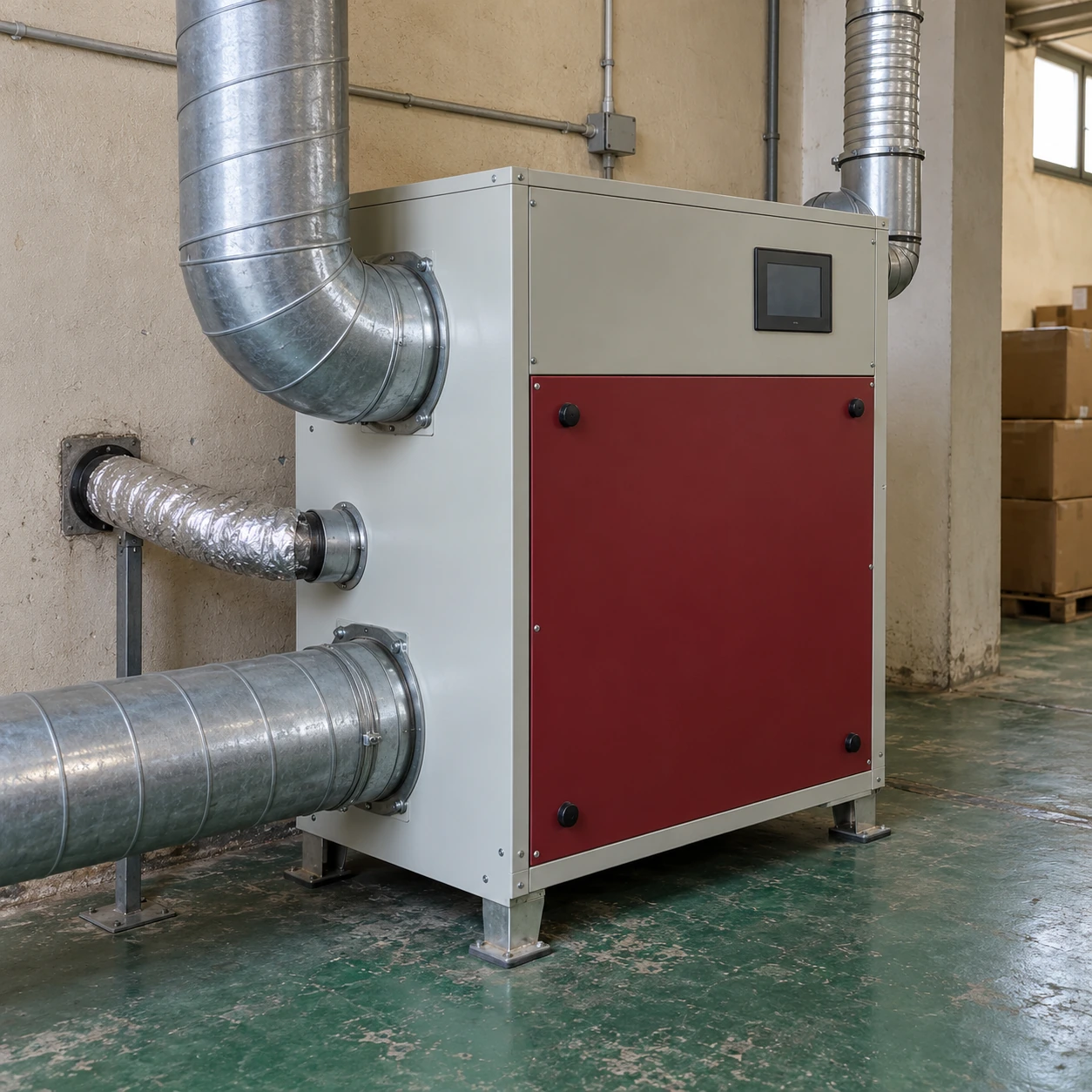
Desiccant Dehumidifiers
Desiccant Dehumidifiers
| Compact cabinet / dry-air flow | 554 × 399 × 786 mm (W × D × H); 300 m³/h |
|---|---|
| Industrial cabinet / dry-air flow | 758 × 494 × 1089 mm (W × D × H); 750 m³/h |
| Moisture removal at 20°C, 60% RH | Compact: 0.9–1.2 kg/h; industrial: 3.3 kg/h |
| Electric regeneration / airflow | Compact: 50–65 m³/h; industrial: 135 m³/h |
| Supply / connected load | Compact: 230 V, 1-phase, 50 Hz, 1.4–1.8 kW; industrial: 400 V, 3-phase, 50 Hz, 5.1 kW |
| Control options | External humidity sensor, remote enable and fault indication, according to the control package |
Dimensions are external cabinet W × D × H; allow additional duct and service space. The listed duties apply to their matched configurations. Moisture removal changes with inlet temperature and humidity.
Cabinet arrangement, duct connections, controls and drying capacity can be customized to suit the operating environment and installation requirements.
Desiccant dehumidifiers remove water vapour with a rotating moisture-adsorbing rotor. A separate heated air stream regenerates the rotor for continuous operation. They suit industrial storage, moisture-sensitive handling and process-air duties where cooling alone does not provide the required humidity control.
When cooling the room is not enough
A warehouse can be cool and still suffer from damp packaging, caking powders or condensation on colder equipment. The useful target is the moisture condition around the stored material or exposed process. A room temperature setting alone does not define that condition.
For warm, humid spaces with moderate drying requirements, compare refrigerant dehumidifiers. Desiccant equipment becomes especially relevant when the required air is drier, the operating temperature is lower, or drying must continue independently of cooling demand. Selection still depends on the unit's permitted operating range and its capacity at the intended inlet conditions.
Two air paths, one rotating rotor
Process air passes through the drying sector, where the desiccant retains water vapour. Slow rotation carries that loaded material into a separate regeneration sector. Heated regeneration air releases the retained moisture and carries it away through the wet-air outlet.
This arrangement needs distinct process and regeneration connections. The wet outlet belongs outside the controlled space; returning it to the room would return the moisture just removed. A condensing accessory is a different configuration where an external wet-air discharge is impractical.
Airflow does not equal drying capacity
Airflow describes how much air moves through the equipment. Moisture removal describes how much water it extracts under specified inlet conditions. A high airflow figure alone cannot establish that a machine will hold the required humidity.
Calculate the load from incoming ventilation air, door openings, leakage, wet materials and the process itself. Separate initial drying of a damp space from the smaller continuing load after conditions stabilise. Frequent loading-door traffic can matter more than the room's floor area; reducing that entry load may be more effective than simply adding a larger machine.
Make the installation work around the air paths
- Separate discharge from intake. Locate wet-air exhaust so it cannot be drawn back into either inlet. Plan insulation and condensate drainage for the wet duct where needed.
- Account for duct resistance. Bends, filters and long runs consume fan pressure. Check both air circuits, support ducts independently and leave the service panels accessible.
- Measure the occupied or process zone. Place the humidity sensor away from the immediate dry-air jet and frequently opened doors. A misleading sensor location can stop drying while other areas remain damp.
Keep the rotor effective in daily service
Intake filtration protects the rotor from contamination. Restricted filters, interrupted rotor movement or a regeneration fault can all reduce drying while the process fan still runs. Include access for filter replacement and maintenance of the rotor drive, seals and heater in the installation plan.
For a quotation, share the operating temperature, humidity target, air source and daily moisture-generating activities, together with the available exhaust route and electrical supply. These determine a workable configuration more reliably than a generic room-coverage claim. Pressurised air for pneumatic equipment requires a compressed air dryer with the appropriate pressure duty.
Cabinet arrangement, duct connections, controls and drying capacity can be customized to suit the operating environment and installation requirements.