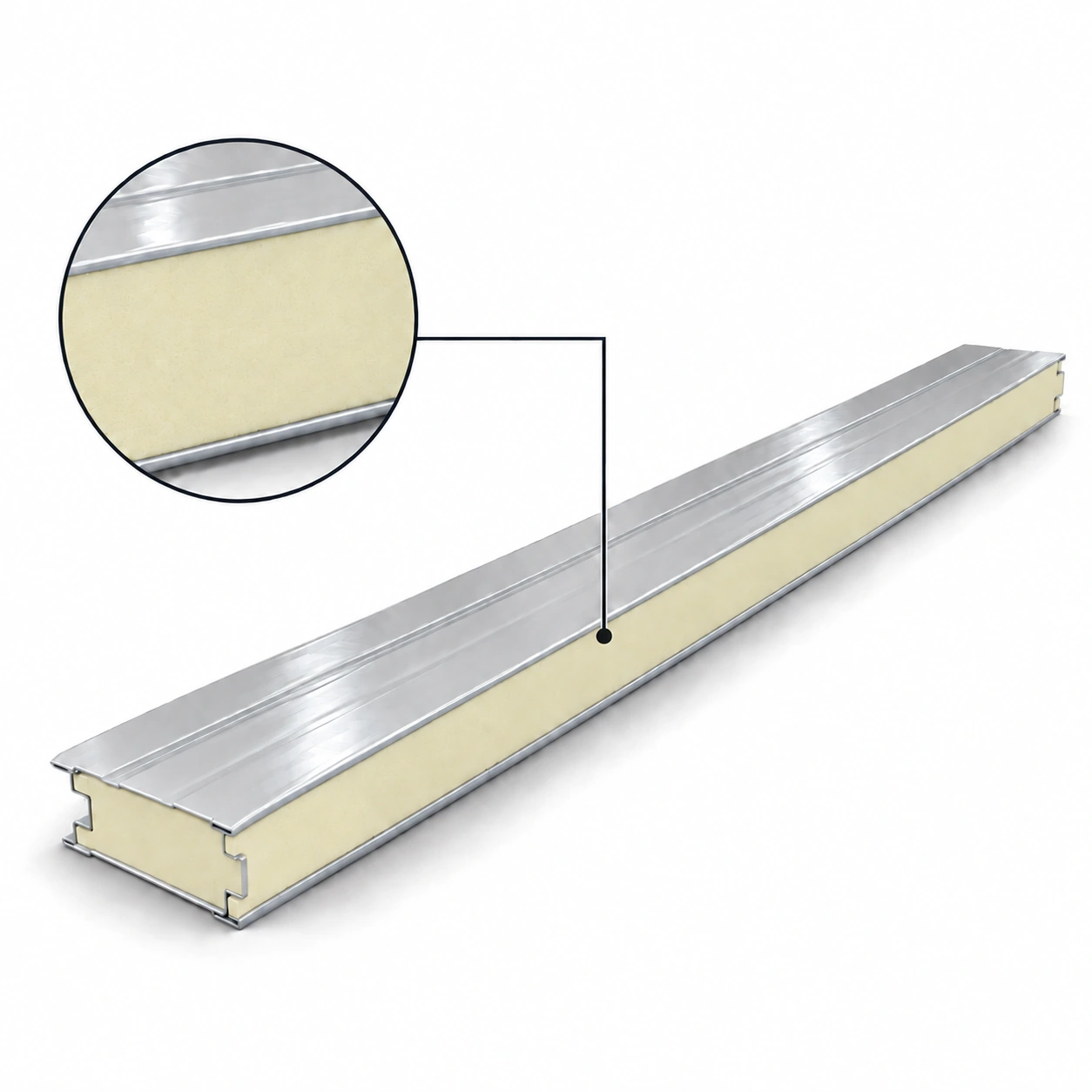
Cold Room Panels
freezer panel walls
| Brand | shengtongJH |
|---|---|
| Application | Walls for engineered sub-zero enclosures |
| Core options | PUR / PIR rigid foam |
| Panel width | 1140 mm |
| Thickness selection | 100 / 150 / 200 / 250 mm options; selected by thermal design |
| Facings | PPGI or SS304 stainless steel |
| Joint system | Interlocking profiles with continuous vapour-control detailing |
| Panel length | Cut to wall elevation and support arrangement |
Panel dimensions, surface finish and connection details can be configured for your application.
Freezer panel walls work across a substantial temperature difference. Warm-air leakage, incomplete floor insulation and poorly coordinated door surrounds can create frost or condensation even when the main wall panels are correctly specified.
Follow the warm-air path
Air entering through a small discontinuity can carry moisture towards a cold surface. Frost at a joint is therefore a reason to investigate the seal, pressure conditions and operating routine; it is not automatically a request for thicker panels.
Trace the enclosure around the floor edge, corners, ceiling and door. Specify a continuous vapour-control arrangement on the appropriate warm side for the actual conditions. Penetrations and concealed connections need the same care as the visible panel-to-panel joint.
The floor belongs in the design
A freezer wall cannot compensate for an unsuitable slab build-up. The floor insulation, vapour layer and any frost-protection provision require a coordinated design based on the site and operating temperature. Wall panels are not substitutes for a floor system designed for rack and vehicle loads.
Door traffic changes the load
Frequent opening introduces heat and moisture. Coordinate the opening size, gasket condition, door operating routine and any appropriate threshold treatment with the freezer design. Increasing wall insulation alone will not solve an open-door problem.
Accommodate movement and service access
Temperature differences can create movement between the inside and outside faces. Supports and fixings need to suit the panel and design conditions rather than rigidly restraining every connection. Keep evaporators, pipework and heavy services on suitable independent supports.
Inspect seals before cooling and follow the agreed commissioning procedure. Once the room is operating, repair damaged facings and joints promptly so moisture does not enter concealed areas. shengtongJH can coordinate freezer wall dimensions, facing choices and junction accessories around the approved enclosure design.