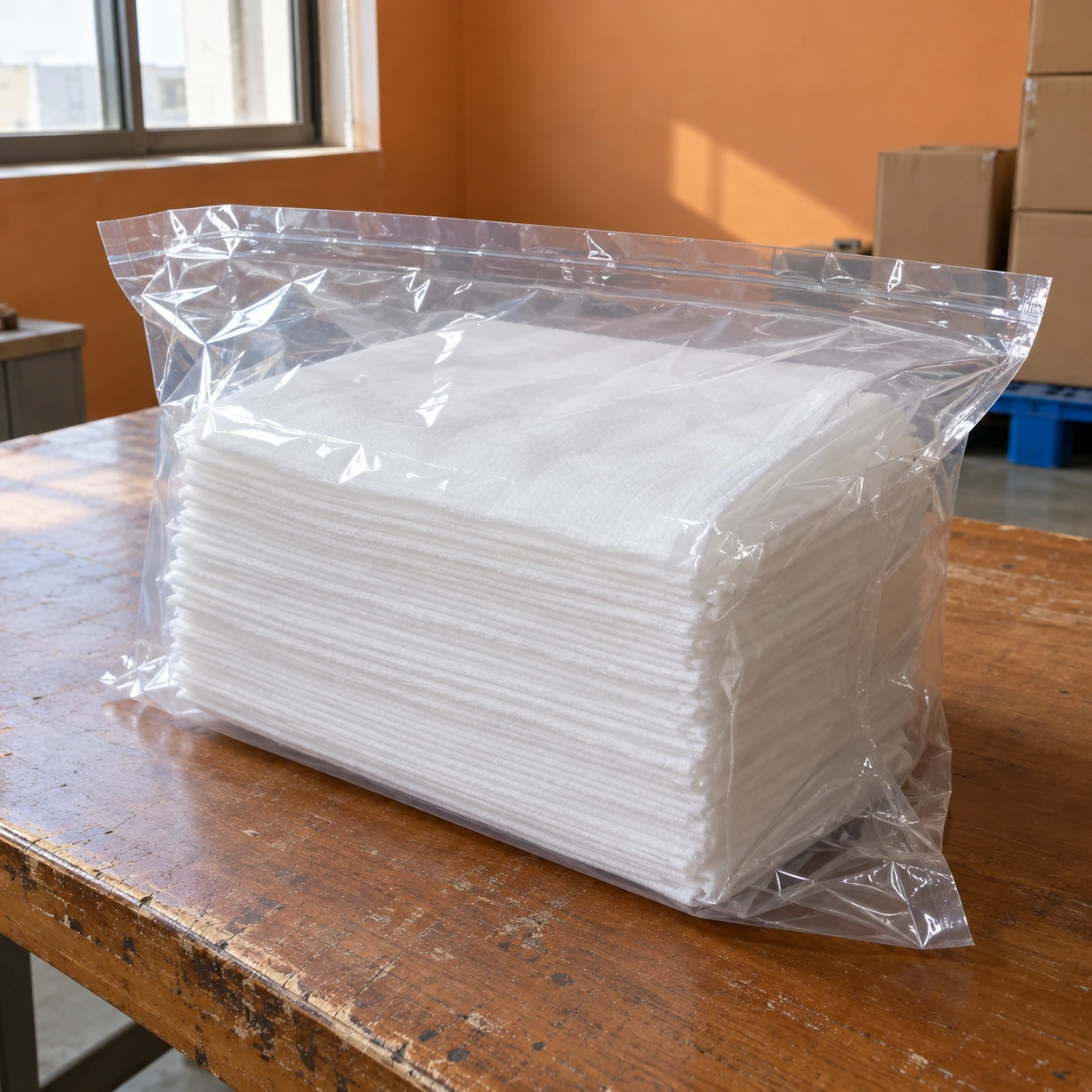
Cleanroom Wipes
irradiated cleanroom wipe
| Brand | shengtongJH |
|---|---|
| Product form | Dry industrial wiping cloth supplied in sealed packs |
| Nominal unfolded cloth L × W | 230 × 230 / 300 × 300 mm; other cut sizes by specification |
| Substrate options | Knitted polyester; polyester/cellulose nonwoven where suitable for the process |
| Edge options | Sealed edge for selected polyester constructions; cut edge for suitable substrates |
| Inner-pack quantity options | 10 or 20 cloths; pack size matched to task consumption |
| Packaging arrangement | Two nested sealed bags; the approved pack configuration must match the treatment records |
| Treatment option | Gamma irradiation with a defined product and packaging configuration |
| Processing evidence | Batch-linked irradiation/processing record identifying the treated product and accepted process |
| Sterile supply distinction | Validated sterile configuration only when supported by the corresponding validation and batch-release evidence |
| Material assessment | Particle/fibre release, absorption and chemical compatibility relevant to the intended wiping task |
| Traceability | Product identity, lot identification and applicable storage/use-by information on supply documents |
Treatment conditions and acceptance requirements are defined for the selected product and package. Irradiation status does not independently establish sterility, low endotoxin or a cleanroom-grade suitability claim.
Cloth dimensions, substrate, edge construction and pack quantity can be customized to the production workflow, with any change assessed against the specified treatment and packaging requirements.
An irradiated cleanroom wipe has undergone an irradiation process intended to reduce microbial contamination. The treatment description alone does not establish a validated sterile product. Selection should connect the wipe, its packaging and the processing evidence to the intended manufacturing task.
Decide which microbial-control claim the process needs
The word irradiated describes a processing step. A validated sterile supply arrangement adds evidence that a defined process consistently achieves its stated sterility requirement for the specified product and packaging. Treating those descriptions as interchangeable can leave a purchasing specification weaker than the manufacturing procedure requires.
For some industrial cleaning stages, a documented microbial-reduction treatment may meet the assessed requirement. Other operations require validated sterile consumables. Even when a finished product is sterilized later, the acceptable incoming contamination still depends on the manufacturing process. Later sterilization is not a general reason to accept any wipe or package.
Link the received pack to the processing record
A useful receiving check connects the label on the delivered material to its batch documents. Confirm the product identity, substrate, pack format and lot, then check that the treatment record applies to that configuration. A document for a different wipe or a different packaging arrangement does not establish the status of the received goods.
A colour-change irradiation indicator can show exposure to a process, but it does not replace validation or release evidence. Equally, a sealed bag is a packaging feature rather than proof of sterility. Keep damaged, unidentifiable or document-mismatched packs outside the approved supply flow until their status is resolved.
Choose the cloth for the surface
Knitted polyester can suit repeated wiping where the process calls for a durable synthetic cloth. A polyester/cellulose nonwoven may offer a different absorption and handling profile. Neither choice is universally better: consider the liquid being collected, the surface texture and how much fibre or residue the operation can tolerate.
A sealed edge can reduce loose edge fibres, but it does not establish zero particle release. Assess the complete wipe in the intended wet or dry condition. For sensitive parts, check solvent compatibility and potential extractable residues alongside microbial requirements.
Keep the packaging relevant to the route
Nested packs allow outer surfaces to be removed at designated transfer stages. Define which layer is removed at each boundary and how the remaining pack is handled. Opening both layers in an uncontrolled area defeats that arrangement.
Choose an inner-pack count that can be used within the approved handling period. An oversized opened pack may create more handling and leftover material than the lower unit price saves. Reclosing it does not restore its original unopened status.
Fit the wipe into the cleaning procedure
The cloth collects and transfers soil; irradiation does not make it a disinfectant or guarantee that the wiped surface becomes sterile. Where the procedure requires a cleaning or disinfecting solution, use a compatible liquid and follow its defined application and contact conditions. Avoid returning a used wipe to a clean solution container.
Set a consistent wiping pattern, expose a fresh face as required and replace the cloth before it redistributes collected contamination. Procurement should preserve the agreed substrate, edge and package across repeat orders. shengtongJH can coordinate those supply details, while the product-specific evidence determines which treatment or sterile claim is appropriate.
Cloth dimensions, substrate, edge construction and pack quantity can be customized to the production workflow, with any change assessed against the specified treatment and packaging requirements.