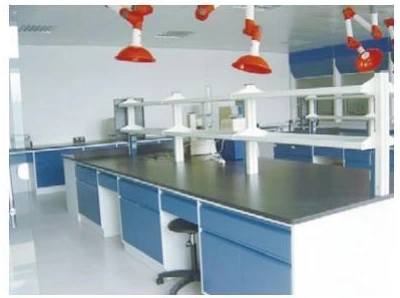
Laboratory bench with a service shelf and base storage
Cleanroom Tables, Benches & Stools
Laboratory Bench
| Specification | Configuration options |
|---|---|
| Brand | shengtongJH |
| Layout | Wall-side bench or double-sided island bench |
| Wall bench W × D × H (mm) | 1200 × 750 × 850 / 1500 × 750 × 850 / 1800 × 750 × 900 |
| Island bench W × D × H (mm) | 2400 × 1500 × 850 / 3000 × 1500 × 850 / 3600 × 1500 × 900 |
| Worktop options | Epoxy resin, suitable chemical-resistant laminate or stainless steel |
| Base options | Coated steel, stainless steel or polypropylene cabinet system |
| Services | Selected water, drain, power and gas interfaces; accessible service zone |
| Storage / accessories | Drawers, cupboards, reagent shelf and task-specific fittings |
| Customization | Length, work height, materials, storage and services |
Dimensions and configurations can be customized for your application.
Arrange the worktop, utilities and storage around the laboratory task instead of treating the bench as a row of cabinets.
Give instruments and sample handling their own space
A laboratory bench combines a work surface, supporting structure and practical access to utilities. Begin with the instruments and tasks: sample preparation, weighing, inspection and wet handling do not all need the same surface or arrangement. Leave useful space around equipment for opening lids, connecting tubing and cleaning, rather than filling every available area with cabinets.
The catalogue illustrates both wall-side and central laboratory benches. A wall bench provides a clear rear service zone and can keep one side of a process contained. An island allows access from two sides but needs coordinated traffic and service connections so people do not repeatedly reach across one another's work.
Worktop selection
Select the surface for the actual chemicals, temperatures and cleaning agents. Epoxy, laminate and stainless steel have different limitations. No single finish should be assumed resistant to every spill or direct heat source.
Services and maintenance
Arrange shutoff points and electrical connections where they remain accessible. Keep wet-service routes coordinated with power, and allow valves, traps and cables to be serviced without dismantling the working area.
Preserve working posture and clear circulation
Choose work height around seated or standing tasks and retain knee space where operators sit. Under-bench storage is useful only when doors and drawers can open without blocking another workstation. Reagent shelving should not force frequent reaching over exposed samples or place heavy containers above sensitive equipment.
For vibration-sensitive balances, hazardous chemicals or tasks requiring filtered product protection, provide the appropriate dedicated equipment. A laboratory bench is not itself a fume hood or clean-air workstation. Confirm equipment loads and any concentrated support points before selecting the structure. Layout, worktop material, services and storage can be customized to your laboratory process.