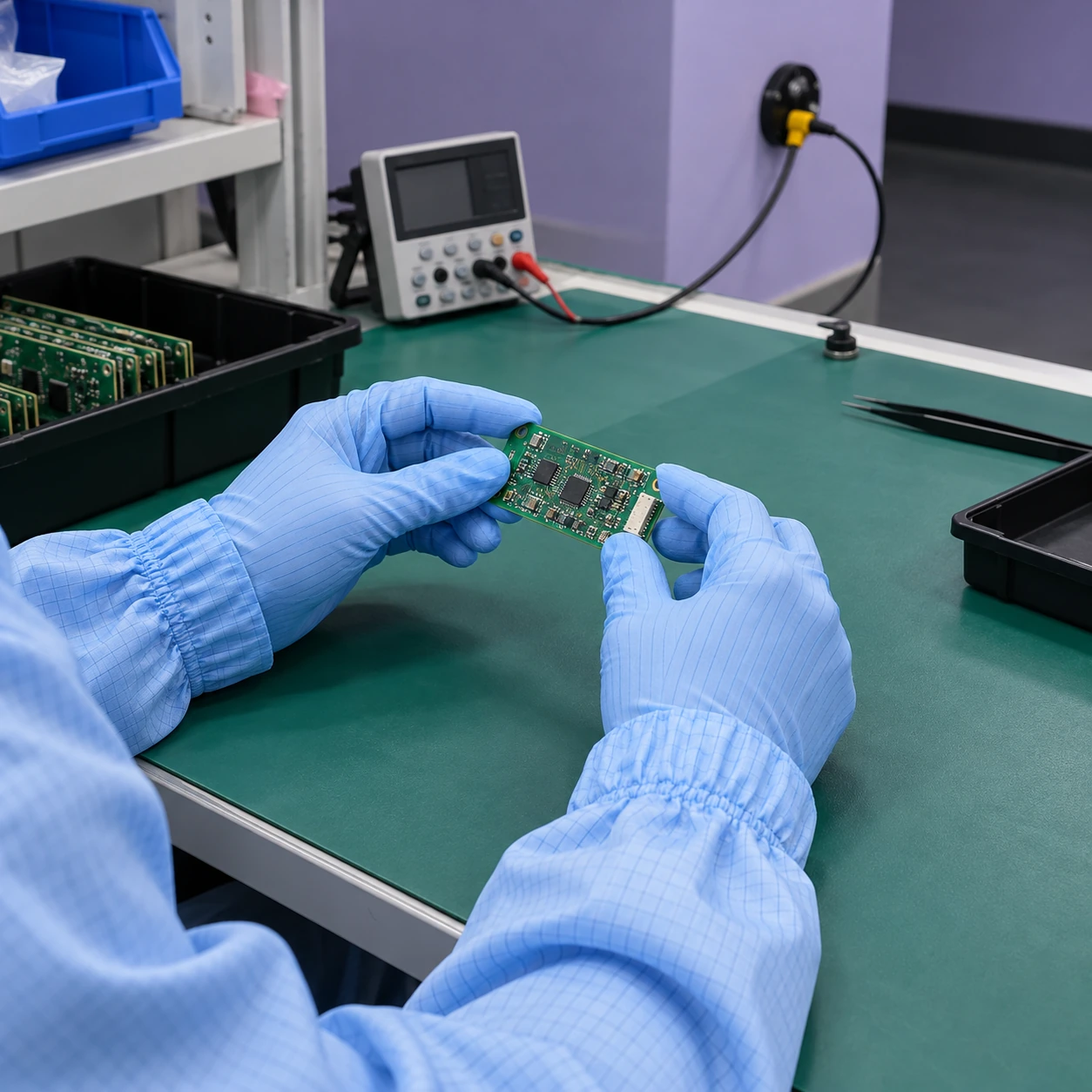
Cleanroom Gloves
esd cleanroom gloves
| Barrier material candidates | Nitrile or vinyl; electrical suitability verified for the selected product |
|---|---|
| Hand sizes | XS–XXL in selected nitrile families; S–XL vinyl options |
| Total length options (mm) | 300 or 305 according to qualified glove construction |
| Nitrile nominal flat palm widths (mm) | 75 / 85 / 95 / 105 / 115 / 125 |
| Surface and cuff | Smooth or textured working area; beaded cuff |
| Electrical evidence | Glove and wearer-system resistance assessment using an appropriate method such as ANSI/ESD STM15.1 |
| Acceptance conditions | Site-specific limits, conditioning, humidity and worn-glove configuration recorded |
| Cleanroom supply | Process-approved particle/residue performance and cleanroom packing |
No universal resistance value is assigned to all glove materials. The actual offered glove must meet your application's electrical and cleanliness requirements together.
Material, size assortment and cleanroom packaging can be customized around your approved ESD workstation and glove specification.
ESD cleanroom gloves must support both contamination control and the site's electrostatic-discharge programme. The glove is part of a system that includes the wearer, grounding arrangements, work surface and the item being handled.
Keep the glove from interrupting the intended path
Grounding the operator does not automatically settle the electrical behaviour of the surface touching the component. A glove can alter that path, so its electrical characteristics need to be considered with the wearer and work arrangement. Colour, a cleanroom label or the polymer name cannot establish that it is suitable.
Use the site's ESD programme to define how sensitive items are handled. Gloves supplement the approved controls; they do not replace a suitable work surface, personnel grounding or handling procedure.
Evaluate the glove as it will be worn
ANSI/ESD STM15.1 addresses resistance measurements for gloves and finger cots, including their use with personnel. Data from a flat material sample and a worn-glove assessment answer different questions. Identify the method and configuration when comparing supplier results.
Record conditioning and relevant environmental conditions. Also consider the actual fit and whether another glove or liner is worn underneath. A result from a different layer arrangement should not be assumed to apply unchanged.
Keep contamination evidence alongside electrical data
A material with useful electrical behaviour may still introduce unacceptable particles or residues. Conversely, a clean-looking barrier may not have the electrical characteristics required for a sensitive component. Approve both functions for the same product.
Grip and finger control matter too. If loose film causes repeated adjustment or awkward component handling, the glove can make the workstation procedure harder to follow despite acceptable laboratory data.
Define what changes trigger review
- A different formulation, surface treatment or glove supplier.
- A new inner glove, liner or hand-size arrangement.
- A change to the approved cleaning exposure or working environment.
- Different components with more demanding handling requirements.
Keep incoming product identity and lot information aligned with the approved glove. Where the ESD programme requires periodic verification, use its defined method rather than inventing a resistance limit from an unrelated catalogue.
Use the correct protection category
These gloves are selected for handling ESD-sensitive items. They are not electrical-insulating PPE for contact with energized equipment. For a discussion of charge generated during everyday handling, see anti-static cleanroom gloves.
Material, size assortment and cleanroom packaging can be customized around your approved ESD workstation and glove specification.