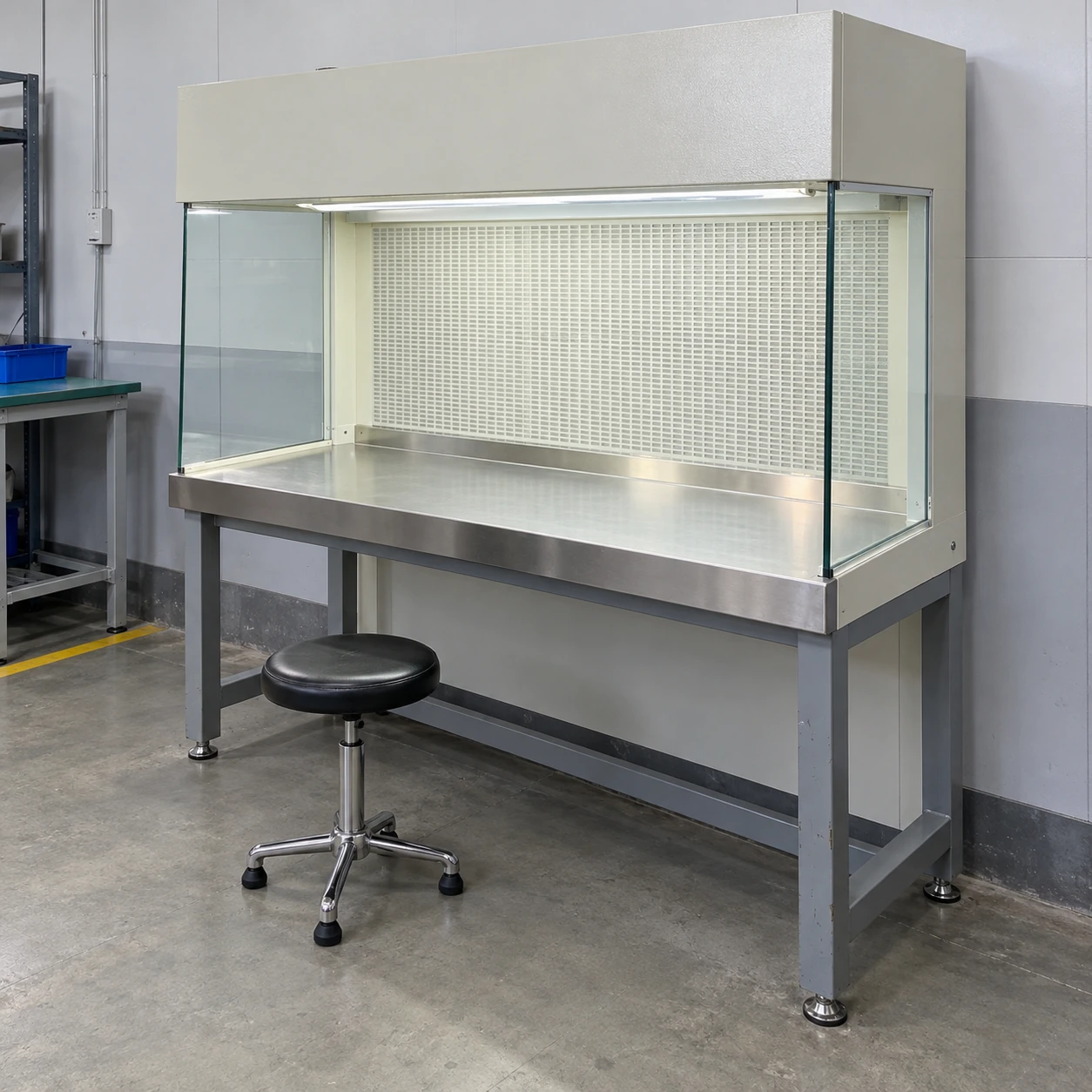
Clean Benches & Local Clean Air Systems
laminar flow hood horizontal
| Brand | shengtongJH |
|---|---|
| Air direction | Horizontal, from rear filter towards the open front |
| Overall W × D × H | 1300 × 820 × 2040 / 1800 × 820 × 2070 mm, including stand |
| Work zone W × D × H | 1200 × 500 × 570 / 1700 × 500 × 570 mm, paired with the respective cabinet |
| Construction | Powder-coated steel enclosure; stainless steel worktop; glazed sides |
| Filtration | Inlet prefilter and sealed final HEPA filter |
| Air speed selection | Adjustable; typical working setting 0.3–0.5 m/s, verified across the defined plane |
| Electrical selection | 220 V, 50/60 Hz; 110 V, 60 Hz configuration by selection |
| Cabinet input selection | 400 / 500 W configurations; internal equipment loads specified separately |
| Controls and access | Fan adjustment, work lighting, accessible prefilter and service panels |
Dimensions and electrical figures describe selectable configurations, not interchangeable parts. Final drawings and the complete supplied configuration determine fit and operating duty.
Work width, stand height, side access and service interfaces can be customized to the production station.
A horizontal laminar flow hood can replace an open inspection position with a defined rear-to-front clean-air path. Retrofitting it works best when the surrounding handling sequence is planned at the same time.
Keep the production sequence outside the critical air path
An existing work line often moves parts from one side of the operator to the other. A new clean bench should support that sequence without forcing incoming packaging, completed parts and tools across the same exposed surface.
Identify the step that actually needs protection. Bulk unpacking can remain outside the hood, while the clean component enters only for assembly or inspection. This reduces crowding and prevents the workstation becoming a storage shelf.
Check the operator's position
Combine worktop height, stool adjustment and viewing distance. An operator leaning over a low fixture may interrupt the stream from the rear filter. A smaller usable depth can be more practical than a deep cabinet whose critical position is difficult to reach.
Glazed sides improve visibility but can limit the approach of a wide part. Check the loading motion, not just whether the component fits when stationary.
Check what is behind the enclosure
Existing wall sockets, cable trays or shelving can block the inlet or service panel. The new cabinet's rear depth includes more than the visible worktop.
Do not push the equipment against a wall until the selected intake and filter-access arrangement are confirmed. Leave a safe service route that does not require dismantling adjacent stations.
A retrofit changes the local air movement
A nearby fan, doorway or ceiling outlet can challenge the clean stream at the opening. Evaluate the station with normal production traffic and equipment in place, rather than checking it only in a quiet empty room.
Horizontal clean air exits towards the user. Use this format for assessed nonhazardous tasks; it does not capture contaminants released by the work. Grinding, solvent fumes and biological aerosols require their own appropriate controls.
Make service interruption predictable
Keep the replacement filter, gasket arrangement and normal operating measurements in the equipment record. When the filter or fan is serviced, confirm the affected air performance before restarting sensitive production.
For purchase, a simple plan of the line with incoming and outgoing materials is more useful than the required width alone. shengtongJH can coordinate the cabinet format and supporting arrangement around that work sequence.
Work width, stand height, side access and service interfaces can be customized to the production station.