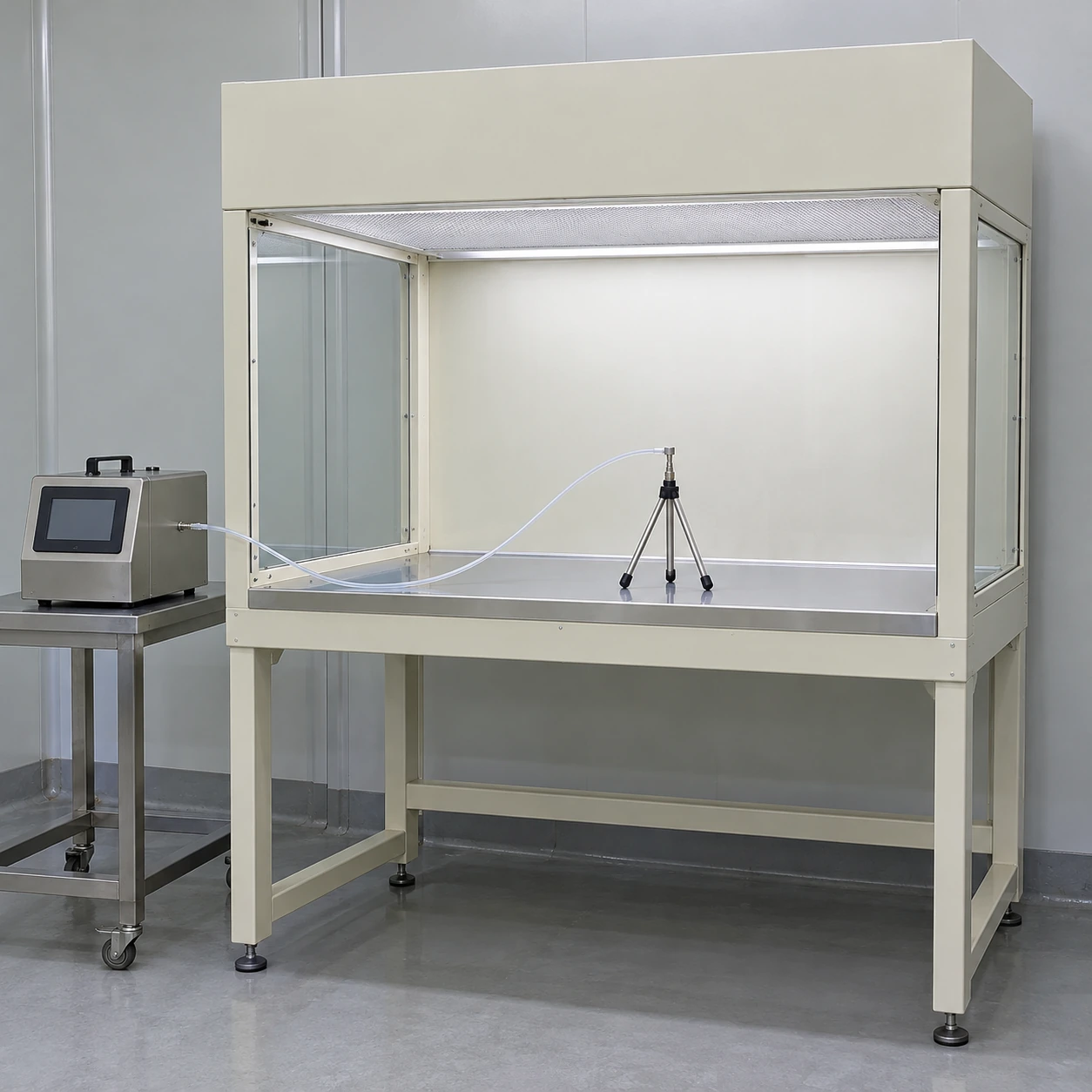
Clean Benches & Local Clean Air Systems
iso 5 laminar flow hood
| Brand | shengtongJH |
|---|---|
| Air direction | Vertical downflow; product protection only |
| Overall W × D × H | 1060 × 620 × 1850 / 1460 × 620 × 1850 mm, including stand |
| Work zone W × D × H | 935 × 530 × 650 / 1335 × 530 × 650 mm, paired with the respective cabinet |
| Materials | Coated steel body, stainless work surface and glazed sides |
| Final filtration | Sealed HEPA cassette with upstream prefilter |
| Clean-zone objective | ISO Class 5 by particle concentration, where specified and demonstrated in the agreed installed condition |
| Acceptance condition | Defined work zone, particle sizes and occupancy/operating state |
| Supporting checks | Airflow distribution and installed filter integrity, as required by the agreed test plan |
| Electrical supply | 220 V, 50/60 Hz; destination-specific configuration option |
| Controls | Adjustable fan and lighting; airflow indication option |
ISO Class 5 is a specified performance objective until verified for the identified zone and condition. It is not a supplied certificate, sterility claim or biosafety classification.
Work-zone size, access, monitoring and the required acceptance scope can be configured for the application.
An ISO 5 requirement applies to measured airborne particle concentration in a defined clean zone. Select the hood and acceptance scope together; a filter grade alone does not establish the installed work-zone classification.
Define what is being classified
ISO 14644-1 addresses airborne particle concentration. The result belongs to a specified zone, particle-size basis and test condition. It does not describe every surface in the room, prove sterility or classify the biological hazard of a procedure.
For a hood, identify the working area that must meet the requirement. A result measured near an empty supply face is not automatically evidence for an obstructed operating position farther away.
Set the condition
Agree whether acceptance concerns the installed empty workstation or the station operating with its normal equipment and activities. Identify the critical product positions.
Agree the measurements
Use an appropriate particle-counting plan with identified locations, sample conditions and instruments. Record the cabinet and room operating settings.
Keep the result traceable
The report should identify the actual equipment, work zone and tested condition. Retain it with the configuration and relevant maintenance records.
Why a HEPA label is insufficient
A filter test concerns the filter under its specified conditions. In the cabinet, air may leak around its frame or become disturbed by the plenum, workpiece and room. The installed system therefore needs more than a filter specification to support a clean-zone claim.
Airflow mapping and integrity checks answer different questions from particle counting. One checks distribution, another investigates filter or seal leakage, while particle measurements characterize the zone under the stated conditions. Select the necessary combination through the application's acceptance plan.
Keep the operating arrangement controlled
A new instrument, blocked inlet or changed room diffuser can alter performance. Reassess affected conditions rather than assuming an earlier result covers every later layout.
Separate other requirements
Temperature, humidity, viable contamination, chemical control and personnel protection each need their own criteria where relevant. ISO 5 particle classification does not replace them.
shengtongJH can source a workstation and coordinate the requested test scope around the process. State the protected area and operating condition in the enquiry so the quotation includes the relevant evidence instead of an undefined cleanliness promise. The classification basis is described in ISO 14644-1.
Work-zone size, access, monitoring and the required acceptance scope can be configured for the application.