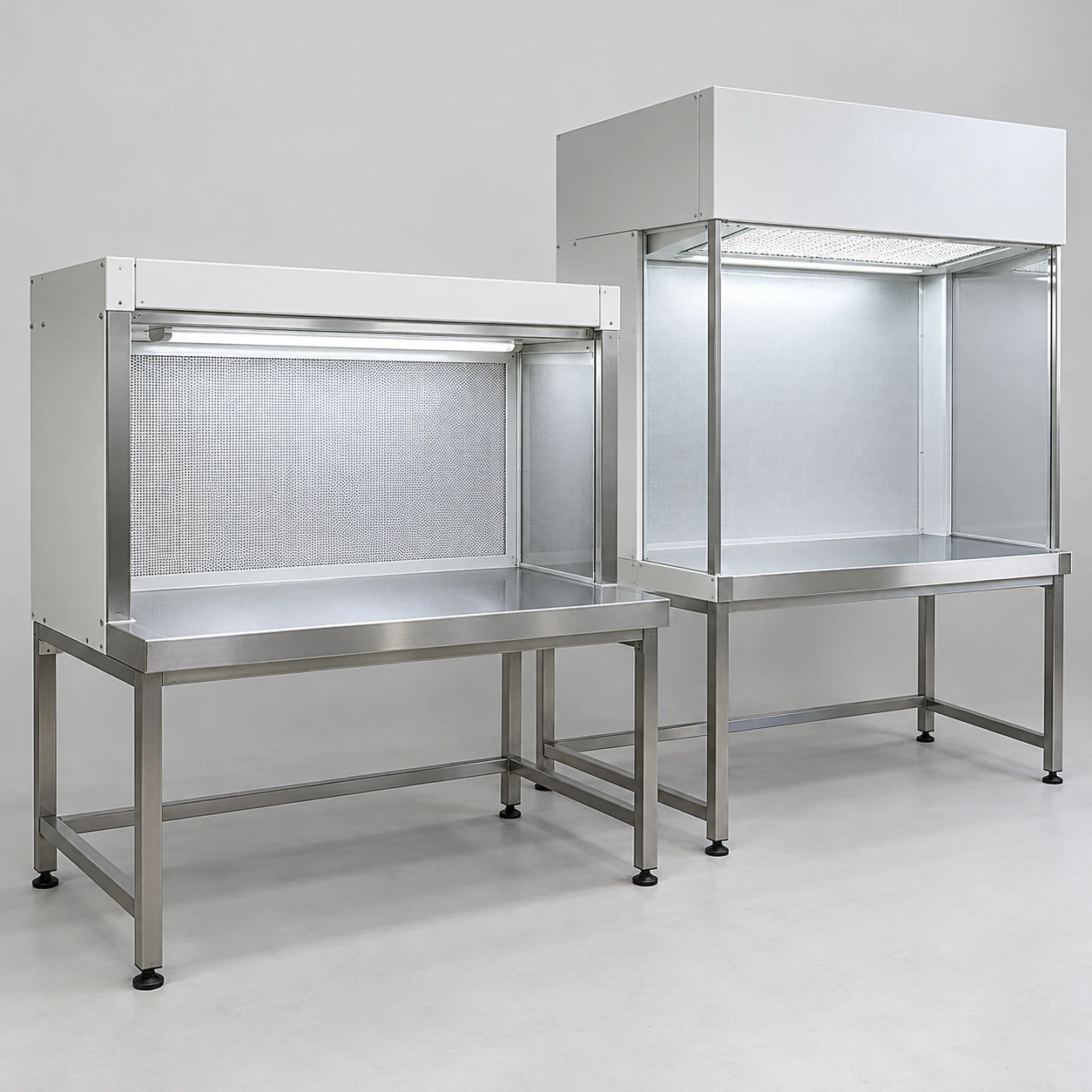
Clean Benches & Local Clean Air Systems
horizontal vs vertical laminar flow hood
| Brand | shengtongJH |
|---|---|
| Horizontal work zone W × D × H | 1200 × 500 × 570 / 1700 × 500 × 570 mm |
| Horizontal overall W × D × H | 1300 × 820 × 2040 / 1800 × 820 × 2070 mm |
| Vertical work zone W × D × H | 935 × 530 × 650 / 1335 × 530 × 650 mm |
| Vertical overall W × D × H | 1060 × 620 × 1850 / 1460 × 620 × 1850 mm |
| Final filtration | HEPA supply filter with a compatible prefilter and seal |
| Materials | Coated steel cabinet, stainless worktop and transparent side panels |
| Selection boundary | Nonhazardous product protection; neither clean-bench format provides biological containment |
| Electrical supply | Complete configuration selected for 220 V or destination-specific supply |
Horizontal and vertical dimensions describe different cabinet families. Match the internal and external size within the selected family.
Work-zone size, fixtures and access details can be customized around the required airflow direction.
Choose airflow direction from the object and operation. The useful question is which arrangement lets filtered air reach the sensitive surface with the fewest obstructions.
Low parts with a clear rear approach
For a small exposed component, horizontal flow can provide a direct path from the rear filter to its working surface. The layout is effective when tools and hands can remain downstream or to the side of that path.
A large instrument between the filter and product creates a wake. The resulting problem is the obstruction, not simply insufficient fan power.
Taller equipment with a clear upper approach
Vertical flow changes the first surface reached by the clean air. It can be easier to arrange taller equipment when the critical area is open from above.
A broad lid or raised tray can still shelter the task below. More internal height does not make every space beneath an instrument a protected zone.
Trace the operation, not just the stationary object
A component may fit comfortably in either cabinet. During use, however, an operator may turn it, lift its lid or bring a tool over it. These movements change which surface is upstream and what can interrupt the clean-air path.
Try the complete sequence on a work-area drawing. Mark the vulnerable surface, tool position and route for clean supplies. This often makes the airflow choice clearer than comparing external dimensions or filter specifications.
Large flat item
Check whether its exposed face is best approached from the rear or from above, and whether the operator can work without shielding it.
Tall instrument
Identify the actual sensitive opening. The instrument's height is less important than the path between that opening and the supply filter.
Repeated transfers
Choose an arrangement that keeps incoming and completed parts from crossing over exposed work during every cycle.
Neither direction provides biological safety by itself
Both ordinary clean-bench formats are for nonhazardous product protection. Downward air is not equivalent to a Class II cabinet's inflow and filtered exhaust system. If the task requires personnel or environmental containment, resolve that requirement before comparing clean-bench directions.
After choosing a layout, verify it with the normal equipment and materials in place. A suitable empty cabinet can perform differently once the task fills the workspace.
Work-zone size, fixtures and access details can be customized around the required airflow direction.