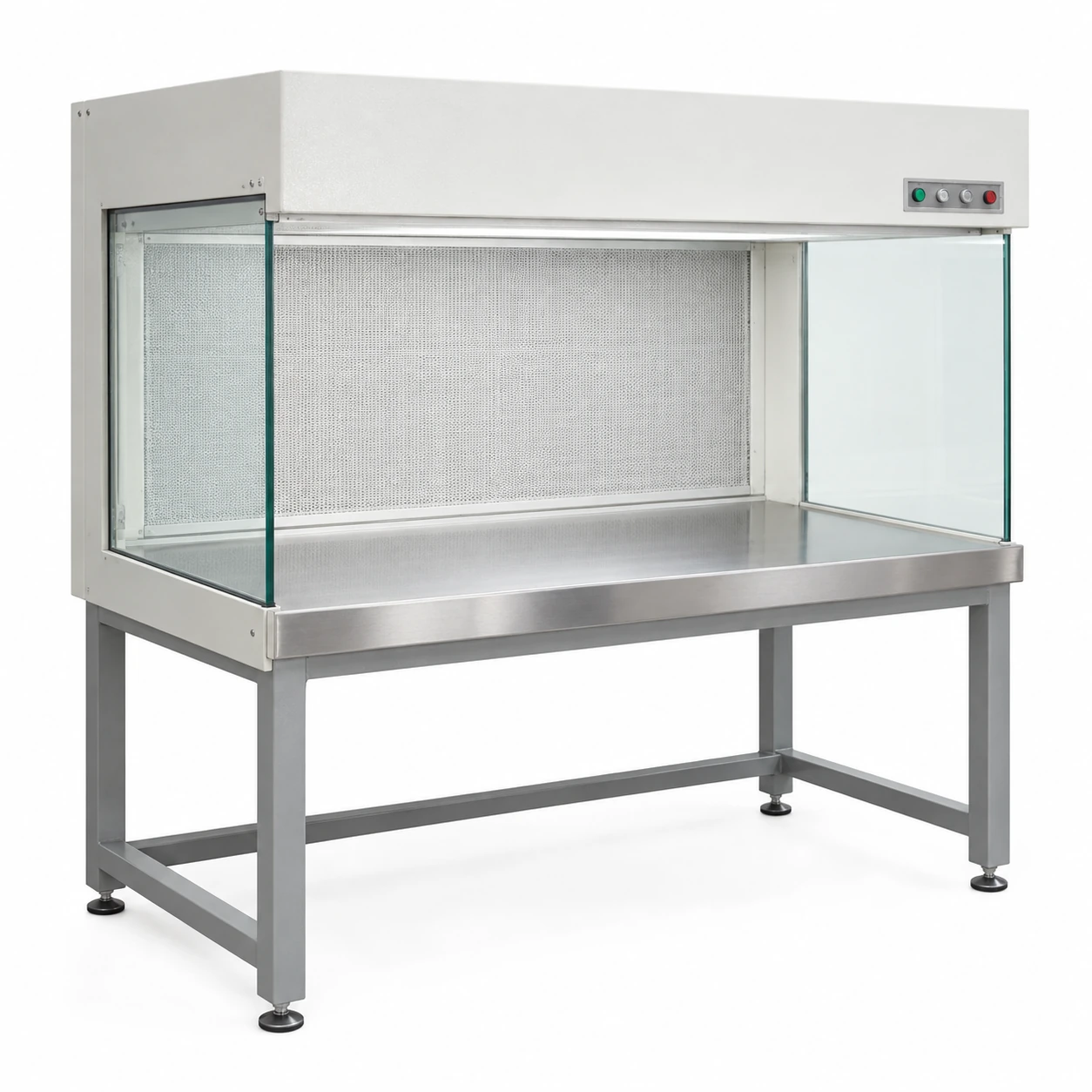
Clean Benches & Local Clean Air Systems
hepa filter laminar flow hood
| Brand | shengtongJH |
|---|---|
| Air direction | Horizontal, from rear filter towards the open front |
| Overall W × D × H | 1300 × 820 × 2040 / 1800 × 820 × 2070 mm, including stand |
| Work zone W × D × H | 1200 × 500 × 570 / 1700 × 500 × 570 mm, paired with the respective cabinet |
| Construction | Powder-coated steel enclosure; stainless steel worktop; glazed sides |
| Filtration | Inlet prefilter and sealed final HEPA filter |
| Air speed selection | Adjustable; typical working setting 0.3–0.5 m/s, verified across the defined plane |
| Electrical selection | 220 V, 50/60 Hz; 110 V, 60 Hz configuration by selection |
| Cabinet input selection | 400 / 500 W configurations; internal equipment loads specified separately |
| Controls and access | Fan adjustment, work lighting, accessible prefilter and service panels |
Dimensions and electrical figures describe selectable configurations, not interchangeable parts. Final drawings and the complete supplied configuration determine fit and operating duty.
Work-zone width, filter sealing, materials and control options can be customized to the application.
A HEPA-filtered laminar flow hood is a complete workstation: the fan, distribution plenum, filter seat and enclosure must deliver clean air to the work together.
The filter is only one part of the air path
A good filter cannot correct an air leak around its frame. The hood needs a firm filter seat, an appropriate gasket compression and a plenum that distributes fan output across the face. Air taking a shortcut around the filter can carry room particles straight into the working zone.
For a new workstation, buy these interfaces as a matched assembly. Selecting the largest free-air fan and a high-grade filter separately can leave the fan operating at the wrong pressure or make part of the filter face much faster than another.
Before the final filter
An accessible prefilter catches much of the larger incoming dust. Its condition affects the fan's available pressure and the service load on the final stage.
Across the filter
The housing must support and seal the cassette without damaging its media. The required frame and clamp arrangement should be recorded with the replacement specification.
After the filter
The clean air needs a clear route across the exposed item. Deep trays and tall instruments can create sheltered areas that the nominal filter rating does not describe.
Choose from the actual task
Horizontal flow suits small components arranged so each critical surface receives air before it passes a dirty object or the operator's hands. Tall equipment may be easier to arrange under vertical flow, although its upper surfaces can still block air from reaching the space below.
For optical preparation, check access for viewing and tool movements. For electronics assembly, address electrostatic requirements through a compatible grounding and material scheme; a metal bench alone is not a verified ESD workstation. Restrict either clean-bench arrangement to nonhazardous tasks requiring product protection.
Place the station away from door draughts and strong room supply jets. Leave the inlet and service panels clear, and verify the work area after installation. A HEPA certificate documents the filter; the cabinet's installed airflow and cleanliness require their own evidence.
Specify workpiece size, exposed surfaces and the normal load when requesting a configuration. The complete enclosure can then be selected with a practical replacement-filter route.
Work-zone width, filter sealing, materials and control options can be customized to the application.