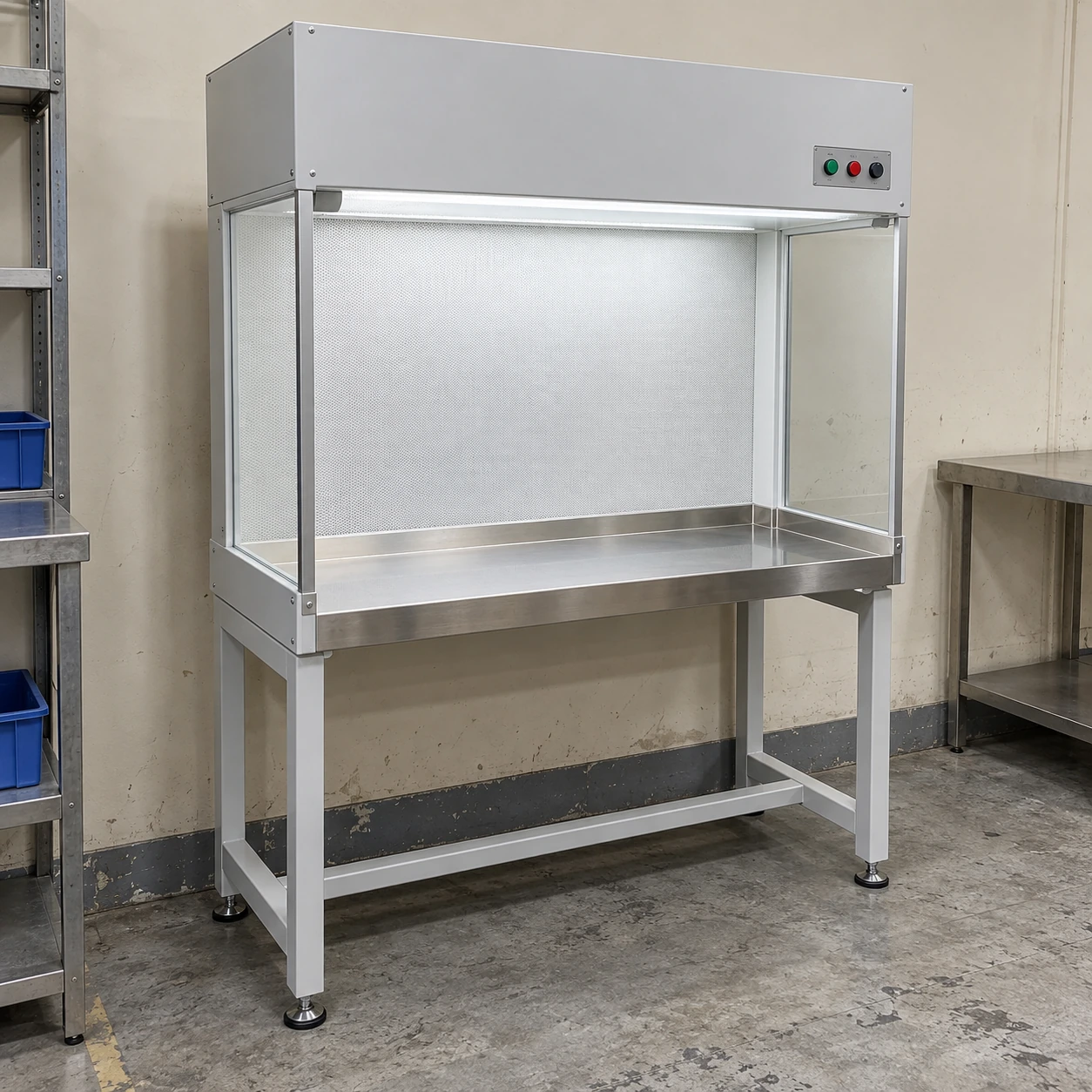
Clean Benches & Local Clean Air Systems
economical laminar flow hood
| Brand | shengtongJH |
|---|---|
| Air direction | Vertical downflow; product protection only |
| Overall W × D × H | 1060 × 620 × 1850 / 1460 × 620 × 1850 mm, including stand |
| Work zone W × D × H | 935 × 530 × 650 / 1335 × 530 × 650 mm, paired with the respective cabinet |
| Materials | Coated steel body, stainless work surface and glazed sides |
| Final filtration | Sealed HEPA cassette with upstream prefilter |
| Working airflow | Adjustable; 0.3–0.45 m/s setting range selected with the filter and work layout |
| Electrical supply | 220 V, 50/60 Hz; destination-specific supply option |
| Cabinet input selection | 150 / 250 W configurations, excluding equipment plugged into the work area |
| Controls | Fan speed, lighting and manual front access; airflow monitoring option |
Dimensions and electrical figures describe selectable configurations, not interchangeable parts. Final drawings and the complete supplied configuration determine fit and operating duty.
Cabinet size, materials, support and control options can be customized around the industrial task and purchasing scope.
An economical laminar flow hood should perform the required task with manageable operating and service costs. The smallest cabinet or lowest headline price is not always the least costly working solution.
Size the protected task rather than the whole department
A local hood can be a practical way to protect one nonhazardous exposed operation. Define that operation carefully so the cabinet does not grow simply to hold supplies that could remain elsewhere.
At the same time, leave enough space for the largest fixture and normal movements. A cabinet that forces constant unloading and rearrangement can cost more in production time than a slightly wider format.
Purchase cost
Compare complete equipment, support, filters, utilities and the required acceptance scope. Missing items can erase an apparent saving.
Operating cost
Compare electrical input at equivalent operating duty and usage. A lower fan setting is not a saving if it fails to deliver the required clean-air path.
Service cost
Consider filter availability, access and downtime. Well-defined ordinary components are easier to source than an undocumented special arrangement.
Keep sophistication proportional to the consequence of failure
Simple local controls may suit a stable task with an established operating check. Where a loss of airflow has a serious process consequence, a suitable monitoring and response arrangement can be worth more than cosmetic features.
Choose materials for the actual exposure. A cleanable work surface and smooth accessible joints matter to daily use. A premium finish across every exterior panel may add little for dry inspection work, while an unsuitable surface in the working zone can make cleaning difficult.
Use the right airflow format
Horizontal and vertical supply offer different routes to the product. Choose from the workpiece and installation, not a claim that one direction is universally cheaper or better.
Keep the equipment within its role
A clean bench is for nonhazardous product protection. Cost reduction must not substitute it for a biological safety cabinet, chemical fume hood or other required protective equipment.
Make the quotation easy to evaluate
State the task, useful work dimensions, room constraints and required evidence. Ask for the selected configuration and replacement-filter details to be recorded together. This makes future maintenance less dependent on a generic product name.
shengtongJH can coordinate a practical equipment package around those requirements. Price and delivery terms are established for the actual configuration and destination through the quotation enquiry.
Cabinet size, materials, support and control options can be customized around the industrial task and purchasing scope.