Clean Benches & Local Clean Air Systems
diy laminar flow hood
| Brand | shengtongJH |
|---|---|
| Supply options | Matched fan-filter module, enclosure components or complete clean bench |
| Filter frame W × H × depth | 610 × 610 × 66 / 1220 × 610 × 66 mm; cabinet-specific alternatives |
| Enclosure direction | Horizontal rear supply or vertical overhead supply, designed as separate arrangements |
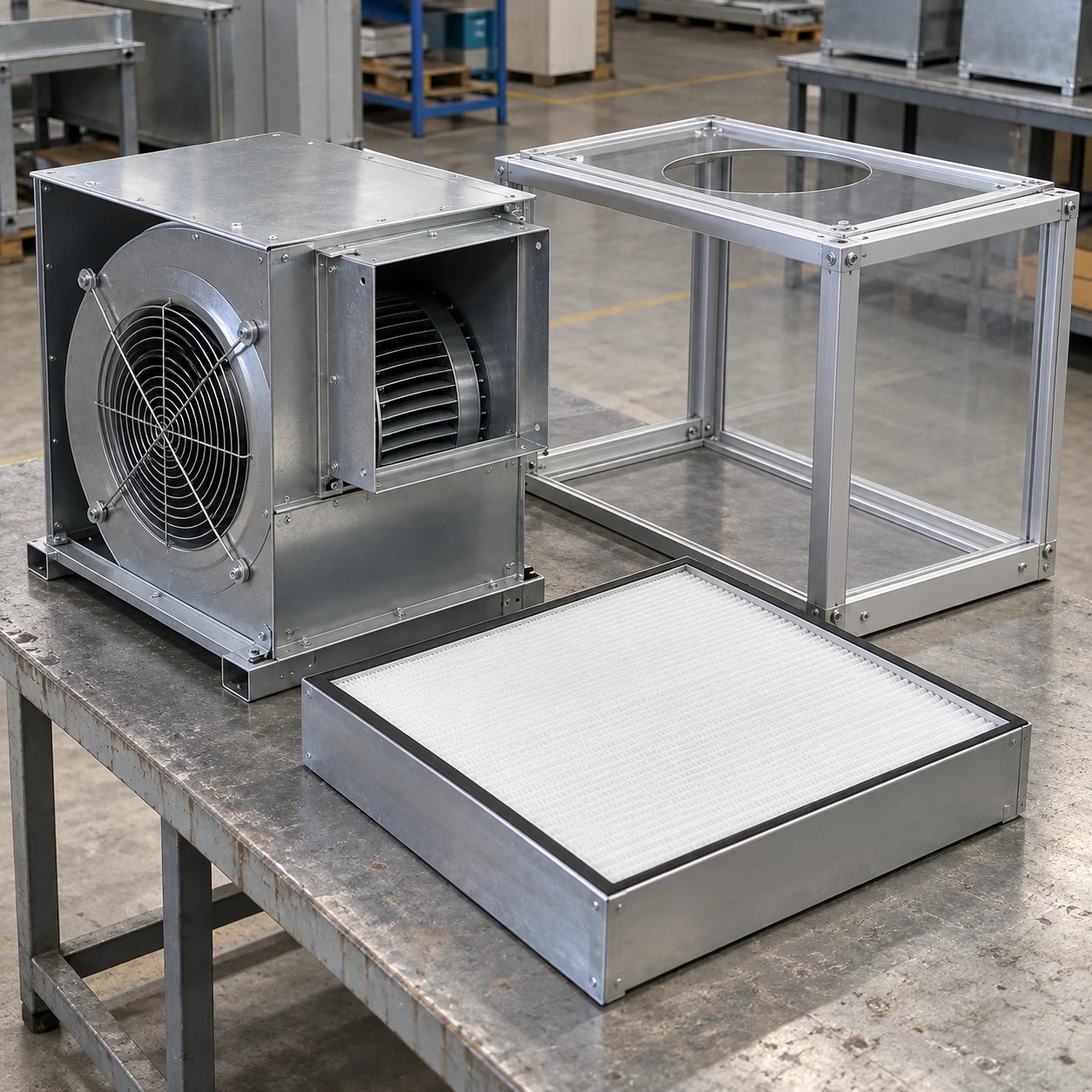
| Frame and surfaces | Supported metal frame, smooth cleanable work surface and transparent side panels |
| Sealing | Filter seat and gasket or gel interface matched as one assembly |
| Fan selection | Based on required flow through the selected filter, enclosure and loaded prefilter |
| Electrical configuration | Enclosed controls and protected wiring selected for the destination supply |
| Intended use | Nonhazardous industrial product protection |
| Commissioning scope | Air distribution, seal integrity and required work-zone particle performance |
Component sizes do not define a validated finished hood. The completed assembly requires its own engineering and acceptance criteria.
Modules, enclosure dimensions, service access and controls can be configured for the nonhazardous industrial task.
A DIY laminar flow hood project is an equipment-integration task. For industrial use, a matched fan-filter module and cleanable enclosure reduce uncertainty compared with assembling unrelated components.
Choose which part you are actually building
There is a large difference between fitting a complete clean-air module over an existing fixture and designing a workstation from a loose fan and filter. The first still needs a suitable support and work layout; the second also needs an engineered distribution chamber, sealing system and electrical enclosure.
A free-air fan rating is not its delivery through a final filter. The assembled resistance changes the operating point. Uneven fan discharge can also produce fast and slow areas unless the plenum and filter face are designed together.
Reuse the production fixture
An existing table may be worth retaining if its surface, stability and cleaning access suit the task. Add a supported hood without obstructing machine maintenance.
Buy the air module together
A matched fan, filter seat and control arrangement provides a defined starting point. Keep access for the inlet prefilter and final filter replacement.
Specify the finished result
Define the usable zone, normal load and required particle performance before assembly. A smoke trace or a filter label is not a substitute for the complete acceptance checks.
Where a complete cabinet is the better purchase
Repeated production tasks benefit from consistent geometry, documented replacement parts and a known service route. If engineering time, electrical work and installed testing approach the cost of a complete bench, a simple supplied workstation can be the more economical choice.
Porous or shedding surfaces make cleaning difficult. Unsealed joins and an unsupported filter frame create leakage paths. These issues are easier to prevent in the design than to compensate for with more fan power later.
Keep self-integrated clean-air projects within assessed nonhazardous product-protection duties. A homemade clean bench is unsuitable as a biological containment cabinet, and adding a UV lamp does not create personnel protection or validate a sterile process.
shengtongJH can source a complete bench or the defined industrial components around an approved design. The enquiry should identify the fixture, protected area and who will complete integration and commissioning.
Modules, enclosure dimensions, service access and controls can be configured for the nonhazardous industrial task.