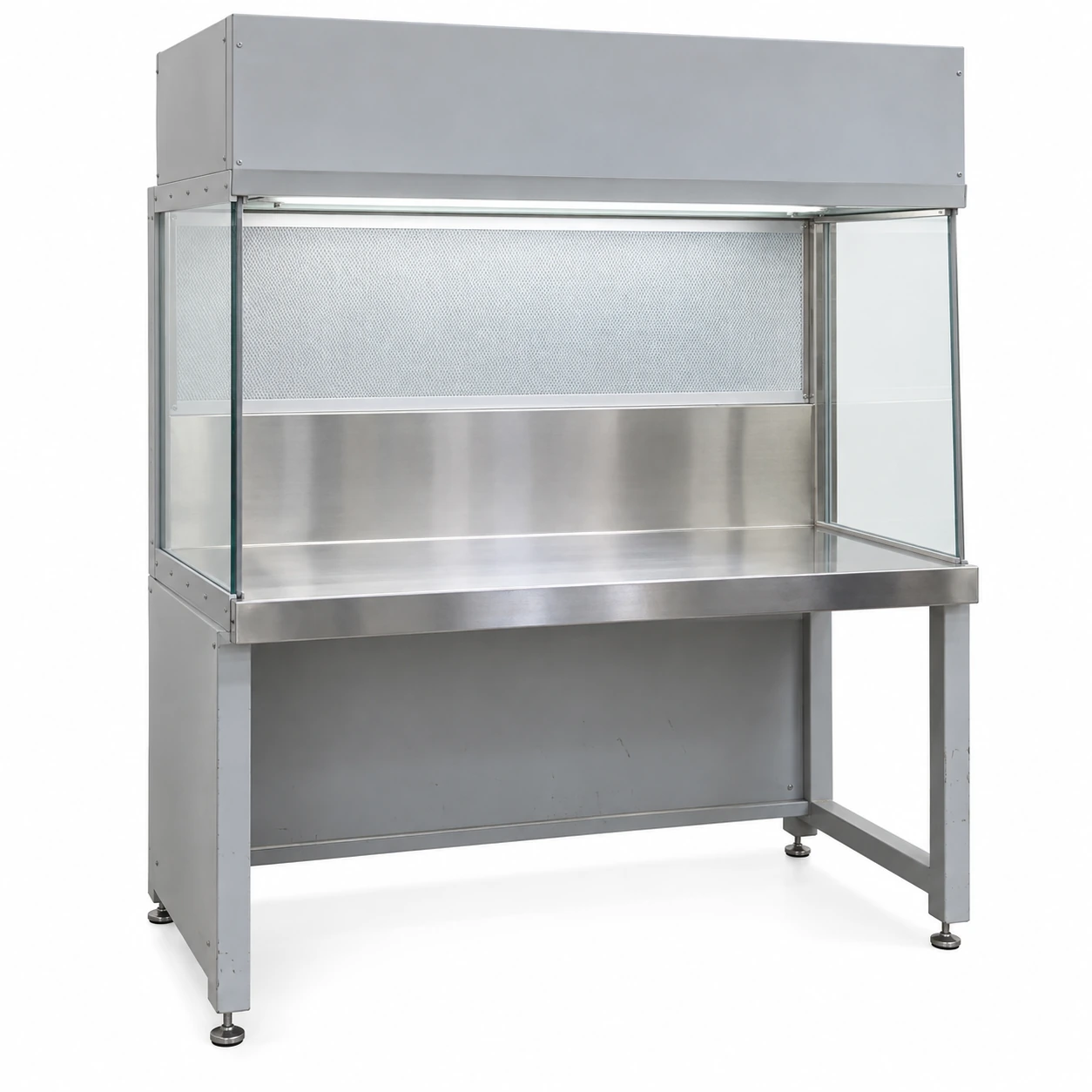
Clean Benches & Local Clean Air Systems
chemical clean bench manufacturer
| Brand | shengtongJH |
|---|---|
| Air arrangement | Vertical filtered downflow over the work zone |
| Work-zone W × D × H | 1200 × 645 × 610 / 1700 × 645 × 610 mm |
| Cabinet W × D × H | 1300 × 750 × 2040 / 1800 × 750 × 2040 mm, including stand |
| Work surface / housing | 304 stainless steel / powder-coated steel; stainless enclosure option |
| Final filtration | HEPA; H14 selection with matching filter test documentation |
| Air velocity setting | 0.3–0.5 m/s average, selected and checked for the working arrangement |
| Cabinet electrical input | 400 / 450 W configurations; connected instrument loads additional |
| Supply options | 220 V, 50/60 Hz; 110 V, 60 Hz by matched configuration |
| Controls and lighting | Fan adjustment and LED task light; airflow monitor option |
| Work opening | Glass side screens; sash and opening height selected for the task |
| Intended duty | Nonhazardous, particle-sensitive material preparation and inspection |
| Containment | No hazardous vapour or powder containment in this standard clean-bench configuration |
Select one matched cabinet configuration. Working space, outside size and service clearance are different; final dimensions and electrical loads follow the approved equipment schedule.
Work surfaces, cabinet dimensions and service interfaces can be customized to an approved nonhazardous application; hazardous processes require separately selected containment equipment.
A chemical-laboratory purchase must distinguish particle protection from hazardous-emission control. shengtongJH coordinates clean-bench sourcing for appropriate nonhazardous work, with the manufacturer and configuration identified for the selected supply.
Start with the protection requirement
An ordinary positive-flow clean bench sends filtered air towards an open working area and back into the room. It does not capture hazardous solvent vapour, corrosive fumes or toxic dust. A HEPA filter captures particles; it is not a general chemical-gas removal device.
If the operation generates hazardous emissions, specify appropriate extraction or containment through the site's risk assessment. The laboratory fume hood category is the relevant starting point for discussing chemical-extraction requirements. Adding a duct or carbon pad to a standard clean bench does not establish safe containment.
Where a clean bench can fit
Some chemical-industry tasks are principally concerned with keeping particles off an inert component, clean container or nonhazardous material. The actual process determines suitability: handling a closed container is different from opening a volatile substance or producing dust.
For an approved particle-sensitive operation, define the exposed surface and arrange a clear filtered-air route to it. Keep packaging outside the active area and choose a fixture that does not obstruct the supply. Do not infer suitability from the industry name alone.
Material compatibility is a separate selection
Specify cleaning agents, likely residues and contact conditions. Stainless steel grades, coatings, transparent panels and seals respond differently to chemicals. A stainless worktop does not make the entire enclosure resistant to every corrosive substance.
Consider seams, fasteners and removable surfaces as well as the main table. Cleaning access can be more important than a glossy finish when residues must be removed routinely.
Define the manufacturer's deliverables
A procurement package should identify the cabinet construction, filter assembly, electrical configuration and any required inspection documents. The purchase needs a clear description of which components are included and who supports their replacement.
shengtongJH acts as a sourcing and supply coordinator. Factory identity and evidence apply to the selected manufacturer and equipment; no general factory certification or chemical-resistance guarantee is implied.
Resolve mixed requirements before ordering
Some applications need both product protection and operator containment. A conventional fume hood and an ordinary clean bench address different air paths, so neither should be assumed to meet both requirements without a suitable engineered design.
Provide the process and hazard information to the responsible safety professional and define the required enclosure performance before comparing quotations. For an approved nonhazardous task, the bench can then be selected around useful working space, compatible surfaces, services and the required clean-air evidence.
Work surfaces, cabinet dimensions and service interfaces can be customized to an approved nonhazardous application; hazardous processes require separately selected containment equipment.