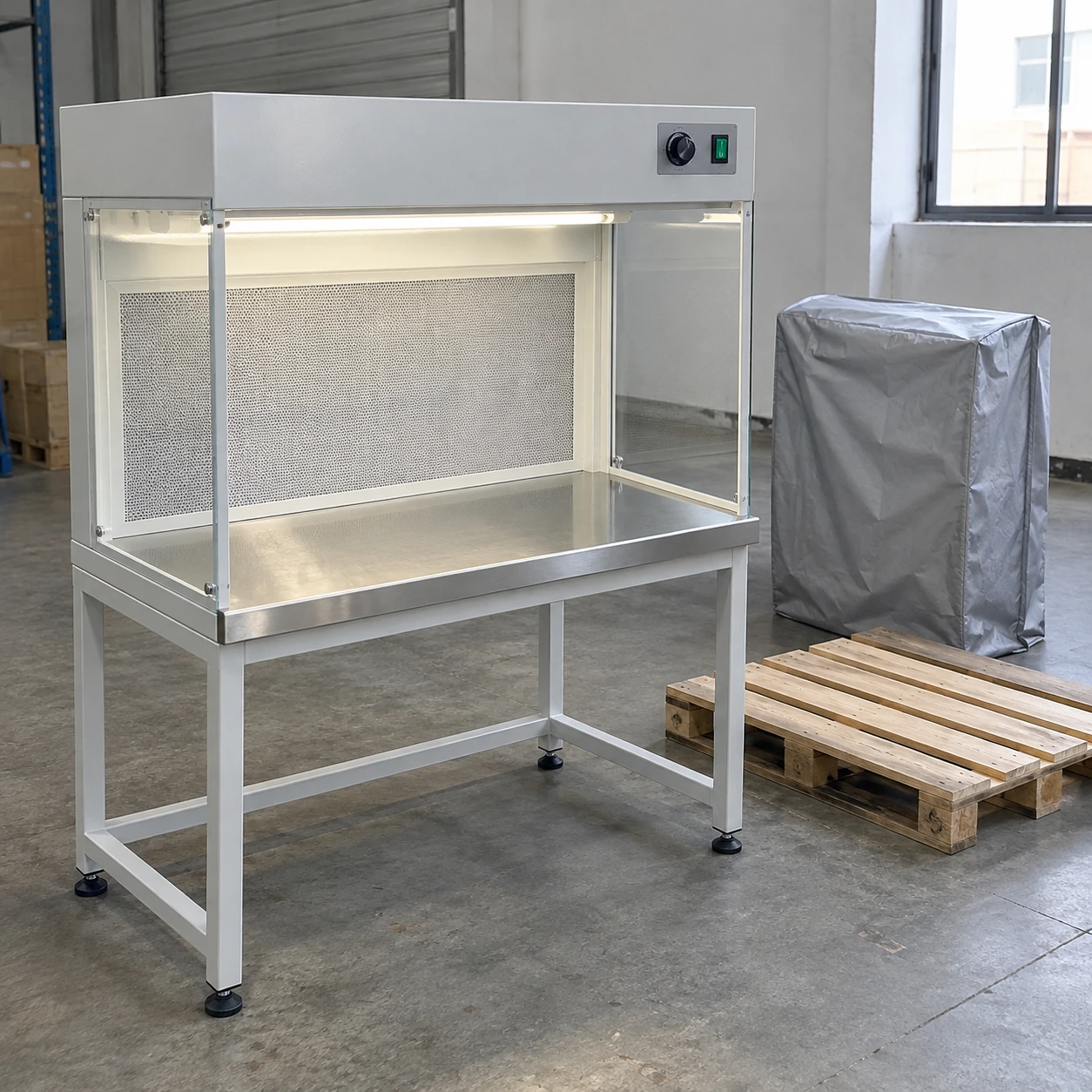
Clean Benches & Local Clean Air Systems
buy laminar flow hood
| Brand | shengtongJH |
|---|---|
| Air direction | Horizontal, from rear filter towards the open front |
| Overall W × D × H | 1300 × 820 × 2040 / 1800 × 820 × 2070 mm, including stand |
| Work zone W × D × H | 1200 × 500 × 570 / 1700 × 500 × 570 mm, paired with the respective cabinet |
| Construction | Powder-coated steel enclosure; stainless steel worktop; glazed sides |
| Filtration | Inlet prefilter and sealed final HEPA filter |
| Air speed selection | Adjustable; typical working setting 0.3–0.5 m/s, verified across the defined plane |
| Electrical selection | 220 V, 50/60 Hz; 110 V, 60 Hz configuration by selection |
| Cabinet input selection | 400 / 500 W configurations; internal equipment loads specified separately |
| Controls and access | Fan adjustment, work lighting, accessible prefilter and service panels |
Dimensions and electrical figures describe selectable configurations, not interchangeable parts. Final drawings and the complete supplied configuration determine fit and operating duty.
Cabinet size, support height, service fittings and destination electrical configuration can be customized to the industrial application.
Buying a laminar flow hood starts with a short description of the work that needs protection. That description should lead to a cabinet configuration, a usable installation and clear acceptance responsibilities.
Describe the task
Identify the exposed part, largest fixture, tools and normal handling sequence. State whether the material creates any biological, chemical or dust exposure concern.
Choose a working arrangement
Compare rear-to-front and downward supply against that layout. Select useful internal space and access before deciding on the overall cabinet size.
Agree the complete scope
Define the filter, stand, controls, utilities, transport arrangement and installed checks. Confirm who performs each installation activity.
Resolve the details that cause delivery-day problems
A cabinet must pass through the receiving route and stand on a suitable floor or counter. Check door openings, lifts, turns and the route into the room. Include the packed or partly disassembled delivery arrangement where it affects access.
Confirm voltage, frequency and plug or connection requirements. Equipment inside the hood can create additional load beyond the cabinet's own fan and lighting. This load belongs in the electrical plan rather than being assumed available from any built-in socket.
Write an acceptance condition
If the process needs a particle class or other clean-zone criterion, define the test condition and responsible party. Filter documentation and factory checks are useful, but they do not automatically cover the final room and loaded work layout.
For a nonhazardous task, the acceptance scope should be proportionate to the actual requirement. Avoid purchasing unrelated features while leaving the essential result undefined.
Keep the replacement information
Ask for the supplied configuration drawing and the filter specification, including the seal. Record how the prefilter is serviced and how the final cassette is removed.
These details reduce later uncertainty when an ordinary maintenance purchase must match equipment that has been in use for several years.
Turn the requirement into a quotation
shengtongJH operates as an equipment and materials procurement supplier. A quotation can be developed from the selected configuration, quantity and destination; this page does not imply a ready-stock unit or a fixed dispatch time.
Use the product enquiry to provide the task and installation information. For mammalian cell culture or other containment duties, identify that requirement at the start so a clean bench is not ordered for a biological safety cabinet application.
Cabinet size, support height, service fittings and destination electrical configuration can be customized to the industrial application.