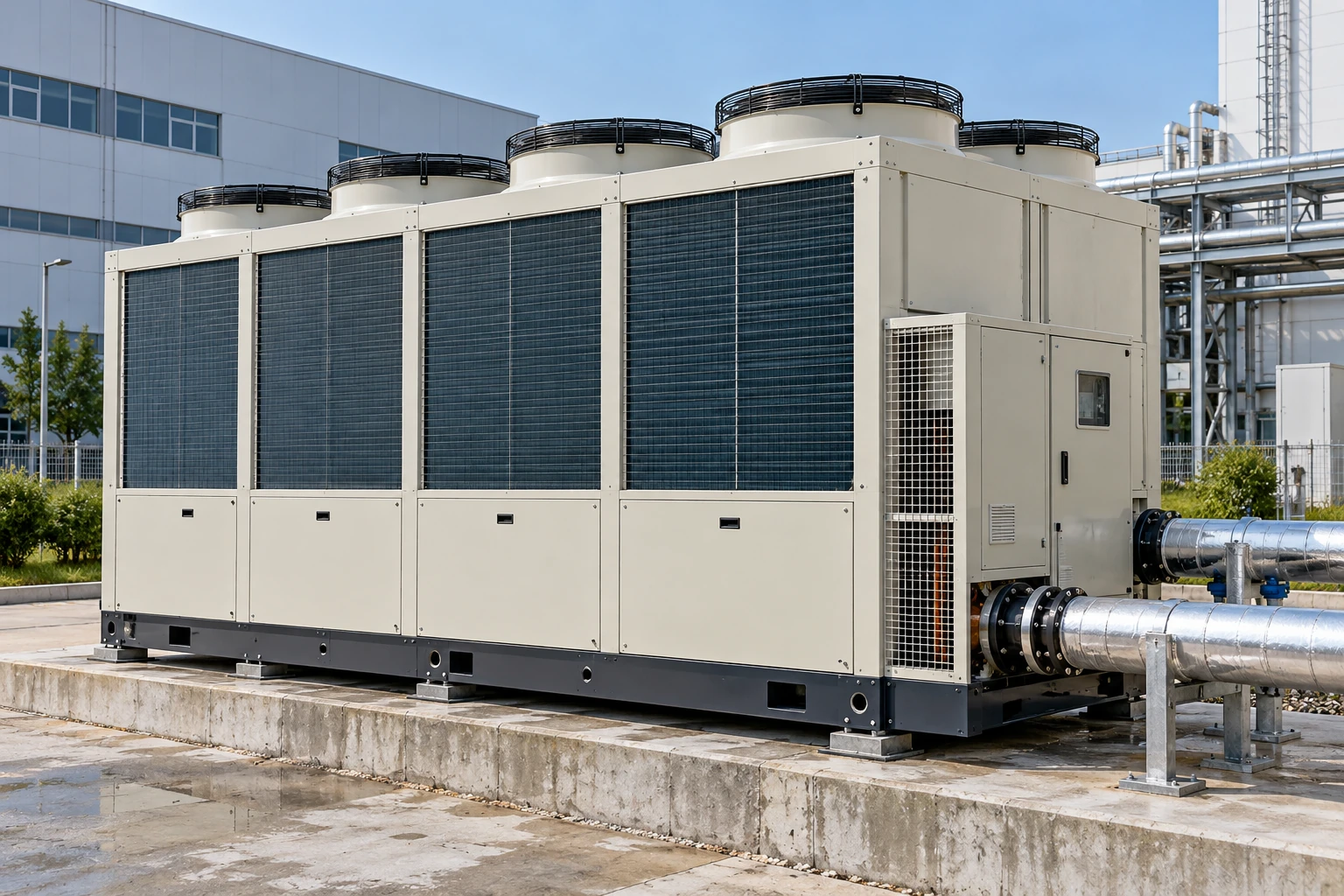
Air-to-Water Heat Pumps
commercial air to water heat pump
| Brand | shengtongJH |
|---|---|
| Nominal heating module classes | Approximately 65 / 110 kW; multi-unit plants selected from the load schedule |
| Heating duty points | Outdoor air 7°C with leaving water 35°C, 45°C or 55°C for comparison; winter design selection additionally required |
| Typical heating input classes | 65 kW class: about 16–22 kW; 110 kW class: about 29–36 kW at air 7°C and leaving water 35–55°C |
| Cooling duty | Reversible configurations; cooling output selected separately from the heating class |
| Supply | 380–415 V, three-phase, 50 Hz; destination-specific configuration by agreement |
| Envelope options, W × D × H (mm) | Approximately 1,800 × 1,000 × 2,000 or 2,300 × 1,150 × 2,250 per module |
| Water distribution | Integral or separate pumps; buffer and expansion equipment selected for the complete loop |
| Building interfaces | Remote enable, common alarm and compatible communication options |
| Outdoor options | Coil protection, vibration isolation, defrost drainage and freeze protection |
| Capacity management | Inverter or staged modules, with supplementary heat integration where required |
Power ranges describe common configuration classes at the stated comparison conditions, not a fixed rating. Final heating/cooling output, input and current are specified for the selected package.
Module quantity, distribution, supplementary heating and building-control interfaces can be customized for your facility.
A commercial air to water heat pump can serve central heating and cooling loads in industrial campuses, warehouses and other commercial facilities. Its suitability depends on the required water temperature, seasonal demand and the distribution equipment already installed.
Check the existing heat emitters first
A retrofit may retain air-handling coils or other emitters originally selected for hotter boiler water. At a lower supply temperature they may deliver less heat. Review their output against the actual room or process load before assuming that replacing the heat source alone will meet the requirement.
Possible responses include larger coils, reduced building losses, selected higher-temperature equipment or a hybrid arrangement. The choice should reflect the site's operating hours and peak conditions rather than forcing every project into the same configuration.
Separate peak demand from normal operation
A facility may need maximum heat only for a limited number of hours. Compare a heat pump sized for the full design load with a system that uses supplementary capacity during the coldest periods. Include electrical demand, control complexity and resilience in that comparison.
Several modules can follow varying load more closely and allow some equipment to remain available during service. Their combined nominal capacity does not establish standby capacity: calculate what remains when one required module is unavailable.
Evaluate costs over the actual operating year
Use heating and cooling demand profiles, local weather and tariffs to estimate operating costs. Include circulation pumps, defrost effects and any supplementary heaters. A favourable catalogue COP at one condition is not an annual system-efficiency guarantee.
Raising the heating-water temperature can increase electrical demand even when nominal heating output appears similar. Select the lowest temperature that reliably serves the load, with reset control where the distribution system permits it.
Make the location workable
Review noise at occupied areas and neighbouring boundaries, condenser airflow, drainage and maintenance routes. Screens and acoustic measures must not create recirculation or block service panels. Keep defrost water away from pedestrian routes.
Plan seasonal operation
Define who authorises heating/cooling changeover and how valves, pumps and terminal units respond. Confirm insulation and condensate drainage before enabling cooling in pipework previously used only for heating.
Agree the performance brief
Provide the load schedule, required water temperatures, outdoor design conditions and available electrical supply. Include existing plant data for a retrofit. shengtongJH can coordinate the selected modules and supporting equipment around those requirements, with the accepted duty and supply scope recorded in the quotation.
Module quantity, distribution, supplementary heating and building-control interfaces can be customized for your facility.